

Here's my Top 10 links from around the Internet at 10:00 am today in association with NZ Mint.
Bernard will be back with his version tomorrow.
As always, we welcome your additions in the comments below or via email to bernard.hickey@interest.co.nz.
See all previous Top 10s here.
1. History as science
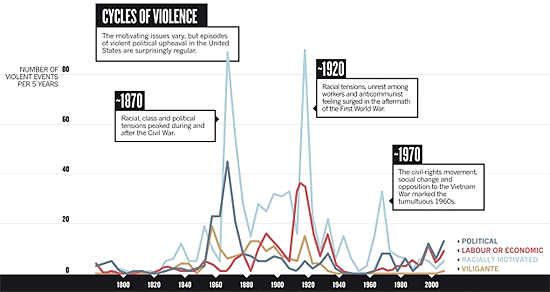
Will we get a sudden surge in violence peaking about 2020?
Laura Spinney has been reviewing the work of someone who thinks so.
Advocates of 'cliodynamics' say that they can use scientific methods to illuminate the past. After all, we have brought analytical technique to industry, rocket science, and the financial industry - why not history? But historians are not so sure. They like the way they have always analysed things - and telling others what is 'important'.
To Peter Turchin, who studies population dynamics at the University of Connecticut, the appearance of three peaks of political instability at roughly 50-year intervals is not a coincidence. For the past 15 years, Turchin has been taking the mathematical techniques that once allowed him to track predator–prey cycles in forest ecosystems, and applying them to human history. He has analysed historical records on economic activity, demographic trends and outbursts of violence in the United States, and has come to the conclusion that a new wave of internal strife is already on its way. The peak should occur in about 2020, he says, and will probably be at least as high as the one in around 1970. “I hope it won't be as bad as 1870,” he adds.
2. Entertaining spectacle, economic disaster
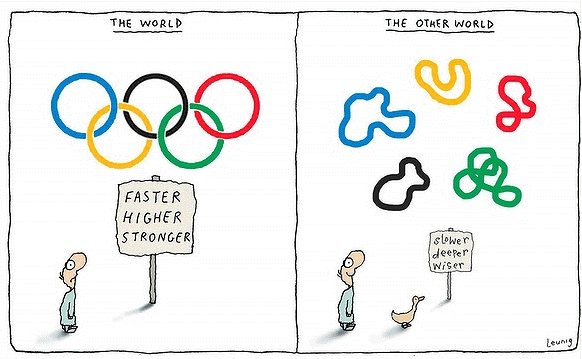
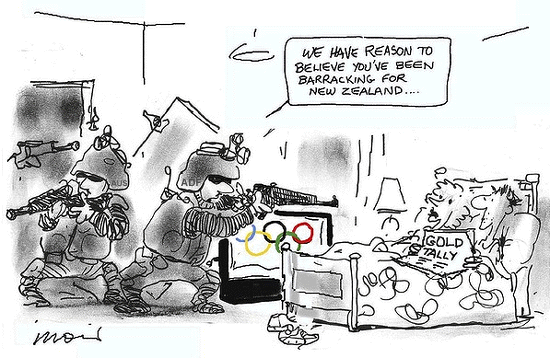
Greece had the Olympics in 2004 and look what happened to them. Joshua Mills at the NY Times reviews the completely dodgy logic that is used to lure sports events and the resulting infrastructure. (Been to an event in Auckland's Queens Wharf 'Cloud' recently?)
Playing host to the Olympics rarely turns out to be an economic benefit for a country or city, and sports economists have convincingly documented how silly the expectations sometimes are, as Nick Watanabe of the University of Missouri did with regard to the London Games (“Yeah, so if we don’t include costs, there is a profit”).
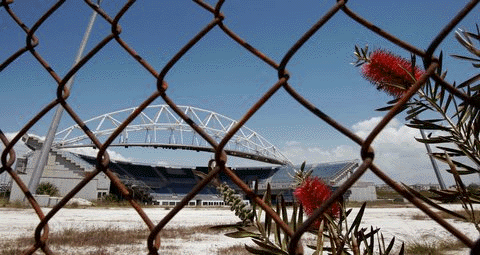
The 2004 Olympic beach volleyball stadium in Athens, seven years after the Games.
3. Does the world need Iran's oil? Apparently not
Iraq has overtaken Iran as the second-largest Opec oil producer for the first time since the late 1980s, a symbolic shift that signals the huge impact of western sanctions on Tehran and the steady recovery of Baghdad’s energy industry. How will Iran respond, especially given it is under pressure in Syria?
It’s been about a month since the full extent of the West’s oil sanctions against Iran went into effect. And so far, they seem to be working better than expected. Iran’s oil exports have fallen by about 1.4 million barrels per day, which “substantially exceeds” an earlier estimate of 900,000 barrels, according to an Aug. 9 report by Goldman Sachs energy analyst David Greely.
That’s a 50 percent cut in Iran’s crude exports in the past year, quite a bit steeper than the gradual “20 to 30 percent” decline predicted in June by Iran’s government, which gets about 80 percent of its revenue from oil. At $100 a barrel, that’s roughly $100 million a day in revenue that is no longer flowing into Iran’s coffers. And inflation is starting to take hold - the price of chicken has tripled since last year.

4. Crime of the century V
The New York State Department of Financial Services superintendent, Benjamin Lawsky is following the form of some big crusading NY officials; Eliot Spitzer and Rudy Guiliani both of whom made careers out of bringing crooks and crims to heel, including those in the financial industry. Jonathan Weil at Bloomberg wonders if he can handle the pressure - from all sides. Go Ben.
If what Lawsky alleges is true, Standard Chartered deserves to lose its state license. If that meant the bank couldn’t process dollar payments for clients that have operations in New York, so be it. Just because a bank has $624 billion of assets shouldn’t make it immune from the law.
Since 2009, the Justice Department has entered deferred-prosecution agreements with six banks, including Barclays and Credit Suisse Group AG, over transactions with Iran and other banned nations in violation of U.S. sanctions. Most violations involved stripping information from wire-transfer documentation to hide the role of a prohibited person or country. Lawsky’s order against Standard Chartered shouldn’t jeopardize other agencies’ investigations. If anything, it should make Standard Chartered more eager to settle with them.
Federal regulators and prosecutors are the ones who created the power vacuum here, by going so soft on the banking industry for so long. Lawsky is filling it in, and evoking memories of how Eliot Spitzer challenged the securities industry a decade ago when he was New York attorney general. We’re about to find out whether Lawsky has the chops or the stomach for the role.
Apparently, Standard Chartered "helped build the damning case against itself" according to Reuters.
5. Swiss help German 'loophole opportunists' escape to Singapore
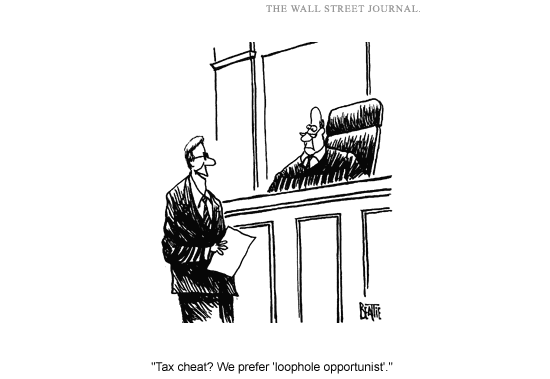
The German state of North Rhine-Westphalia has made headlines by buying data on Swiss bank accounts in a crackdown on German tax evaders. But now they have found evidence that Swiss bank UBS may have helped Germans shift their assets to Singapore before a tax treaty between Germany and Switzerland goes into effect next year. Spiegel Online has the story.
The idea was to go after wealthy Germans who had stashed money in Switzerland to avoid paying taxes back home. But now German tax authorities' hunt for tax evaders could turn into a headache for Swiss banking giant UBS.
German investigators who recently purchased data on UBS bank clients have come into possession of documents that show how Swiss banks allegedly help clients transfer their assets to Southeast Asia to evade taxes, according to the Friday edition of the Financial Times Deutschland. "For the first time, we have a paper trail to Singapore," a source close to the North Rhine-Westphalian state Finance Ministry told the newspaper. North Rhine-Westphalia, Germany's most populous state, has led the way in buying Swiss bank customer data in a bid to catch German tax cheats.
6. A two directional threat to the financial system
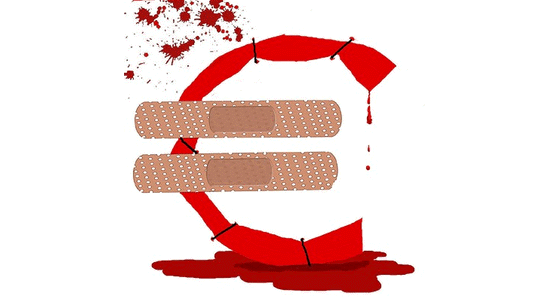
This thoughtful post at Australia's MacroBuiness.com.au highlights the vastly different ways the world's 'capitalist' systems respond to the international banking players. Who is gaming who? See #5 above. Is Singapore gaming Europe? The life of a regulator is getting very tough.
The locus of power has long been the point where banking and politics intersect. But the way they interplay is very different in different parts of the world. The capital markets may be global, but the banking systems on which that activity rests remain national. The tension between the global and the national is making the current situation intractably complex.
7. 300 kms on a single charge
A small battery company backed by General Motors is working on breakthrough technology that could power an electric car more than 300km on a single charge in the next two-to-four years, GM's CEO says. The Daily Telegraph has more:
Speaking at an employee meeting, CEO Dan Akerson said the company, Newark, California-based Envia Systems, has made a huge breakthrough in the amount of energy a lithium-ion battery can hold.
GM is sure that the battery will be able to take a car 100 miles (160km) within a couple of years, he said. It could be double that with some luck, he said.
"I think we've got better than a 50-50 chance," Mr Akerson said, "to develop a car that will go to 200 miles (320km) on a charge," he said. "That would be a game changer."
8. 'Job 1 is fixing competitiveness'
Printing money would lock in an uncompetitive economy and remove any imperative for politicians to take hard-but-necessary decisions. A central banker talking sense. The European Central Bank should not buy Spanish and Italian debt because it "makes no sense" and will take away the pressure on politicians to act, Belgium's central bank governor has said.
Luc Coene told Belgian newspapers De Tijd and L’Echo that buying the bonds of these countries would only serve to weaken the ECB and do nothing to resolve underlying issues of competitiveness.
“It makes no sense for the ECB to start financing those countries,” said Mr Coene, “It would only lead to the ECB taking on the whole public debt of Spain and Italy onto its balance sheet," he said.
"That would in turn weaken the ECB and do nothing to resolve the underlying problems."
Rolling back the last decade's debt splurge will involve the pain of adjustment. How come people believe this can happen without a cost? The most people seem to accept is that 'someone else' must pay - or the latest fad, printing money where there is apparently no cost and no pain for the mistakes that have been made and the debt that has been accumulated. Sounds like a snake-oil solution to me.
9. 'The cult of equity is dying'
Bill Gross, the PIMCO supremo and someone always worth reading, and he warns we should prepare for inflation because it will become the policymakers' preferred way out of our mess.
This long-term history of inflation adjusted returns from stocks shows a persistent but recently fading 6.6% real return (known as the Siegel constant) since 1912 that Generations X and Y perhaps should study more closely. Had they been alive in 1912 and lived to the ripe old age of 100, they would have turned what on the graph appears to be a $1 investment into more than $500 (inflation adjusted) over the interim. No wonder today’s Boomers became Siegel disciples. Letting money do the hard work instead of working hard for the money was an historical inevitability it seemed.
Yet the 6.6% real return belied a commonsensical flaw much like that of a chain letter or yes – a Ponzi scheme. If wealth or real GDP was only being created at an annual rate of 3.5% over the same period of time, then somehow stockholders must be skimming 3% off the top each and every year. If an economy’s GDP could only provide 3.5% more goods and services per year, then how could one segment (stockholders) so consistently profit at the expense of the others (lenders, laborers and government)?
Unfair though it may be, an investor should continue to expect an attempted inflationary solution in almost all developed economies over the next few years and even decades. Financial repression, QEs of all sorts and sizes, and even negative nominal interest rates now experienced in Switzerland and five other Euroland countries may dominate the timescape.
The cult of equity may be dying, but the cult of inflation may only have just begun.
10. 260,000 un- or under-employed workers won't take 5,000 rural jobs
Waikato University reckons importing cheap labour from the islands is a winner-for-all. You agree? According to the June HLFS there are 156,400 unemployed people in New Zealand (that's 'actual' not s.a.) plus another 109,500 who were employed but wanted more work. And yet, farmers can't fill the jobs they have and need to go to Tonga to find workers.
A new government program designed to bring seasonal workers from the Pacific Islands to work in horticulture and viticulture for up to seven months per year is proving a win-win initiative for both New Zealand and the Pacific source countries.
With funding from the World Bank and the Department of Labour, Professor John Gibson, Halahingano Rohorua and the World Bank’s David McKenzie are researching the impact of the Recognised Seasonal Employer (RSE) Program, and their initial findings show that the scheme is succeeding in targeting poorer, less well-educated migrants from Tonga.
The RSE draws 5,000 temporary migrants a year from 11 eligible Pacific Forum member countries. Based on the results of household surveys in both Tonga and Vanuatu, the researchers found that males with lower levels of education are more likely to apply for RSE than those with more education. In Tonga, they found RSE migrants were also more likely to be less well-off.
There’s strong international interest in temporary migration programs like the RSE as a way to relieve labour shortages in developed countries and aid development in poorer countries where population growth often greatly exceeds formal employment growth. Such schemes allow workers to send remittances home and gain new skills without the source country losing the worker permanently and the host country facing long-term assimilation costs.
We welcome your comments below. If you are not already registered, please register to comment
Remember we welcome robust, respectful and insightful debate. We don't welcome abusive or defamatory comments and will de-register those repeatedly making such comments. Our current comment policy is here.