

Here's my Top 10 links from around the Internet at 11.30 am today in association with NZ Mint.
As always, we welcome your additions in the comments below or via email to bernard.hickey@interest.co.nz.
See all previous Top 10s here.
My must watch article today is #4 on 'how the eurozone is a cage for masochists.' My must watch video is #5 on the skateboarders of Ordos.

1. Watch what BHP says - BHP CEO Marius Kloppers gave a major speech yesterday on the outlook for China's growth and its demand for commodities.
He pointed out China's demand for steel (and the iron ore and coking coal used to produce it) would moderate as China's economy matured from one based on investment to one based on consumption. Could be good news for us as China switches from concrete to cheese.
The full speech is well worth a read because it shows the last decade of growth in China was exceptional (ie won't be repeated)
We (meaning Australia and New Zealand) can't rely on the same thing again to dig us out of the hole.
We will have to find other sources for growth.
Or get ready for the inevitable slowdown and asset price declines we missed out on in the last four or five years.
In the 10 years or so that have passed since China first came to the fore as a commodities demand force, two things have happened: First, steel intensity per unit of GDP in China surged as early stage infrastructure and construction was required. This has now peaked, and we expect it to progressively decline as we have seen in historical examples. Put simply, this is a lead indicator of the progression of the Chinese economy toward maturity. However, we will continue to see per capita consumption of steel growing, albeit at a slower rate, as steel intensity of GDP declines.
And secondly, as the industry matured it has progressively improved its ability to supply the volumes to meet demand. As a result, the ‘supply shortage’ has largely been filled, or is well advanced in being fulfilled. Therefore, what we are now witnessing is the rebalancing of supply and demand and a progressive recalibration of prices back to long term sustainable pricing levels. In effect, what this means is that the record prices we experienced over the past decade, driven by the ‘demand shock’, will not be there to support returns over the next 10 years.
What we can instead expect is demand growth at more predictable and sustainable levels and more moderated pricing. This ‘mean reversion’ in prices and returns is something we at BHP Billiton have anticipated for some time.
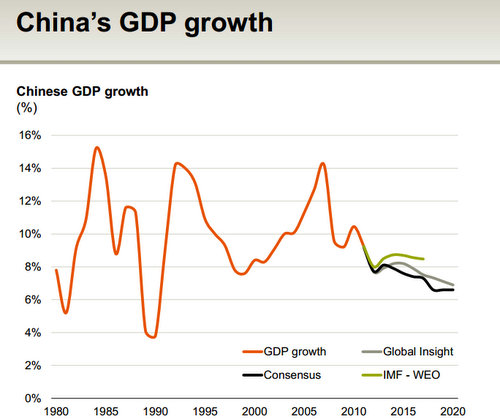
2. Hadn't thought of this angle - There's been a growing frustration and a dawning realisation that China either can't or won't fire up its economy again in the same way it did after the Lehman crisis in late 2008 and early 2009.
Here Bloomberg points out China doesn't need to when it looks at the growth in its labour force, which is slowing as its population begins to age and the effects of the one-child policy take hold.
The ruling Communist Party hasn’t rolled out a stronger monetary and fiscal policy response as officials watch for signs that the economy is stabilizing. While the government has this year described the labor market as “grim,” pressure for job creation is lessening as the one- child policy introduced in 1979 caps new entrants to the workforce.
As recently as 2010, Premier Wen Jiabao said that an 8 percent expansion was necessary for “basic stability of employment,” and anything lower will create “problems,” according to the party’s Qiushi magazine.
“With China’s shifting demographics, that benchmark should shift as well,” said Louis Kuijs, chief China economist for Royal Bank of Scotland Plc in Hong Kong, who previously worked for the World Bank in Beijing. Labor market resilience “reduces the perceived urgency of a major policy response,” he said.
The working-age population is growing at 0.5 percent a year now, one-third the pace of 10 years ago, Kuijs estimates. That means the benchmark growth rate may be 7 percent, he said.
3. 'A lasting depression for Europe' - The Telegraph reports George Soros has called on Germany to act urgently to stop Europe from falling into a lasting Depression.
He even suggests Germany should leave if it doesn't want to put up its dosh.
"There is a real danger of the euro destroying the European Union. The way to escape it is for Germany to accept ... greater commitment to helping not only its interests but the interests of the debtor countries, and playing the role of the benevolent hegemon," he said at a luncheon hosted by the National Association for Business Economics
Germany should act as the leader of the union such as the United States was for the free world after the Second World War, Mr Soros said.
The influential fund manager floated another solution to the crisis that has gone on for more than two years: Germany could leave the euro, "and the problem would disappear in thin air," as the value of the euro declines and yields on the bonds of debtor countries adjust.

I wish John Key would read Mr Wolf's fine prose.
It is no secret why growth is slowing in high-income countries: this is due to fiscal tightening, weak financial systems and powerful uncertainty. This toxic combination is particularly threatening inside the eurozone, where, again no surprise, countries reliant on exports are affected by the shrinking economies of big trading partners. As the latest Global Financial Stability Report shows, cumulative capital flight from peripheral eurozone economies is more than 10 per cent of gross domestic product.
Indeed, without support, principally from the European Central Bank, peripheral economies would have had to impose exchange controls. They might even have left the eurozone. The fear of break-up remains pervasive: it is always hard to make masochism a credible strategy.

5. Ordos is back - Remember the ghost city in China where buildings were built but no-one came?
HT to Leith van Onselen at Macrobusiness.com.au for pointing me to this latest skating video set in Ordos.
While the skating is worth watching in itself, the bigger takeaway is that Ordos – a shiny city built to house one million residents – remains almost completely empty three years after Aljazeera’s first ground-breaking report.
These kind of malinvestments – projects that cost billions of dollars but provide next to no economic return – have the potential to become a millstone for China’s banks and economy going forward, subtracting from its growth potential.
With the real estate market accounting for around 10% of China’s GDP growth, and affecting many related industries, there also remains the concern that construction and sales could grind to a halt, crimping local government land sale receipts and dragging China into a sharp recession.
6. And now the price - Ambrose Evans Pritchard reports at The Telegraph about the price the Germans are demanding for Greece's latest bailout and the triggering of the Big Bazooka.
Tonight's summit of Eurozone leaders could be entertaining in a bad way.
There must be an EU “currency commissioner” with sweeping powers to strike down national budgets; a “large step towards fiscal union”; and yet another EU treaty.
Finance minister Wolfgang Schaeuble dropped his bombshell in talks with German journalists on a flight from Asia, and apparently had the blessing of Angela Merkel, the chancellor. “When I put forward such proposals, you can take it as a given that the chancellor agrees,” he said.
Officials in Brussels reacted with horror. “If that is the demand, they are not going to get it. Nobody in the Council wants a new treaty right now,” said one EU diplomat. “We’ve got the fiscal compact and quite enough fiscal discipline. Not even the Dutch want a commissioner telling them how to tax and spend,” he said.
The new demands risk another stormy summit in Brussels on Thursday, pitting Germany against the Latin bloc. The last summit in June ended with an acrimonious deal in the small hours on a banking union that began to unravel within days.
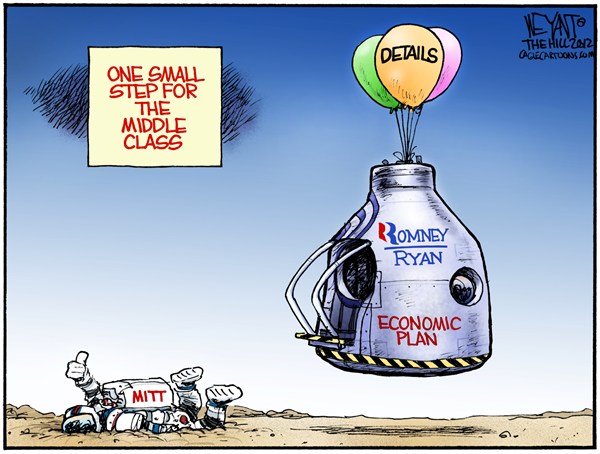
7. Would Romney call off Quantitative Easing? - Now the US Presidential election race is tightening up people are starting to to wonder what a President Romney would do to economic policy.
Former White House economist Bruce Bartlett looks at the possibility that the Fed's QE Infinity would be called off. Oy Vey. Romney has already said he would not reappoint Bernanke late next year.
That would unnerve markets, to say the least...
At a minimum, it is doubtful that the Fed will continue to maintain its present policy of being highly accommodative. A key element of this policy has been the Fed’s “forward guidance” that it will continue being accommodative at least through 2015 – well past the point when Mr Romney will have had the opportunity to appoint a new Fed chairman and one or more new members of the board. (It is highly unlikely that Mr Bernanke would continue to serve on the board if he is not reappointed chairman.)
At a minimum, the ability of the Fed to credibly make promises about future policy is threatened by potential changes in party control of the White House and the wide divergence in the monetary views of the two parties. If policy is quickly reversed, it will call into question the ability of the Fed to use forward guidance as a policy tool again in the future.

8. This is a bit off the beaten track - FT.com's Simon Kuper has written a lovely, wistful ode to forty-something men, which struck a few nerves for me. HT @samfromwgtn
Frantic busyness has its upsides. Nowhere in my peer group have I witnessed a textbook midlife crisis. Nobody has the time. Anyway, my “Generation X” was never much given to fantasy. Our teenage soundtrack featured gloom merchants like The Smiths, we came of political age after all utopias had collapsed, and then graduated into recession. The dream among my peers isn’t a Ferrari and a 22-year-old model.
Rather, the dream now is of a cafè latte alone: a small victory in the struggle to preserve fragments of what Orwell called “ownlife” amid the onslaught of mortgage, toddlers, in-laws and physical decline.
We welcome your comments below. If you are not already registered, please register to comment
Remember we welcome robust, respectful and insightful debate. We don't welcome abusive or defamatory comments and will de-register those repeatedly making such comments. Our current comment policy is here.