

Here's my Top 10 links from around the Internet at 10:00 am today in association with NZ Mint.
Bernard will be back with his version tomorrow.
As always, we welcome your additions in the comments below or via email to bernard.hickey@interest.co.nz.
See all previous Top 10s here.

1. Aussie banks 'need more capital': IMF
The IMF's Financial System Stability Assessment of Australia has said (page 22, para 35) that the four major Australian banks may need as much as 5% of its risk-weighted assets (RWA) in additional capital to pass their toughest stress test.
That is rather a lot to find; by my calculations, those four have at least A$2.5 trillion in RWA, so 5% is about A$125 billion.
That same report sets out their risks and obligations to New Zealand - we represent about 40% of their cross-border exposures.
A more easily digestable summary of the IMF Report can be found in an AFR story:
The International Monetary Fund says Australia’s largest four banks should be forced to raise billions of dollars in extra capital, a move that would hit profits, because of their dominance over the industry. Raising concerns about aspects of the banking system, the Washington-based fund called for tougher stress tests to assess how the banks would manage a financial crisis like the one that hit after the Lehman Brothers collapse.
It proposed an upfront fee paid by banks to insure depositors’ cash, a step designed to avoid expensive government bail-outs. The report is unusually tough – Australia’s banking system was praised around the world for surviving the 2009 financial crisis mostly in good shape. Analysts said tougher protections for the banking system would hurt returns to shareholders and have a knock-on effect across the economy because banks make up a third of the sharemarket and a major source of dividend payments.
2. 'We won't do it': ABA
However, these big banks have rejected the IMF suggestion. More from The Australian:
Australian Bankers Association chief executive Steven Munchenberg said the banks should not be required to hold more capital given the increased regulation facing the sector.
The banks are in discussions with the Australian Prudential Regulation Authority on the framework it will put in place around banks considered "systemically important". "APRA's conservative approach on capital definitions means that Australian banks hold more capital than otherwise would be the case," Mr Munchenberg said.
3. Unintended consequence?
Matt Nolan at TVHE is scratching his head at the Fabian-conducted campaign by Labour+Greens to bring in a capital gains tax on housing, and why they think it will help housing affordability.
So depending on where we define the boundary of the tax we will surely be increasing the tax on investing in the supply of property … and if we are worried we have “too few houses” for some reason then this won’t help.
Now prices are meant to fall because we don’t have a “bubble” from “investors” being “morons” or something, that’s nice – but surely the observed drop in house prices in the first instance will be due to the future tax liability that has now been thrown on property. This does nothing for “affordability” of housing services for people, as if you buy a house you have to pay the tax, and if you are renting the cost depends on the supply of property (and household income).
I’m all for treating asset classes the same, most definitely. But I am perplexed that we believe introducing a tax on something will make it more affordable (as that is the thing people seem most concerned about) – so if you would like to tell me in comments that would be much appreciated.
Andrew Coleman looked at the impact a capital gains tax might have in New Zealand (in a 2009 paper well worth re-reading). Might be different to the impacts intended. It seems it will make it tough for renters - but be good for the country.
A capital gains tax will have the following effects: it will lead to an increase in rents; it will lead to a reduction in the number of people renting, and an increase in homeownership rates; it will lead to an increase in the net foreign asset position; and it will lead to a decline in the fraction of large houses in the economy. It is possible that homeownership rates could rise by several percent if a capital gains tax were introduced, with a similar sized increase in the net foreign asset position.
Rodney Hide is also anti a capital gains tax. Here he is in the Herald on Sunday:
There's a plan about to make houses affordable by taxing capital gains. I am not a supporter. The Government taxes tobacco and alcohol to put up their price. It's hard to see how a new tax will have the opposite effect on houses.
Politicians prove incredibly inventive in arguing for new taxes, but claiming they will make houses affordable takes the biscuit. There are many reasons why Auckland house prices are high. A lack of tax isn't one of them.
One reason is that Auckland councils have for years run a deliberate policy to hike house prices. The council doesn't put it that bluntly, calling it "smart growth" or a "compact Auckland". But the policy works by hiking house prices. The policy's purpose is to get us to live in apartments over train stations. That way we will be more likely to take a train and the mountains of cash that councils have sunk into trains, stations and rail lines over the years won't look such a waste.
4. 'Do the work first, then ask'
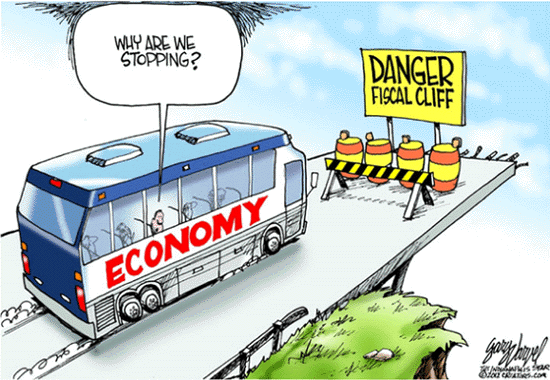
Greece's creditors will eventually have to write down the value of the country's debt for a second time, but only after Athens has done the hard work of getting its budget into shape, according to the head of Germany's central bank, Jens Weidmann.
"One might well wonder whether the leap of faith that one grants if a debt haircut is done today sets the right incentives now, or whether it would not make sense to promise a haircut, which will be necessary at the end to regain access to capital markets, for when the reforms - which are the actual goal - will have been implemented," Mr Weidmann said.
"A haircut does not yet solve the problems. I can do a haircut today but if the budget as such is not sustainable then I'll be back in the same situation in 10 years," he added. "That wouldn't make sense."
Mr Weidmann also argued that granting Greece debt relief now would in effect create moral hazard - leading to a situation in which leaders in other bailed-out nations, such as Portugal and Ireland, would no longer be able to push austerity measures and reforms through their parliaments. "This is what is on my mind," Weidmann said. "That is, how can you maintain that pressure to act?"

5. End run
In a rather remarkable achievement, 62 organisations have largely agreed how we should address our water quality issues. But not everyone agrees, and they have taken their campaign international, dissing the efforts in the NY Times.
"There are almost two worlds in New Zealand," said Mike Joy, a senior lecturer in environmental science at Massey University in Palmerston North. "There is the picture-postcard world, and then there is the reality." The clean and green image has long been promoted by the isolated country in its striving to compete in world markets.
But an international study in the journal PLoS One measuring countries’ loss of native vegetation, native habitat, number of endangered species and water quality showed that per capita, New Zealand was 18th worst out of 189 nations when it came to preserving its natural surroundings. Dr. Joy said that for a country purporting to be so pure, New Zealand seemed to be failing by many international environmental benchmarks.
6. A man without a plan
Robert Shiller thinks there is no miracle cure for an economy's ills other than working hard on a myriad of small practical things. And he thinks American voters instictively know that. Here is the guts of his view from Project Syndicate: What Shiller doesn't address is that if Sperling is so influential, and has been there for a decade ...
Today, the most powerful economic adviser remaining in the White House is Gene Sperling, head of the National Economic Council (NEC), the agency created by President Bill Clinton in 1993 to serve as his main source of economic policy (somewhat shunting aside the Council of Economic Advisers). Because this position does not require Congressional approval, the president may appoint whomever he wants, without having his choice raked over the coals in the US Senate.
That is why Obama could appoint the highly talented but politically unpopular Summers, the former president of Harvard University. Sperling is not nearly so well known as Summers. But his record of influence in government is striking; indeed, he has been at the pinnacle of economic-policymaking power in the US for almost a decade.
He was the NEC’s deputy director from its beginning in 1993 until 1996, and its director from 1996 to 2000. Obama reappointed him as head of the NEC in January 2011.
His 2005 book The Pro-Growth Progressive contains many ideas about how to make the economy perform better. None is grandiose, but together they might help substantially. Some of these ideas found their way into the American Jobs Act, which might have had some real impact had Congress passed it in 2011. The AJA embodied some of what Sperling describes in his book: subsidies for hiring, wage insurance, and job training, as well as support for education and early learning. Moreover, the AJA would have offered some balanced-budget stimulus – the kind of stimulus that would boost the level of economic activity without increasing the volume of government debt. But the public, despite its concern about unemployment, is not very interested in the details of concrete plans to create more jobs. Sperling is just not very visible to the public.
His book was not a best seller: in commercial terms, it might be better described as a dud. Sperling is fundamentally different from the typical academic economist, who tends to concentrate on advancing economic theory and statistics. He concentrates on legislation – that is, practical things that might be accomplished to lift the economy. He listens to academic economists, but is focused differently. At one point in his book, Sperling jokes that maybe the US needs a third political party, called the “Humility Party.” Its members would admit that there are no miraculous solutions to America’s economic problems, and they would focus on the “practical options” that are actually available to make things a little better.
In fact, Americans do not need a new political party: with Obama’s reelection, voters have endorsed precisely that credo of pragmatic idealism.
7. In China 'Audi' means 'Big Shot'
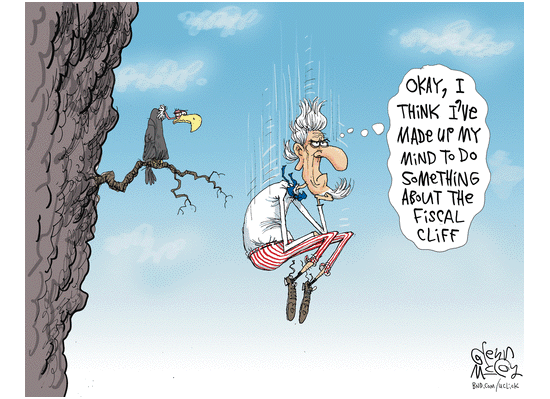
Same as Herne Bay, then. Michael Wines explains: (Revealing pic on this story too.)
As the Chinese have abandoned their bicycles, the black A6 has become the automobile of choice for practically any party official or military officer with enough clout to secure one.
At the least, that is a cast of thousands: Audi sold 313,000 cars in China in 2011, and the research firm LMC Automotive estimated this year that a fifth of sales go to governments, state institutions and state-owned companies. About half of all A6s sold worldwide (229,200 in 2011) are bought in China and Hong Kong, the research firm Dunne & Company reported last year.
More than a perk, the black Audi is a rolling advertisement for its occupant’s importance and impunity in a nation obsessed with status. Black A6s slice through traffic queues and scream down the emergency lanes of Beijing’s traffic-clogged freeways, sometimes with a flashing red light stuck on the roof or implanted in the grille. Ordinary drivers know better than to cut them off or complain, at least publicly.
8. Confessions of a deficit denier
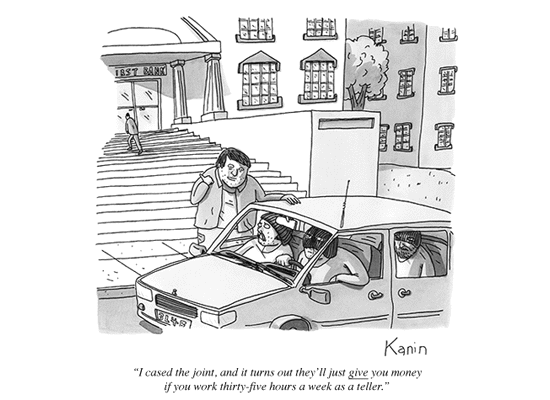
Anatole Kaletsky at Reuters is saying stuff that isn't being said in respectable society these days - the fixation with excess sovereign debt is pointless. Here's a taste:
Why are sophisticated investors unmoved by the deficit panic? Because they know that governments, at least outside the euro zone, are nowhere near bankruptcy. In fact, debt levels are not dangerously high.
The U.S. government net debt is expected to stabilize at 89 percent of gross domestic product from 2014 to 2017, according to the International Monetary Fund, even if all the Bush tax cuts were extended and without any of the spending cuts assumed in the fiscal cliff. Similar stable debt levels are projected for Germany, France, Italy, Britain and even Spain. Assuming debt levels do stabilize in the rage of 85 percent to 100 percent of GDP, these won’t be worryingly high. U.S. national debt peaked at 110 percent of GDP in the late 1940s, and Britain’s was even higher. But nobody worried much about national bankruptcy after World War II – and the confidence proved justified. For the U.S. and Britain both enjoyed their strongest economic performance in the two decades after their deficits peaked at more than 100 percent of GDP.
The U.S. and British fiscal situations today are even less troubling — partly because two-thirds of the government debt issued since the 2008 crisis has been bought by the central banks. Since the Federal Reserve and the Bank of England are part of their respective governments, the bonds they own represent debts the government owes to itself.
9. Build, build, build
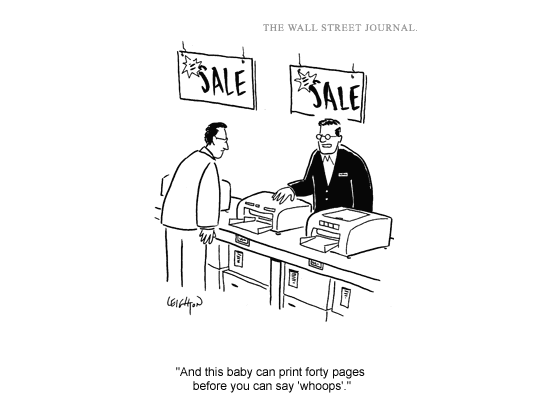
Labour leader David Shearer has set himself a goal of 10,000 affordable houses a year for ten years. And he is ready to change (gut?) the RMA (read, council blockages) and free up more land. Time to buy Fletcher Building stock?
Labour get it is a supply problem, one caused by disfunctional councils, especially in Auckland. Will be interesting to see what happens when 100,000 new 'affordable houses' impact resale values of existing stock. I'm all for it, but doubt the electors will be thrilled if their 'investment' stops paying off.
The simple fact is we need more affordable houses. It's time for Government to step up. And we will.
Today I’m announcing that we will put 100,000 Kiwi families into their first home. That’s the sort of big change we need to make a big difference to people’s lives. We’ll oversee and invest in a large scale 10 year building programme of entry-level houses that Kiwis are crying out for. Yes, it’s a big commitment and it’ll take a couple of years to ramp up, but we can do it. I won’t stand by while the dream of home ownership slips away from future generations.
At the peak of last decade, about 30,000 new homes were built a year. Now it’s less than half that.
These are the missing rungs on the housing ladder. And it shows what an active and responsible government can do to help. The start-up cost of the building programme will be financed through issuing government stock called Home Ownership Bonds. The money we make from selling the houses will go back into the pot for building more.
10. It's a wonderful world
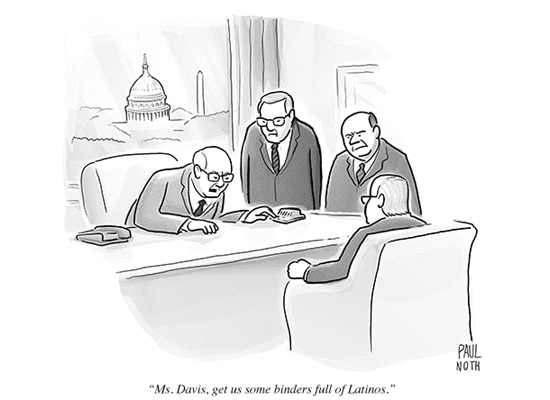
One for the doomsters ... to cheer you up.
We welcome your comments below. If you are not already registered, please register to comment
Remember we welcome robust, respectful and insightful debate. We don't welcome abusive or defamatory comments and will de-register those repeatedly making such comments. Our current comment policy is here.