

Here's my Top 10 links from around the Internet at 10:00 am today in association with NZ Mint.
Bernard is back tomorrow with his version.
As always, we welcome your additions in the comments below or via email to bernard.hickey@interest.co.nz.
See all previous Top 10s here.

1. Is financial globalisation in reverse?
In 2008 after the bout of financial contagion, cross-border capital flows abruptly collapsed. Almost five years later, they remain 60% below their pre-crisis peak.
Global financial assets have grown by just 1.9% annually since the crisis, down from 7.9% average annual growth from 1990 to 2007.
Martin Baily and Susan Lund wonder if financial globalisation is reversing itself. They don't think the reversal is all that healthy. More from their article in Project Syndicate:
Current trends seem to be leading toward a more fragmented global financial system in which countries rely primarily on domestic capital formation.
Sharper regional disparities in the availability and cost of capital could emerge, particularly for smaller businesses and consumers, constraining investment and growth in some countries.
And, while a more balkanized financial system does reduce the likelihood of global shocks creating volatility in far-flung markets, it may also concentrate risks within local banking systems and increase the chance of domestic financial crises.
So, is it possible to “reset” financial globalization while avoiding the excesses of the past?
2. Soros's alchemy: Eurobonds
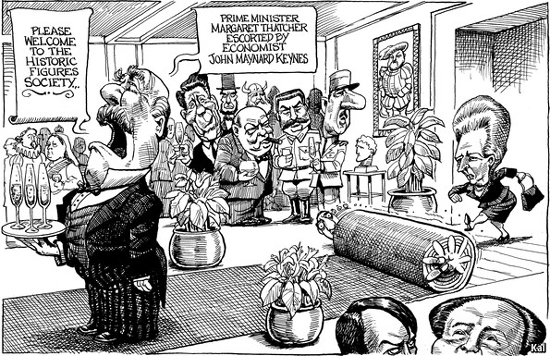
George Soros has a 'miraculous' solution for Europe but his plan is vehemently opposed by Germany. However he says the Germans have no right to prevent others from banding together and issued Eurobonds - and if they are still opposed, he suggests they quit the eurozone. His idea is set out in Project Syndicate and Spiegel Online:
The causes of the crisis cannot be properly understood without recognizing the euro’s fatal flaw: By creating an independent central bank, member countries have become indebted in a currency that they do not control.
At first, both the authorities and market participants treated all government bonds as if they were riskless, creating a perverse incentive for banks to load up on the weaker bonds. When the Greek crisis raised the specter of default, financial markets reacted with a vengeance, relegating all heavily indebted eurozone members to the status of a Third World country over-extended in a foreign currency.
Subsequently, the heavily indebted member countries were treated as if they were solely responsible for their misfortunes, and the structural defect of the euro remained uncorrected.
Once this is understood, the solution practically suggests itself. It can be summed up in one word: Eurobonds.
If countries that abide by the EU’s new Fiscal Compact were allowed to convert their entire stock of government debt into Eurobonds, the positive impact would be little short of the miraculous. The danger of default would disappear, as would risk premiums. Banks’ balance sheets would receive an immediate boost, as would the heavily indebted countries’ budgets.
------------------------------------------------------------------------------------------------------------------------------------------
Keep it safe. Keep it in a New Zealand Mint safety deposit box. Details here »
------------------------------------------------------------------------------------------------------------------------------------------
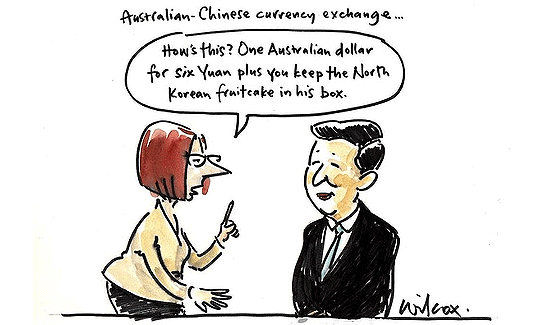
3. Don't call it a currency war
But the rhetoric shows signs of heating up again, amid forceful moves by major central banks to pump up their economies through the creation of new money.
The US Treasury Department said Friday in a report that China’s currency is “significantly undervalued” and that it would “closely monitor” Japan’s aggressive new monetary policy to ensure the goal was economic growth, not a weaker yen. The world’s finance ministers and central bankers will gather in Washington this week for the semi-annual meeting of the IMF. Currencies are sure to be a hot topic. The Globe and Mail reports:
Foreign exchange markets are shifting. Currencies such as the Canadian dollar are suddenly havens for investors and currencies such as the Thai baht are a play for yield. The primary reason is the growth-seeking, zero-interest, money-creating policies of the United States, Europe and Japan.
Canada, Thailand and others are suffering as a result. If that isn’t war, what is it?
It is more accurately a game of survival in the post-crisis global economy where old formalities no longer apply. The policies of the US. Federal Reserve, the Bank of Japan, the Bank of England and others look aggressive because they appear to break the rules. These central banks have created the equivalent of trillions of dollars. What else could this be but a blatant attempt to debase their currencies to give their exporters an advantage in international markets?
If you accept that view, then you think most every policy maker on the planet is a liar, and you deny the validity of an overwhelming body of evidence that concludes that the policies of the Fed and others are doing more good than harm. Even the central bank of Brazil has concluded that its exporters benefit more from stronger growth in the United States than they are hurt by a stronger currency.
The world economy is stuck in purgatory between recession and recovery. The objective of each player is to escape, but none knows quite how to do it. This isn’t a state of war: Nothing is gained by attacking an opponent outright.
But there is an element of survival of the fittest. Countries will do what they can to revive their economies. The contest is complicated by the fact that a handful of players are considerably stronger than the others. But countries have no choice but to play the game.
4. Today's raw market data ...
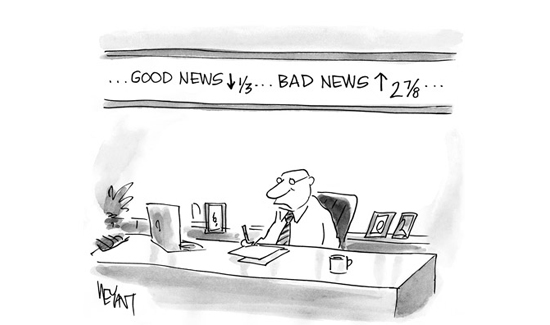
A quick new week update:
| as at 11:10am |
Today 9:00 am |
Friday |
Four weeks ago |
One year ago |
| NZ$1 = US$ | 0.8584 | 0.8634 | 0.8237 | 0.8236 |
| NZ$1 = AU$ | 0.8175 | 0.8186 | 0.7949 | 0.7947 |
| TWI | 78.81 | 79.30 | 75.77 | 73.50 |
| Gold, US$/oz | 1,477 | 1,536 | 1,604 | 1,653 |
| Dow | 14,844 | 14,865 | 14,462 | 12,853 |
| Copper, US$/tonne | 7,510 | 7,510 | 7,556 | 8,054 |
| Volatility Index | 12.06 | 12.24 | 13.36 | 19.55 |
------------------------------------------------------------------------------------------------------------------------------------------
New Zealand Mint. Experts in gold & silver bullion, commemorative coins and jewellery. Details here »
------------------------------------------------------------------------------------------------------------------------------------------
5. Low risk
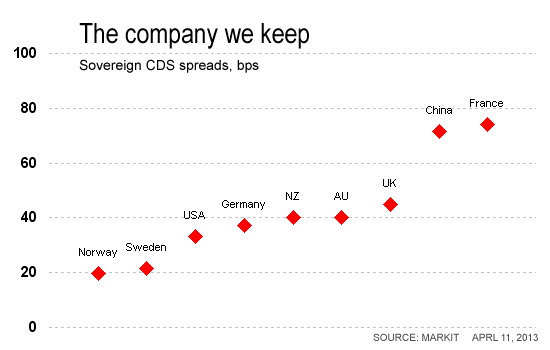
Even though the NZ Government has almost NZ$78 billion of securities out there ( 37% of GDP ), the credit markets really like us. Not only do they keep buying the stuff, they price it with among the least-risk premiums of most countries. It is another thing that hurts the exchange rate, along with surging dairy prices and growing credibility that we will be back in surplus next year. Perhaps we only shine in an 'ugly lineup' ? After all, risk is relative.
6. 'Targeting the wrong metric'
New Zealand's monetary policy targets inflation. Sure, that hurts many people, but so does unemployment. But the evidence is that unemployment causes more problems than inflation, or so says a bunch of academics at a Scottish university. They say that unemployment causes four times the hurt that inflation does, so we should actually use monetary policy to target unemployment first.
Higher unemployment and higher inflation correlate with lower levels of reported well-being, their research shows. But the impact of unemployment is much larger. A one percentage point increase in unemployment lowers well-being more than twice as much as an equivalent rise in inflation, the paper says based on US and European data.
We find, conventionally, that both higher unemployment and higher inflation lower happiness. We also discover that unemployment depresses well-being more than inflation. We characterise this wellbeing trade-off between unemployment and inflation using what we describe as the misery ratio. Our estimates with European data imply that a one percentage point increase in the unemployment rate lowers well being by two and a half times as much as a one percentage point increase in the inflation rate.
------------------------------------------------------------------------------------------------------------------------------------------
Available now. Our brand new 1 oz Taku gold bullion coin. Details here »
------------------------------------------------------------------------------------------------------------------------------------------
7. Read this first-home-buyers and weep
Americans think their houses are still overvalued - and that's after seeing that the multiple between incomes and the mortgage payment for a median house is less than 3x. Median pay is US$52,513 and the median house price is US$157,400 according to Zillow.
At todays exchange rate that is NZ$61,150 in pay and NZ$183,350 for a median house (that is probably spec'd better than a kiwi one). The New Zealand data is NZ$78,700 in household take-home income (~$NZ102,000 pre-tax) and $400,000 for the median priced house. That is a full year's extra income required on a household basis. We don't need Nick Smith and Len Brown arguing.
We believe that current home value appreciation is not sustainable and is due to inventory shortages and more importantly record low mortgage rates. In the future we will see stagnant or depreciating home values and a price-to-income ratio that is more in line with its historical average.
8. Cheap in gold ?
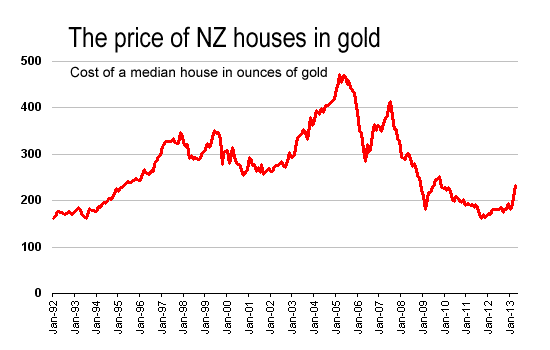
Over the past few days we have seen a sharp fall in the price of gold, news that followed reports of sharp rises in the median price of New Zealand homes (the median hit $400,000 for the first time ever). While the cost of houses in gold has fallen as a result, the shift is not a lot in historical context.
In 1992 when the price of gold was US$350/oz, it took about 170 ounces of gold to buy a median priced house. Before last week's news, the cost in gold was very similar. Today, even after the changes we reported last week, it takes only about 230 ounces of gold to buy a median priced house - not a great difference over more than 20 years.
However, this chart shows that in the intervening period there have been substantial swings and so the price of gold is not well correlated to New Zealand house prices.

9. Job losses
A couple of big job losses reported this week. Sealed Air in Rotorua announced that 112 positions would go over the next 12 months as production is shifted to their major Hamilton facility. And most DHB's announced that they will be outsourcing hospital kitchen work, affecting about 1,300 positions. But real losses in both cases won't be anywhere near these numbers. The Rotorua site is being redeveloped and more than 300 replacement positions have been announced. And the outsourcing contractors for the hospital kitchens will be involved in major hiring.
We are keeping a tally of reported job losses and we are asking readers for help keeping track of them. Let us know when you see some.

10. Today's quote
"You aren’t wealthy until you have something money can’t buy." Anon
Dairy prices
Select chart tabs
11. New service - Farms For Sale
In case you missed the announcement elsewhere of this website, starting today we are now listing working farms for sale in New Zealand, here »
We welcome your comments below. If you are not already registered, please register to comment
Remember we welcome robust, respectful and insightful debate. We don't welcome abusive or defamatory comments and will de-register those repeatedly making such comments. Our current comment policy is here.