
By Bernard Hickey
Where's the real estate shock?
The blast waves from the Labour-Green electricity policy bombshell reverberated further out into the business and political landscapes this week.
The sense of shock and anger deepened among many in business. Business NZ and chambers of commerce protested publicly to Labour and the Greens that a return to such state control would have a chilling effect on investment and massively destroy shareholder value.
It was as if there had been a death in New Zealand's economic policy family.
For almost 30 years a generation of bureaucrats, politiciians, lobbyists, business leaders and policy wonks broadly agreed de-regulation and unfettered markets were forces for the greater good.
Parties of the centre-right and centre-left often bickered over the details and how quickly to drive this forward, but there was never any real debate about a full reversal.
The business community is now well into the second of the classic five stages of grief - first denial, then anger, followed by bargaining, then depression and finally acceptance.
The first response from share-brokers and fund managers was to deny that such a policy would actually be enacted, either because a Labour-Green government would be unelectable, or because they wouldn't do it even if they made it to government.
Now the anger is welling up as business leaders realise the policy is broadly popular with the voters who will decide the election and that National doesn't have any MMP mates left. Many muttered darkly this week about foreign investor flight, capital starvation, higher interest rates and power blackouts.
Yet interest rates have actually fallen, the New Zealand dollar has strengthened and the overall stock market has surged back to record highs since the April 18 announcement.
However, there have been real and significant drops in the share prices of Contact and Trustpower.
The share market isn't universally popular with investors, but it is very good at price discovery after news. Investors can buy and sell in reaction very quickly, easily and cheaply.
Verdicts take minutes rather than months.
The real estate market is much less liquid and harder to read in the short term.
It can take many months for a shock to go through the meat grinder of sales campaigns, auctions, settlements and be mushed up with a moveable feast of other factors such as interest rates, foreign investor demand and housing supply.
But even with that, I'm surprised we have seen so little shock and anger from real estate investors at the prospect of a Labour-Green government.
Both remain committed to a Capital Gains Tax. Both want to launch massive state house building campaigns to add new supply to an under-supplied market, particularly in Auckland.
Both are eyeing reform of the accommodation supplement, which is a massive subsidy for private landlords.
Labour and the Greens are also determined to rewrite the Reserve Bank Act to extract economic policy from its current Catch 22 situation where a high New Zealand dollar helps keep interest rates low and reassures foreign property investors they are onto a one-way bet.
The Greens and NZ First would also push for a ban on non-resident purchases of local houses, as well as for land.
The combined effect a capital gains tax, more housing supply, lower rents, less foreign investor demand, fewer rent subsidies and potentially higher mortgage interest rates would have at least a dampening effect on house prices, if not worse.
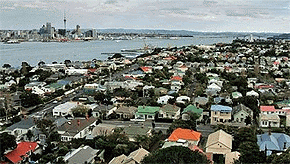
Yet there is not a whisper of this in the auction rooms and open homes around the nation, and certainly not in Auckland, where the market is in full boom mode.
How long before the denial, shock and anger we've seen this week from business leaders extends to property owners about a Labour-Green 'attack on property wealth and its chilling effects on private investment'?
Perhaps what is needed is a joint press conference and a combined policy news release, just as we saw on April 18. That is bound to come before the November 2014 elections.
-------------------------------------------------------------------
This article first appeared in the Herald on Sunday. It is used here with permission.
We welcome your comments below. If you are not already registered, please register to comment
Remember we welcome robust, respectful and insightful debate. We don't welcome abusive or defamatory comments and will de-register those repeatedly making such comments. Our current comment policy is here.