

Here's my Top 10 links from around the Internet at 10 am today.
As always, we welcome your additions in the comments below or via email to bernard.hickey@interest.co.nz.
See all previous Top 10s here.
My must reads today are #2 and #7 on the challenges for China. There are plenty and it's not a simple story of boom or bust.

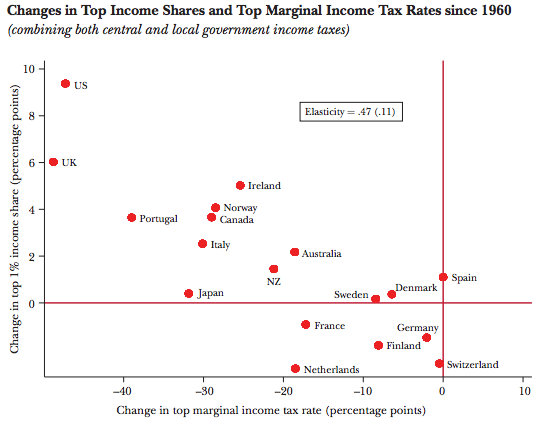
1. The American outlier - US and British economists Facundo Alvaredo, Anthony Atkinson, Thomas Piketty, and Emmanuel Saez have written a paper trying to put growing income and wealth inquality into an international context.
The chart below showing how dramatic the change is in the United States and the connection between cuts in top tax rates and increasing inequality is interesting. New Zealand has cut its top tax rates too, but the rise in inequality hasn't been nearly as dramatic.
They also find little connection between economic growth rates and lower tax rates, which is a shibboleth of the Rogernomics/Reagonomics/Thatchernomics revolution and was the major reason cited for New Zealand's big tax switch in 2010.
They also find CEO pay is not linked to company performance and rose sharply as tax rates fell.
If we look at the aggregate outcomes, we find no apparent correlation between cuts in top tax rates and growth rates in real per capita GDP. Countries that made large cuts in top tax rates such as the United Kingdom or the United States have not grown significantly faster than countries that did not, such as Germany or Switzerland.
This lack of correlation is more consistent with a story that the response of pre-tax top incomes to top tax rates is due to increased bargaining power or more individualized pay at the top rather than increased productive effort. Naturally, cross-country comparisons are bound to be fragile. However, the regression analysis using the complete time-series data since 1960, shows that the absence of correlation between economic growth and top tax rates is quite robust.
By and large, the bottom line is conomic growth and top tax rates have all grown at roughly the same rate over the past 40 years—in spite of huge variations in tax policies. More specifically, international evidence shows that current pay levels for chief executive officers across countries are strongly negatively correlated with top tax rates even controlling for firm’s characteristics and performance, and that is stronger in firms with poor governance. This finding also suggests that the link between top tax rates and pay of CEOs is likely to be due to bargaining effects.
2. Perma-bears and stopped clocks - Here's Michael Pettis latest musing via Economonitor on the structural reform necessary in China and an ongoing battle between bullish economists and politicians who say China will never slow down, and bears who say a slowdown (or even a collapse) is possible.
Pettis is more nuanced. He sees a slowdown without a collapse.
For many years before 2007-9 a few analysts have warned that rising consumer credit in the US and peripheral Europe was unsustainable. They warned that rising debt to support misallocated investment in China was also unsustainable. They warned that soaring US mortgages backed by little more than the hope that land prices could only rise would lead to a real estate crisis. They warned that commodity-exporting countries that did not hedge their bets would find themselves in serious trouble when commodity prices collapsed.
Of course you could not have had a bubble unless the majority of analysts disagreed with these warnings, and most analysts did indeed disagree. So what happened when the warnings turned out to be right? Obviously enough the mistaken bulls publicly acknowledged that their models were incorrect and promised to hit the economic history books so that they never again would be so foolish.
Just kidding. What actually happened is that the former bulls immediately trotted out the stopped-clock analogy. The reason the worriers turned out to be right, they earnestly explained, is that they are perma-bears, and as everyone knows a stopped clock will always be right twice a day. This doesn’t mean, however, that models used by the worriers were right and the models used by the bulls were wrong, so of course there is not need for the bulls to change their models.
As China’s growth continues to slow and as its debt problems become obvious to even the most bullish, the stopped clock analogy is working overtime.
3. Just slower - Pettis sees China's growth slowing to 3-4%.
There are other far more likely alternatives for China that involve neither perpetual double-digit growth nor collapse. For example, I have been skeptical about the sustainability of the Chinese growth model since at least 2006-7 but I have never argued that China would collapse, let alone collapse within six months.
My argument is that China’s growth model, which is not at all unique and for which there are many historical precedents, is usually wealth enhancing in its early stages, and then becomes wealth destroying once capital is systematically misallocated. When that happens, debt rises at an unsustainable pace until we reach debt capacity limits, in which case the country will have a debt crisis. I have usually estimated that it would reach debt capacity limits around 2016-18 but now I think it is likely to happen earlier.
However I never believed China would hit those limits, or have a debt crisis, because I was fairly sure that Beijing would begin adjusting earlier. It is during the adjustment period that I expected growth to drop sharply, to 3-4% as the upper limit.

Ooor households account for only a small part of total fuel use. As a result, on average, consumers in the richest 20 percent of the population get six times as much total benefit from fuel subsidies as do those in the poorest 20 percent. The specific amount varies by fuel.
For example, vehicle ownership is low among poor households in poor countries, so they get little direct benefit from a reduction in gasoline prices. On the other hand, since poor households are less likely to be connected to the electric grid, they account for a larger share of kerosene consumption and get more benefit from subsidies of that fuel.
The following chart from the IMF study provides estimates of the distribution of subsidy benefits for four important fuels.

5. Too many cities? - Urbanisation of China is still seen as a future driver of growth in China, with anything from 260 million to 400 million people still yet to move from the country to the cities.
Kate McKenzie from FTAlphaville has written an excellent piece on whether China's build-it-first-and-they-will come approach is working to urbanise China. It may just be creating more ghost cities.
China’s build-first approach hasn’t always gone drastically wrong. As the WSJ notes, “the towering new Pudong business district” was empty when built a decade ago, but later became a “symbol of China’s success”.
On the other hand, is it Pudong that is the exception and Ordos that is the norm, or at least a more common scenario in China’s many smaller cities? Hard data is hard to come by, but the WSJ asserts that the build-now-wait-for-growth strategy has “thrown up empty suburbs and ghost cities like Tieling New City across the country”.

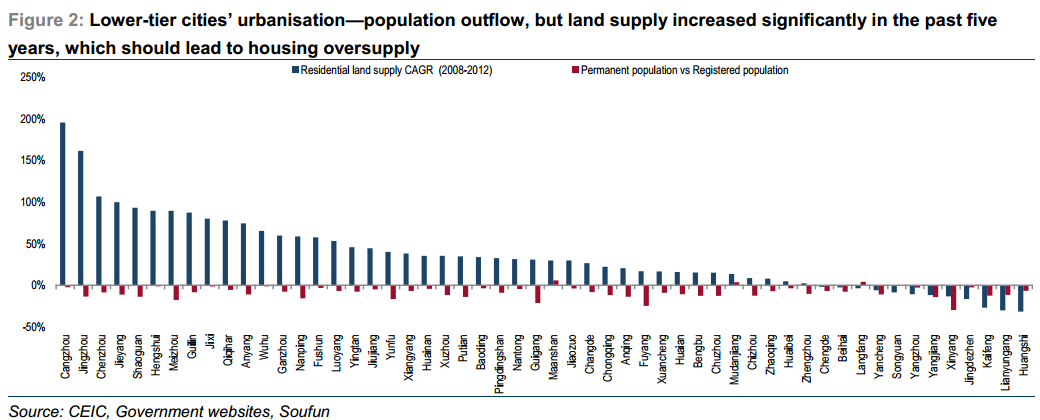
6. Population outflow? - McKenzie cites China Danke's Mao Dajing in this piece explaining how China's urbanisation works. It suggest envelopment of rural populations rather than migration from the country to the city. In some cities there has actually been population outflow.
While common sense assumes China’s urbanisation pertains to rural people migrating to cities, the reality is quite different. Government official data shows that only a third of the newly urbanised population is migrant workers from the countryside.
The remaining two thirds are mostly locally urbanised people, i.e., the city area has expanded to where they live. With more and better job opportunities in higher-tier cities, many lower-tier cities have actually been experiencing a net outflow of population while land sales there increased rapidly exacerbating the housing oversupply.
Among the 287 cities that we managed to collect data on, only 97 (or 1/3rd) have more permanent residents than registered residents (or “local people”, i.e., those with a hukou (formal residence registration)). This means two-thirds or 190 of those cities may have experienced population net outflow.
7. Big problems in little India - Bloomberg reports India has just had to introduce import controls to deal with a current account deficit blowout and a rupee slump.
India's current account deficit is 4.8% of GDP. New Zealand's is forecast to go higher than that, but apparently foreign investors still love us and our currency. No worries then...
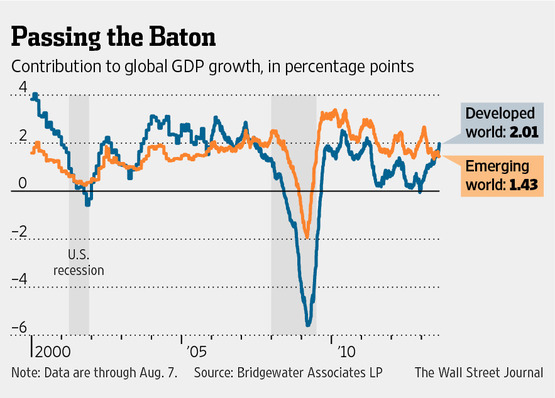
8. Back in charge again - The emerging economies have become the submerging economies of late, the Economist's freeexchange blog points out helpfully with this excellent chart showing developed economies are again contributing more to global growth than emerging economies for the first time since 2007.
The more important point is that advanced economies really shouldn't be contributing more to growth. Emerging markets account for a respectable chunk of global output now: more than half on a PPP basis and about 40% using market exchange rates. And they have vast room for catch-up growth; real per capita output in the emerging world remains just 17% that of advanced economies. It is hard to see how the emerging world can continue to raise its living standards relative to rich economies without contributing more to global growth.
But it's worth remembering that for much of the past century it didn't; catch-up in some emerging economies was offset by regression in others.
9. More on China's urbanisation - This Bloomberg piece on the problems faced on the ground in China's great urbanisation drive is good.
China’s plan to encourage hundreds of millions of rural residents to settle in cities to boost growth faces opposition from local governments, according to Li Tie, an official with the nation’s top economic planning agency.
Officials, researchers and company executives highlighted challenges at an urbanization forum in Beijing on Aug. 10. They cited the strain on local-government finances, the dangers of overbuilding and the cost of scrapping the hukou, or residence permit, system that denies migrants the welfare, health and education benefits of city dwellers.
10. Totally The Daily Show's John Oliver on Australia's election campaigning.
We welcome your comments below. If you are not already registered, please register to comment
Remember we welcome robust, respectful and insightful debate. We don't welcome abusive or defamatory comments and will de-register those repeatedly making such comments. Our current comment policy is here.