
By Bernard Hickey
This view is not going to make me popular among the very lovely luvvies of the film industries of Auckland and Wellington. It's also probably arguing against my own personal financial interest because I'm now a home owner in Wellington.
The Government announced on Tuesday it would increase its Large Budget Screen Production Grant (LBSPG) or rebate to as much as 25% from 15-20% now to win the next three Avatar movies, which would then pump up to NZ$500 million into the local Wellington economy. Wellington Mayor Celia Wade Brown was thrilled. The film industry was over the moon. Even the Labour Party supported the move, albeit begrudgingly.
However, any thoughts of celebration I might have had were promptly snuffed out when I read this Cabinet paper on the decision, and in particular, the Treasury's view on changes to the LBSPG and its associated scheme for local productions known as the Screen Production Incentive Fund (SPIF). The Government announced the combination of the schemes, removed the cap on the SPIF and increase the rebates to a common maximum of 25%.
Read the whole thing to get an insight into how this Government thinks and makes decisions, but the best bits are on pages 14 and 15.
Treasury said in the paper prepared by the Offices of the Economic Development Minister Steven Joyce and Arts, Culture and Heritage Minister Chris Finlayson ahead of the December 2 cabinet decision it did not support the changes to the two schemes, and also wanted the subsidies dropped altogether.
Treasury estimated the current LBSPG scheme had delivered net economic benefits of just NZ$13.6 million over its first seven years from 2004 to 2011 at an annual rate of return of less than 1%.
The cabinet papers show the Government spent NZ$472.48 million through the Large Screen Production Grant (LBSPG) from 2004 to September 2013 to encourage spending of NZ$3.308 billion or an average of NZ$52.49 million per year. That sounds great, until you look at the net benefits for the economy and the Government in particular.
"The current regime is also estimated to have had an overall negative fiscal impact of NZ$168 million once tax revenue that would have been earned anyway is taken into account," Treasury was quoted as saying in the cabinet paper released with the decision.
So just to summarise and restate in the plainest language. The Government spent nearly half a billion dollars in seven years and got back NZ$13.6 million in net economic benefits. Not only that, but the extra spending actually reduced the Government's fiscal position by NZ$168 million. Steven Joyce is a savvy businessman as well as the Government's Mr Fixit. I can't imagine him signing off on a business decision with a net return of 1% per annum.
So the current scheme, before it was ramped up yet again, didn't make economic or budget sense, yet a Government that is supposedly pursuing a strategy of fiscal restraint and economic rigour pushed ahead with the deal, and against the advice of its economic advisers.
Nebulous wider benefits
Joyce argued there were wider benefits for Tourism and for New Zealand's profile from the new beefed-up scheme and the deal with 20th Century Fox and James Cameron, which specifies one red carpet premiere in New Zealand and a featurette on the DVDs extolling New Zealand's virtues as a place to make high-tech movies.
The trouble is Treasury has looked at the studies of the last smaller scheme and found few wider benefits.
"The two evaluations of the current subsidy scheme show at best small economic benefits, with limited evidence of spillover benefits within the film industry, Tourism and New Zealand in general," Treasury said.
"Further subsidies will only increase costs and offer weak benefits," it added.
Where's the Hobbit theme park?
A quick look at the report on the Tourism sector released by Steven Joyce's own office last month showed real tourism earnings had been falling since 2004 and average spend per person had actually fallen 30% in the decade to 2013. New Zealand talks a good game on becoming the Middle Earth of the Tourism world, but it has done little to actually lift the Tourist sector and offset the hammering it has taken, along with other export sectors, from the over-valued New Zealand dollar.
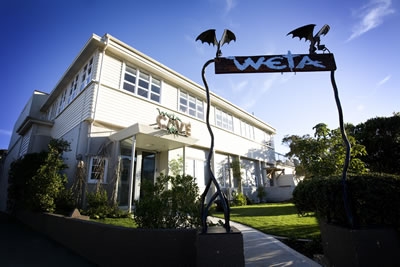
For example, despite nearly half a billion dollars of Government spending on the six Hobbit-themed movies and tens of billions of dollars worth of 'free' promotional value in global cinemas, Wellington still does not have a Lord of the Rings visitor centre or theme park, despite years of chatter. There is a two roomed 'Weta Cave' display in Miramar which is well worth a visit, but is literally no larger than an average house (pictured above). The Weta Cave offers free tours for a maximum of 20 people at a time once every half an hour. It is staffed by Weta Digital workers on their off days. The fine Sunday afternoon I visited last year with my family there were eight people on the tour, and half of them I was related to.
'Race to the bottom'
Both Treasury and the Offices of the two ministers warned that increasing the subsidies meant New Zealand risked joining a "race to the bottom," battle of the subsidies between countries being gamed by the big studios.
"Permanently matching overseas subsidies to generate activity in New Zealand is not a sound basis for economic development policy and favours the film industry over other sectors," Treasury advised the Economic Development Minister.
Exactly. All those redundant fish filleters in Christchurch and timber millers in Rotorua who appealed in vain for help to deal with the same over-valued New Zealand dollar and foreign subsidies as the film industry must be wondering what they did wrong. Why did their lobbying fail, but the lobbying of James Cameron and Sir Peter Jackson did not?
Ready, fire, aim
The cabinet minute also paid lip service to the idea that the new scheme would somehow be temporary and scaled back once conditions allowed. Bizarrely, the decision was taken by the cabinet to make these major changes to the schemes without having done the fiscal analysis on how big the subsidies might actually be and how they fit into the rest of the Budget process.
"Officials will assess the impact on the market of the changes and within one year of their introduction will report back on the options for the appropriation," the cabinet paper read.
Treasury again asked why there was such a rush to combine the two schemes and increase the scale of the subsidies, especially given they were tweaked and boosted less than nine months ago. It recommended doing a proper analysis and making the decision in time for the May Budget. Any deal that had to be done to win the Avatar movies could be done separately and quarantined.
"Given the proposals are likely to involve a fiscal impact, they should be considered as part of Budget 2014 where they can be assessed against other potentially higher priority and higher value initiatives," Treasury said, adding the cabinet paper did not look at the fiscal implications, which should be done before any decision was made. The cabinet went ahead anyway.
Treasury pleaded for the Government to not to 'ready, fire, aim.'
"If Ministers consider decisions are needed quickly to retain the Avatar production in New Zealand, Cabinet could consider a one-off increase in support for that production only," Treasury advised.
Show us the equity
The one aspect of the new scheme that seemed to make sense was the decision to turn the rebate for local productions worth NZ$15 million to NZ$50 million into an equity stake, rather than just a grant. That meant in the unlikely event the movie or TV series made a profit the balance sheet of taxpayers might actually benefit. It also begged the question: why didn't the Government demand an equity stake in the Avatar movies? If only the Government had one with the Hobbit movies and Avatar the deals might actually have made a profit.
The end result is a government decision made against the advice of its main economic ministry and that is unlikely to benefit the economy or the budget. It unfairly subsidises one export industry over many others and was made in un-necessary haste.
This doesn't look like a coherent economic strategy. It looks like another deal cooked up over dinner and handed to the officials to rubber stamp.
We welcome your comments below. If you are not already registered, please register to comment
Remember we welcome robust, respectful and insightful debate. We don't welcome abusive or defamatory comments and will de-register those repeatedly making such comments. Our current comment policy is here.