
By Bernard Hickey
Just imagine if you owned a business and your sales manager told you the business sold 46% of your most popular product to just one customer last year.
Would you celebrate and ask how you could switch all your production to that one product and see if that one buyer wanted to buy all your stock?
Or would you wonder if you might be over-exposed to that one product and one customer?
You may ask, which is this business and who runs it?
It is not a supplier to Countdown. It is New Zealand in 2014.
The product is milk powder and the customer is China.
New Zealand sold 46% of its milk powder to China in 2013.
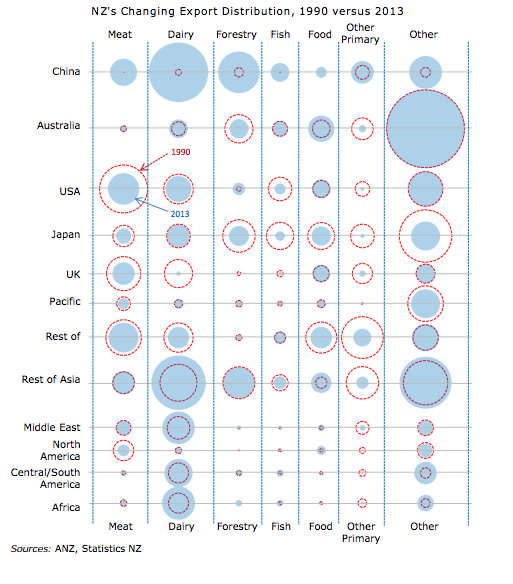
Exports of this one product doubled, helping to drive overall exports to China up 45% to NZ$10 billion for the year. Meat, log, fish and wine exports rose at double digit rates, but milk powder alone made up 40% of all New Zealand's exports to China.
The share of our exports going to China has risen from 3% to 21% in less than a decade. A largely unreported milestone at the end of 2013 was China becoming New Zealand's largest trading partner, both for exports and imports. Australia had been our biggest partner since 1989.
New Zealand has never seen such a dramatic jump in trade with a single partner in such a short space of time.
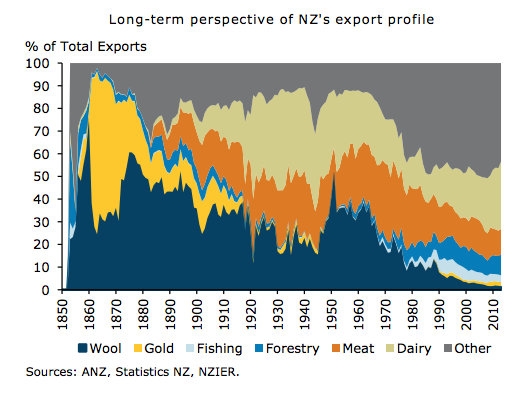
But we have been in this position before of having to think about a dramatic shift in trade before, except in the other direction. In the late 1960s and early 1970s New Zealand worried about just this problem of relying so heavily on one buyer.
Back then New Zealand mostly sold sheep meat and butter to Britain. We fought two wars with Britain to help preserve that trade dependence, but Britain's entry into the European Common Market in 1973 blew away that complacency. Much of the next three decades was spent desperately hunting for other markets to diversify away from Britain.
New Zealand's success in finding other markets and other products was extraordinary, particularly our surge into the Middle East, Southeast Asia and Latin America and our move out into wine, fish, beef and logs. Even by 1992 Britain still bought 14.5% of our dairy exports and China bought just 0.5% of our dairy exports.
But by 2013 Britain's share dropped to 0.3% and China's share was over 25%.
New Zealand is not as dependent on exports of milk powder to China now as it was on exports to butter to Britain in the 1960s, but at the current pace of growth we'll get close sooner than we think.
So is that a good thing?
Most farmers would say we should make hay while the sun shines. But there is also the problem of having too many of one type of egg in one basket.
This explosive growth in demand and prices for milk powder is also dominating our national economic strategy, which is focused mostly on enabling increased production of milk and its subsequent processing into milk powder.
That is putting enormous stress on our waterways, and on the relations between town and country.
New Zealand had a sneak preview of the risks of such a reliance on one product to one country when for a brief moment in August last year it appeared China had banned all New Zealand milk powder imports after Fonterra's botulism scare.
Many breathed a sigh of relief when it became clear only the whey protein concentrate imports had been banned and not the golden goose of plain milk powder.
This reliance on one product to one country is also forcing us to tweak our strategic relations with our oldest friends.
New Zealand now has a clearly softer stance than Australia on China's more muscular stance with its near neighbours Japan and the Philippines in their various disputes over who owns which rocks in the seas between them. Australia angrily protested China's imposition of a air defence zone over the Senkaku Islands late last year. New Zealand just said it preferred China and Japan settled the dispute between themselves.
So far New Zealand has managed its relations with China well and dodged a few bullets, but our largest trading partner now is a country New Zealand knows much less about and has far fewer connections with than Britain.
Those cultural, political and social connections are growing fast, but not as fast as the trade links. Some things change quickly and others do not.
New Zealand sold just NZ$2 million worth of butter to Britain last year and NZ$4 billion of milk powder to China.
Yet we still share a monarch, a language, a political system and our love of Coronation Street with Britain. Few New Zealanders would know the name of China's President Xi Jingping or that China's currency is called the Renminbi.
We have a lot of catching up to do, and perhaps a little spreading around as well.
(Updated with images from this ANZ research note)
------------------------------------------------------------------------------
A version of this article was first published in the Herald on Sunday. It is used here with permission.
We welcome your comments below. If you are not already registered, please register to comment
Remember we welcome robust, respectful and insightful debate. We don't welcome abusive or defamatory comments and will de-register those repeatedly making such comments. Our current comment policy is here.