

Here's my edition of Top 10 links from around the Internet at 10:00 am today. We now have a Monday-Wednesday-Friday schedule for Top 10.
Bernard will be back with his version this Wednesday. We will have another guest posting on Friday.
As always, we welcome your additions in the comments below or via email to david.chaston@interest.co.nz.
See all previous Top 10s here.
1. Why we need innovation clusters
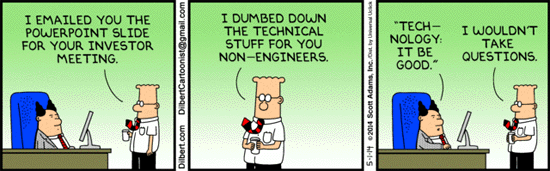
If technology is just a collection of devices and engineering practices and can be put in containers and shipped around the world, while recipes, blueprints, and how-to manuals can be posted online, putting them just a few clicks away, how come technology development is so unequal?
How come Silicon Valley not only survives, but increases its dominance?
New Zealand makes a serious development mistake by thinking science, tech, research, and creative endeavours should be dispersed to the regions.
You need to build significant centers of knowhow.
Ricardo Hausmann thinks economics misunderstands how tech operates in our society.
In fact, much of modern growth theory, starting with Paul Romer’s research in the late 1980’s, sprang from the idea that output was driven higher by ideas that are hard to come by but easy to copy. That is why inventors have to be protected by patents and copyrights or subsidized by governments.
So, if ideas are easy to copy and devices are easy to ship, why do differences in “technology” persist between countries?
The problem is that a key component of technology is knowhow, which is an ability to perform a task. And knowhow, unlike devices and ideas, neither involves nor can be acquired through comprehension.
Technology has trouble diffusing because much of it requires knowhow, which is an ability to recognize patterns and respond with effective actions. It is a wiring in the brain that may require years of practice to achieve. This makes its diffusion very slow: As I have argued previously, knowhow moves to new areas when the brains that hold it move there. Once there, they can train others.
Moreover, now that knowhow is becoming increasingly collective, not individual, diffusion is becoming even slower. Collective knowhow refers to the ability to perform tasks that cannot be carried out by an individual, like playing a symphony or delivering the mail: neither a violinist nor a letter carrier can do it alone.
Likewise, a society cannot simply imitate the idea of Amazon or eBay unless many of its citizens already have access to the Internet, credit cards, and delivery services. In other words, new technologies require the previous diffusion of other technologies.
That is why cities, regions, and countries can absorb technology only gradually, generating growth through some recombination of the knowhow that is already in place, maybe with the addition of some component – a bassist to complete a string quartet. But they cannot move from a quartet to a philharmonic orchestra in one fell swoop, because it would require too many missing instruments – and, more important, too many musicians who know how to play them.
Progress happens by moving into what the theoretical biologist Stuart Kauffman calls the “adjacent possible,” which implies that the best way to find out what is likely to be feasible in a country is to consider what is already there. Politics may indeed impede technological diffusion; but, to a large extent, technology does not diffuse because of the nature of technology itself.
2. When will it happen?
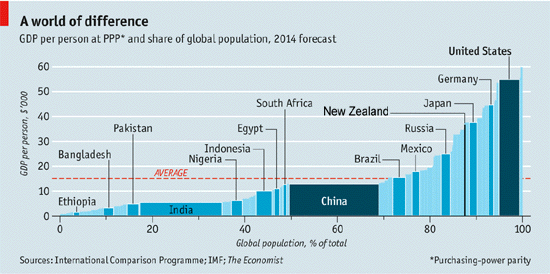
We have earlier reported the recent ICP project's news that China is nearly ready to overtake the US as the world's largest economy, based on updated PPP 'exchange rates'. You can work out yourself when this might happen, here. Its a tool that forces you to think clearly about a few issues.
The Economist has a nice review and a useful chart putting this data into perspective. We have added the NZ data to their chart, here:
3. 'Let's be practical'
The best selling book in America today is Piketty's Capital. But it has basically been ignored in his native France. Outside France it has been widely praised.
The Economist likes its analysis too - but thinks its policy prescriptions are weak.
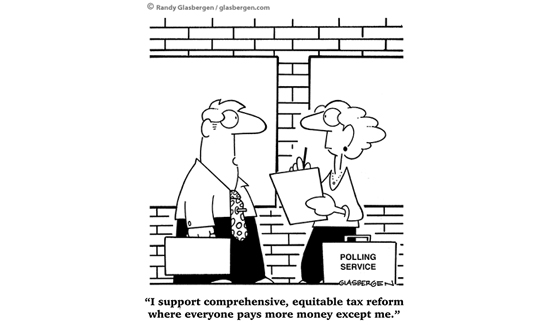
That is where the problems start, because Mr Piketty’s third contribution is to offer policy proposals that assume this growing concentration of wealth is not only inevitable, but the thing that matters most. He prescribes a progressive global tax on capital (an annual levy that could start at 0.1% and hits a maximum of perhaps 10% on the greatest fortunes). He also suggests a punitive 80% tax rate on incomes above $500,000 or so.
Here “Capital” drifts to the left and loses credibility. Mr Piketty asserts rather than explains why tempering wealth concentration should be the priority (as opposed to, say, boosting growth). He barely acknowledges any trade-offs or costs to his redistributionist agenda. Most economists, common sense and a lot of French businesspeople would argue that higher taxes on income and wealth put off entrepreneurs and risk taking; he blithely dismisses that. And his to-do list is oddly blinkered in its focus on taxing the rich. He ignores ways to broaden the ownership of capital, from “baby bonds” to government top-ups of private saving accounts. Some capital taxes could sit nicely in a sensible 21st-century policy toolkit (inheritance taxes, in particular), but they are not the only, or even the main, way to ensure broad-based prosperity.
Mr Piketty’s focus on soaking the rich smacks of socialist ideology, not scholarship. That may explain why “Capital” is a bestseller. But it is a poor blueprint for action.
4. You are 'being utter morons'
Matt Nolan at TVHE:
As someone with the job title “economist”, a large number of my friends only contact me when they want advice on buying currency or whether to fix their mortgage or buy as asset. After providing my thoughts about why things might happen, and what the risks are, I often get the comment “damned two handed economist, not willing to take a position”.
People think they are insulting me. However, if that is the actual attitude of my friends in this case I’d gladly point out that they are being utter morons. Instead, I take this as a compliment.
If I was going to “take a position”, why would I rattle it off to someone, instead of actually taking on the risk of doing so myself – if I genuinely thought that buying and selling currency offered me a good risk adjusted rate of return at this point in my life, then I’d do that, rather than just suggesting it to people.
When giving advice, I simply want people to be aware of the risk involved in the choices they are making – and the fact that there are reasons why asset prices may move one way or the other (and a good number of unforecastable, or unforeseeable, things that may pop up). To give this advice, I need to to be two-handed. It is my job, as a good friend, to help inform not to tell my mates what to do.
It would be the height of arrogance to pretend that, with my training as an economist, I could instantly turn around and fill the role of a professional risk manager for a certain asset class, or the CEO of a firm for a certain product. Instead, I pull together news, ideas, and a good dollop of statistical analysis to provide information for people that will make decisions – filling a role in the production process, not trying to control it.
So economists, stop being so defensive about being called “two-handed” and stop feeling as if you have to take a specific “position” to have worth. The world is complicated, and your advice (if based on intense questioning and analysis combined with clear communication) is valuable in the way it helps people make choices. Embrace the fact you’re born with two hands and make sure you use both of them!
5. Time is money for EU consumers
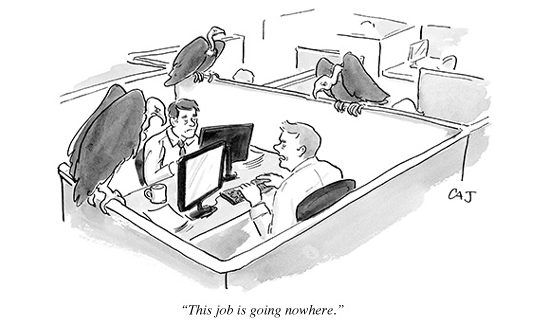
China's west is becoming another powder-keg. Ethnic tension is growing and Beijing is moving in huge numbers of Han Chinese to ensure they control the region - in a rerun of how they control Tibet. That makes the locals a minority, and disaffected.
The recent violent attack in the provincial capital Urumqi highlights the growing problem.
For us its a problem far away and while we don't see any reason to be involved ourselves, if we think about it at all, 'someone else' should do something about it. Beijing is promising to crack down hard.
To understand the tough line, you should know that Urumqi is at the heart of a major 'new' (actually very old) trade route. It uses a route through some unsavoury countries to deliver goods to Western Europe. Probably a few second-thoughts about such a strategy going on about now.
6. Secondary costs
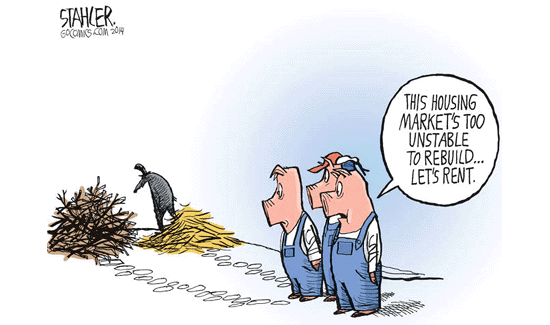
Apart from specialist capital-plant intensive companies, it fairly rare for a commercial enterprise to earn more than its payroll. But banks manage it, in spades.
Banks are 'special' in many ways, and this is just another one.
The record earnings by ANZ for its half year are impressive, to put it charitably. Compensation details won't be available until they release their full year results. But we can look at the last full year using the KMPG FIPS detail, and this is what it shows.
| Number of | Net profit | Payroll | Profit to | |
| employees | after tax | costs | payroll ratio | |
| # | million | million | ||
| ANZ | 8,284 | $1,372 | $ 833 | 165% |
| ASB | 4,695 | $ 723 | $ 443 | 163% |
| BNZ | 4,611 | $ 695 | $ 420 | 165% |
| Kiwibank | 1,024 | $ 97 | $ 111 | 87% |
| Westpac | 4,613 | $ 714 | $ 460 | 155% |
7. A dirty business
Do you use palm oil, buy products made with it*, or use PKE as a feed supplement on your dairy farm?
*Unilever and Nestle are among many that use it.
8. Nature will survive, but will we?
Right from primary school, pc teachers will tell you nature is benevolent. If it wasn't for the problems brought by humans, all the animals would cuddle and be vegan. We gradually get to understand this is rubbish, but some people stay trapped in the myth. However most of us - me included - retain a strong suspicion that humankind may not always be good for the planet.
However, to physicist Alan Lightman, this angst is completely misplaced.
I would argue that we have been fooling ourselves. Nature, in fact, is mindless. Nature is neither friend nor foe, neither malevolent nor benevolent.
Nature is purposeless. Nature simply is. We may find nature beautiful or terrible, but those feelings are human constructions. Such utter and complete mindlessness is hard for us to accept. We feel such a strong connection to nature. But the relationship between nature and us is one-sided. There is no reciprocity. There is no mind on the other side of the wall. That absence of mind, coupled with so much power, is what so frightened me on the sailboat in Greece.
The recent report by the United Nations Intergovernmental Panel on Climate Change documents the damage now being done by human-created greenhouse gases and global warming. In reacting to the report, we should not be concerned about protecting our planet. Nature can survive far more than what we can do to it and is totally oblivious to whether homo sapiens lives or dies in the next hundred years. Our concern should be about protecting ourselves - because we have only ourselves to protect us.
9. A retail version of securitisation
Credit rating agencies are trying to get their head around P2P - peer-to-peer - lending.
FTAlphaville has been looking at their head-scratching. Can credit ratings add anything?
Taken at face value these loans are not intermediated by the platforms but rather by users of the platforms themselves. On that basis, investors don’t need a third party’s view of the risk because the whole structure is built around getting investors to do the due diligence themselves thanks to the “transparency” provided by the platforms in the first place. It’s sort of DIY approach to credit intermediation, which then allows these loans to be so competitively priced versus what banks offer in the market place.
However in practice it is not the wisdom of the crowds that leads to the credit decisions, it’s the platforms doing the real assessment and legwork through the process of matching.
For a start, the platforms verify the identities of the borrowers and control the process. Second, even in the age of P2P Satoshi technology you can’t get away from the need for an intermediary to do the bulk of the work on risk assessment.
So what peer to peer lending really looks like is a retail version of securitisation. The innovation is in marketing it as something new. No wonder the credit agencies are dubious.
10. Today's quote
"Think of how stupid the average person is, and realize half of them are stupider than that." - George Carlin
19 Comments
One of Australia's big banks is facing scrutiny it financed a Cambodian sugar business responsible for forcing almost 500 families off their land, as the conduct of Australia's 'big four' in developing countries is analysed.
http://farmlandgrab.org/post/view/23439-cambodian-woman-run-over-by-har…
home news
seems a shame to be moved on inadvance of a season that could bring you write.
Many farmers in trouble with their banks, or put under “asset management” with tight lending constraints and the vortex of ever-increasing penalty interest rates, have never missed any interest payments on their business debts.
Yet hundreds have found themselves recently reclassified by their bank as financially unviable, on the brink of ruin, or at high risk of failure because of significant land devaluations of the farms that secure their loans.
and
Pedra Branca Dairying, a 1229-hectare farm with up to 2000 cows at Mount Schank, Mount Gambier in South Australia, is still looking for a buyer 12 months after being put in receivership by National Australia Bank. The receiver is PPB Advisory.
"We are very unhappy with the way the bank and receivers have handled the sale," a former senior Elders Real Estate agent handing the sale, claimed.
we don't them winning the bail-out.
I was told by an NZ Banker last week, that if interest rates were to rise anywhere significantly then there would be many huge problems disposing of certain non-profit entities, such as marginal farms, including dairy, rentals, businesses and houses, here too.
I did not dispute his observations.
Devastation created by the greed associated with palm oil is just a symptom of globalistaion. Dairy farming is the equivalent NZ industry.
"New Zealand makes a serious development mistake by thinking science, tech, research, and creative endeavours should be dispersed to the regions."
Those who think auckland show grow out and not at all up, that we should disperse our employment with our housing, and we should effectively live in a number of small villages that just happen to be right next to each other, are making the same mistake and limiting the oppurtunities for wealth creation.
David says......... "New Zealand makes a serious development mistake by thinking science, tech, research, and creative endeavours should be dispersed to the regions."
Accordingly. Silicon Valley should be located in New York City.
I'll accept further sattelite cities well before Aucklands population hits 7.5Million. Right now we are at 1930s Bay area population levels, and are hemorrhaging young smart people to the more vibrant cities of Melbourne and Sydney. I don't think more satelite cities are the solution to aucklands problems.
I wonder how much longer banks, their profits and structure will remain in their current form? They really are starting to look like over sized over feed dinasours, ripe for extinction. How long before some IT savey organisation like Google takes over the sector with an IT heavy/Smart phone or simmilar structure? With a lot less staff and bricks and mortar they should be able to provide a good service at a lot less cost and profit level more appropriate to the contribution that they make to the ecconomy. Remember Banks make 50% of the profit of all companies in the USA. At 2.5 to 3 B$ per year I wonder what our percentage is?
#7.
Douche Bank, Countries far and wide, Governments and its cronies.
How sad.
Take a GANDA at this link in #7....it just about sums up the actions taken to ruin this once beautiful world in this article.
Banks can spoil your appetite, ruin your natives, ruin the environment, all in the name of Mamon.
Aided by Governments I hasten to add.
And ruin Nation is coming to New Zealand, unfortunately.
But we call them something else and feed their kernels to the cows, etc.
So we are complicit as are our National banks, Government ..et al.
Some people will ruin just about anything to grease the palms of others and to milk the profits.
Surely getting back to a simpler existence would be better than the ruination of what was once a beautiful world.
Maybe if we did not run a deficit to keep up appearances, we could enjoy life a little better, without all the problems of big business and even bigger messes and importing crap to export to others destroying their own lands, so they now want to come here and destoy ours.
Both Cunliffe and Key, returned from afar to rule the roost and pluck the chickens.
Then let the foxes, into the hen-house and other crap-houses and even the milking sheds too.
Somewhat self defeating for New Zealand.
How sad.
No 3........the same playing field with the same rules for all would be a good place to start.
Stop subsidising wealthy and poor and with specials and discounts.
#7 A bunch of environmental activists write a hatchet job on palm oil. Dutifully cut and pasted by MSM. Plays right into the hands of soybean oil industry and is lapped up by Interest.co.nz hand wringers.
No mention of compulsory conservation area set aside regulation, profit sharing with local community regulation, the millions lifted out of poverty, 40% of plantations owned by small holders etc. etc.
How many German farmers have to set aside large conservation areas on their farms, do profit sharing on part of their farms with local communities, put up with squatters claiming land rights in cahoots with eco activists?
The crop is ten times higher yielding than canola and only need to be “cultivated” every quarter century unlike German rape seed. As for palm kernel it is a by-product like sheep dags so hardly a driver of the industry. Be thankful they don’t use it to fatten their own beef and dairy cows.
Thanks for the balance provided
Well you were caught a out a beauty fabricating a post by cherry picking information so you have no credibility at all. So is this the monkey see monkey do approach from you now? Made a fool of you now try to turn the same game on others?
Actually there is quite a lot of evidence from academic studies let alone observations on just how damaging palm oil cultivation is due to the fact it takes virgin forest, while soy bean is re-used land.
Small holders are as much of the problem as big holders, both slash and burn, no difference.
In terms of poverty, well true wealth is per capita and inter-generational, and here we are intent on using it up in at most 3 (and 2 are passing). So "profit" sharing is just divying out the one time resource converted to "wealth"
NZ is using palm kernels, that buy is helping with the sale of the product, simple it should be banned in NZ.
regards
I guess there are some people who really don't care about preserving anything of the natural world for the future, leaving tiny strips of land here and there will not preserve these things.
It is a real struggle now to avoid products with palm oil in them, but I try my best to do so
Palm oil is not bad per se, it's the land that it displaces that is the issue. I think most people would prefer that no more untouched tropical rainforest should be converted. Indonesians can rightly point the finger at the First World though and say why not, you cut down most of your forest. There are schemes such as REDD to encourange small landowners to not slash and burn and there are laws to stop this happening. The problem is that corruption is so endemic it is far too easy to bypass the rules.
#10. Classic George Carlin quote. Kind of alarming when you think about it. Democracy really requires an informed population to be effective otherwise people will just vote for the people they "like" or would share a beer with at a BBQ. Oh hang on..........
http://www.youtube.com/watch?v=hYIC0eZYEtI
I often comment on personality types and in particular the Rational types that have a deeper understanding of the world than other types. Most standup comedians are ENTP types are are included in that group. Carlin was pretty much right on everything. FYI Winston Churchill was an ENTP.
By George, I think he has got it.
Pity he died, before his time.
This item should lead the news every night. Should be compulsory viewing, even in schools, Uni etc.
(Better than any other reality show, It might make some people actually.............think).
But of course that would be debateable, cannot have that. Can we.?
We welcome your comments below. If you are not already registered, please register to comment
Remember we welcome robust, respectful and insightful debate. We don't welcome abusive or defamatory comments and will de-register those repeatedly making such comments. Our current comment policy is here.