
By Bernard Hickey
You know an economic idea or trend has crossed over to the mainstream when a big ratings agency starts talking about it.
The ratings agencies were among the last to realise that much of the sub-prime mortgage debt they had given AAA credit ratings to was turning toxic in the mid 2000s.
They were the last to downgrade Greek and Argentinian bonds before their Governments defaulted and forced restructures.
Eventually they did smell when their debt had gone rotten, but it took a while.
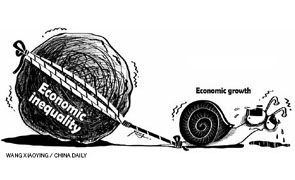
So it's notable when one of them warns that growing income inequality is slowing economic growth.
Up until a few years ago, this was an idea that only those on the more socialist left were saying. It was an issue framed around fairness rather than economic efficiency.
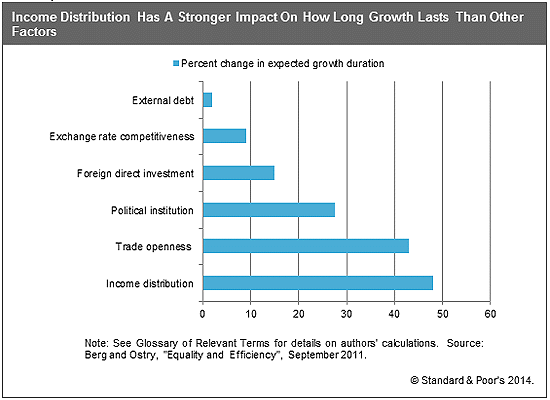
This month Standard and Poor's, one of the two big global ratings agencies, warned that growing income inequality in the United States was slowing growth in the world's biggest economy.
It lowered its growth forecast for the next decade to 2.5% per year from 2.8% because of it.
"Aside from the extreme economic swings, such income imbalances tend to dampen social mobility and produce a less-educated workforce that can't compete in a changing global economy," Standard and Poor's wrote in the detailed report.
"This diminishes future income prospects and potential long-term growth, becoming entrenched as political repercussions extend the problems," it said.
"Our review of the data, as well as a wealth of research on this matter, leads us to conclude that the current level of income inequality in the U.S. is dampening GDP growth, at a time when the world's biggest economy is struggling to recover from the Great Recession and the government is in need of funds to support an aging population."
Standard and Poor's is well aware of what can go wrong when a large group of households see their real incomes fall, as happened in the United States over the last two decades.
To make up for those lower incomes, the households' first instinct was to borrow more in the expectation that they would eventually catch up once their incomes rebounded. But when incomes kept falling for a sustained period and the borrowing kept on at the same rate, those household budgets eventually hit a brick wall.
That's what happened during the Global Financial Crisis. US households defaulted on their mortgages and brought the world's financial system to the brink of collapse.
That has focused the minds of ratings agencies, bond investors and banking regulators globally.
Standard and Poor's suggested various measures to reduce inequality in the United States, including shifting income to those on lower incomes and improving access to education and health-care.
America is, of course, a very different place to New Zealand.
Our education and health-care systems are much more publicly funded and accessible to people across the income spectrums.
Our minimum wage is much higher than America's and over the last 15 years New Zealand has reintroduced a significant amount of income 'shifting' to those on middle to lower incomes, particularly those in working families and the elderly.
Younger, childless people and those out of work have had a much tougher time.
However, the measures that were taken have helped stabilise New Zealand income inequality levels since the late 1990s, but did not improved them at all. Surveys show income inequality is growing as a political issue in New Zealand, but has yet to reach the sort of fever pitch that it is now among economic policy makers and some parts of the political spectrum in the United States and Europe.
New Zealand's relative success in avoiding the blowout in inequality levels seen in America in the last 15 years should not lead to complacency.
The work referred to by Standard and Poor's indicated there are forces of economic gravity at work that naturally push inequality higher. That's because cycles of poverty deepen inequality and the growing political power of the wealthy entrenches and deepens that inequality by introducing tax cuts and protecting special interests.
The work has to be done year after year to reduce inequality or at least stop it from getting worse.
New Zealand's political debate has yet to acknowledge the economic payoffs of reducing inequality. A healthier, better educated and more stable population is much more economically productive.
As Standard and Poor's has forecast, reducing inequality is actually a way to improve economic performance, rather than purely a debate about fairness or 'keeping up with the Joneses'.
Redistributing income and making healthcare and education cheaper for the poor is actually an economic growth strategy.
---------------------------------------------------------------
A version of this article first appeared in the Herald on Sunday. It is here with permission.
We welcome your comments below. If you are not already registered, please register to comment
Remember we welcome robust, respectful and insightful debate. We don't welcome abusive or defamatory comments and will de-register those repeatedly making such comments. Our current comment policy is here.