

Today's Top 10 is a guest post from Elizabeth Davies, a regular contributor to interest.co.nz. You can see more from Elizabeth here.
As always, we welcome your additions in the comment stream below or via email to david.chaston@interest.co.nz.
And if you're interested in contributing the occasional Top 10 yourself, contact gareth.vaughan@interest.co.nz.
See all previous Top 10s here.
1. The ‘Occupy’ movement buys $4 million in student debt ... and forgives it
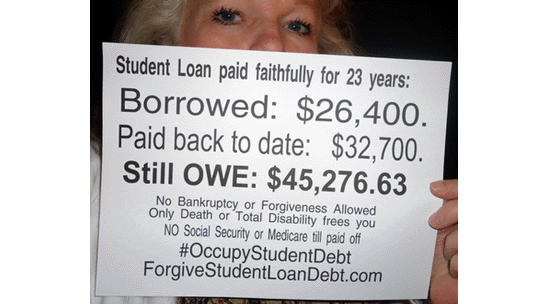
The Occupy Wall street movement marked its third anniversary by setting its sights on student debt, focusing on one particular for-profit Education Company that’s been in the middle of a legal storm recently regarding its predatory lending practices.
Marking the third anniversary of the Occupy Wall Street movement, the group's Strike Debt initiative announced Wednesday it has abolished $3.8 million worth of private student loan debt since January. It said it has been buying the debts for pennies on the dollar from debt collectors, and then simply forgiving that money rather than trying to collect it.
In total, the group spent a little more than $100,000 to purchase the $3.8 million in debt.
While the group is unable to purchase the majority of the country's $1.2 trillion in outstanding student loan debt because it is backed by the federal government, private student debt is fair game.
This debt Occupy bought belonged to 2,700 people who had taken out private student loans to attend Everest College, which is run by Corinthian Colleges. Occupy zeroed in on Everest because Corinthian Colleges is one of the country's largest for-profit education companies and has been in serious legal hot water lately.’
2. Staff sell receipt of millionaire’s 20 cent tip
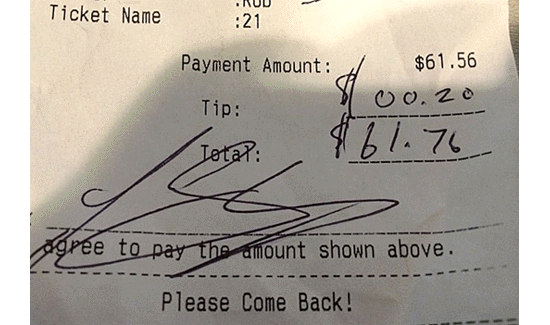
A millionaire US football player redefined the term ‘cheap’ when he gave a 20 cent tip on a $61.56 bill at PYT restaurant.
That’s 0.03%, an absolute insult to the hardworking staff who make their living off tips.
The original receipt is was then sold on eBay for a staggering sum – all of which will go to the staff that made and served his burger.
Philadelphia Eagles player Lesean McCoy, who earns more than $9 million a year, left a 0.03 percent tip on a US$61.56 bill at a local PYT restaurant last week.
The original copy of that receipt has since sparked a bidding war online.
The auction opened on September 13 with a starting bid of 20 cents but has since risen to US$99,900 with just over three days remaining.
“The aforementioned receipt has caused quite the media buzz amongst social media/news networks/celebrities along with many others,” the first-time seller, Fauxrean, said in the auction description.
“Not only do you get to keep a memento of weird current events/social media history but you also get an autograph from incredibly talented Philadelphia Eagles running back, LeSean McCoy!!!”
3. How to dine… below the line
Live below the line is a campaign encouraging people around the world to gain new perspective and line on a daily sum equivalent to the World Bank’s International ‘extreme poverty line’, in New Zealand that’s $2.25 a day.
This year Tear Fund has produced a cook book titled ‘One helping’ which consists of meals costing 75c per portion. All proceeds will go towards combating sex trafficking and slavery.
It may not seem like much, but for many in poverty, NZ$2.25 has to cover more than just food, it pays for housing, transport, bills, education, clothing and the other necessities of everyday life.
It's the price of a piece of cake and a store-bought coffee, says Bell, who plans to live off porridge, bread and "very cheap" coffee for a week.
"It is just a small taste of what many experience in living in poverty, it's really to raise awareness of those living in extreme poverty, and raise funds to help.
"Really I should be giving up the car and walking everywhere as well."
On hand is Tear Fund's cookbook One Helping, providing weeknight recipes from NZ chefs at a cost of 75 cents a helping.
Bell's favourite is the pumpkin and yellow splitpea dahl with homemade flatbread, made at a cost of five cents a loaf.
4. Easy, breezy ... not so beautiful ... cover girl?
Cover Girl is a major sponsor of the NFL but the league’s growing reputation for domestic violence has left a number of fans unimpressed and determined to get Cover Girl to pull their sponsorship.
Fans acknowledge that money talks so the only way to send a message to the NFL is to cause them to lose sponsors. So a series of Cover Girl images featuring beautiful models in makeup and uniforms have been photo shopped to depict abused woman and highlight the appalling and largely unpunished behaviour of famous athletes.
MacFadyen said that her goal is for the pictures to shock female NFL fans into activism.
“I hope they open female NFL fans eyes to the fact that we have the power to make the NFL owners take action and get rid of the leadership that has led the league astray on this issue,” she said.
Stan added, “I hope the pictures are just jarring enough to spur women who are NFL fans, or who just love make-up and fashion (as I do), to raise their voices and demand the ouster of Goodell, and the appointment of a commissioner who gets it. (I nominate Oprah.)”

5. I moustache you a question ... How is this fair?
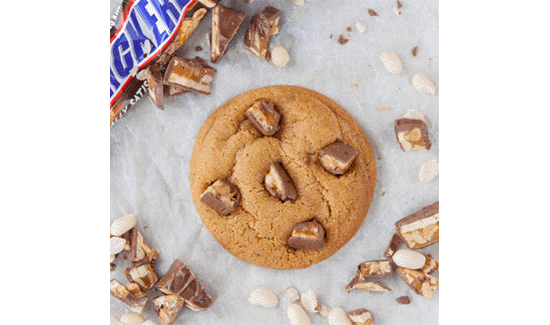
If you haven’t had a snickers bar cookie from Moustache Milk and Cookie bar in Auckland’s CBD, you simply haven’t lived. In the two short years it’s been around this place has become an institution.
Now its owners are facing a proposed 36% rent increase that would likely put them out of business. A petition has been set up to prevent such a tragedy.
Moustache Milk and Cookie Bar in Auckland's CBD was set up by 23-year-old Deanna Yang in 2012.
But two years into a seven-year lease, the shop that sells cookies, milk and coffee faces a 36 per cent rent increase - taking it to $56,080 a year, or $1650 per sq m - which its landlord says is based on market value.
Ms Yang said such an increase would likely lead her to bankruptcy. She has set up a petition on the Change.org website to save the shop, which yesterday had 3256 signatures.
"It basically means we have no choice but to shut our doors. It's seriously just unsustainable to pay that increase in our rent and it seems almost impossible for the market value to have gone up that much in such a short amount of time," she said.
She had seen about five nearby shops shut down within six months and she saw the shop next door being advertised for rent on Trade Me for less than they were proposing to charge her.
6. Fed up ... why the food industry is not your friend
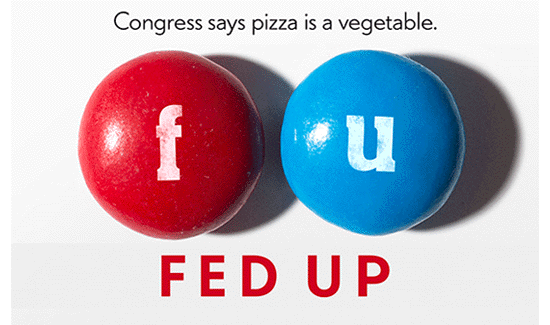
While this movie was released a while ago now, I only saw it recently. After a particularly indulgent binge session my partner suggested we sit down and watch this terrifying documentary which reveals just how much power the food industry in America holds over the government.
I came from a school which had a gold health tick – no soft drink or fried food in our tuck shop. These schools have contracts with pizza hut. This is a must watch of the true horror genre.
A US Government study recently found that 17 per cent of children and young people aged between 2 and 19 are considered obese. Another predicted that today's American children will lead shorter lives than their parents.
Laurie David, who made the climate change film An Inconvenient Truth, calls that statistic "sobering and tragic".
According to Lustig, however, neither obesity nor fat is the issue.
"The food industry wants you to focus on three falsehoods that keep it from facing issues of culpability. One, it's about obesity. Two, a calorie is a calorie. Three, it's about personal responsibility," he said.
"If obesity was the issue, metabolic illnesses that typically show up in the obese would not be showing up at rates found in the normal-weight population.
"More than half the populations of the US and UK are experiencing effects normally associated with obesity. If more than half the population has problems, it can't be a behaviour issue. It must be an exposure problem. And that exposure is to sugar."
7. Can new interim CEO save American Apparel? I kind of hope not
If you’ve never heard of American Apparel, you’re probably not a fourteen year old boy, or you’d have their site saved to your tool bar and their catalogues under your bed.
The label’s founder Dov Charney was ousted three months ago as yet another former employee accused him of sexual harassment.
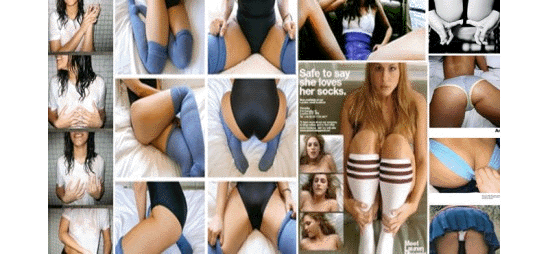
The company has a bad reputation for its exploitative, sexist and plain offensive advertising campaigns.
In June, Mayer led a board coup against Charney that accused him of “willful misconduct,” charging that he failed to prevent an employee from posting nude pictures online of an ex-American Apparel worker who had accused Charney of sex harassment.
In the ensuing melee, the retailer replaced all but two of its board members as part of a deal with New York investment firm Standard General LP.
The New York hedge fund, which partnered with Charney to amass a 44 percent stake, extended the company a $25 million financial lifeline.
Standard General hasn’t taken a side in the dispute over whether Charney should be allowed to return as CEO. A board committee hasn’t yet ruled on the results of its investigation into Charney.
American Apparel has lost about $270 million in the last four years, leaving it with a heavy debt load. In March, it sold $28.6 million in stock to meet an interest payment.
8. How happiness makes us brave ... or stupid
Science is telling us that happier people take more risks. We take bigger risks more frequently in the summer, and in the winter we go into conservative hibernation.
If the All Blacks win, our stock market will likely get a boost and if you guarantee us a higher level of safety we’ll take bigger risks meaning we lose just as much as we always have.
The Cypres eliminated “no-pull” or “low-pull” deaths. These types of accidents are exactly what they sound like — deaths resulting from divers pulling the cord too late or not at all. The Cypres opens the parachute automatically if the diver is seconds away from impact.
Great innovation right? In fact, in 1998, Cypres devices recorded 12 “saves” and there were no low-pull deaths that year. In 1991, before the Cypres penetrated the market, there were 14 deaths. The technology of the Cypres worked to make skydiving safer.
But people were still dying during skydives. And in roughly the same number. What was going on? The divers were trying riskier landings.
With the added safety of the Cypres device, divers started trying to execute more difficult landings to impress their friends. Called a “hook turn,” the diver makes a 90 or 180 degree turn just before landing — and probably dies if he doesn’t get it right. When the Cypres device became standard issue — and the chance of a “no-pull” death plummeted — hook turns became popular.
The reason: risk homeostasis.
“The Cypres device practically eliminated the risks of parachute malfunctions — so skydivers compensated by trying to get themselves killed in other ways,” writes the Agile Lifestyle blog.
You experience this in your own life. If you’re driving down a rainy, winding street, you’ll slow down to stay safe. But if that road opens up into a clear, dry, highway, you’ll probably speed up — yet the chance of getting into an accident is about the same either way.
The takeaway: We all have an appetite for risk. In extreme cases, we’ll risk our lives to keep it sated.

9. For the man/woman who has everything
It seems the more money people have the more desperate they become to spend it on utterly strange and useless things.
When once you had to trawl car boot sales for weird and wonderful things the magic of the internet can now connect weirdo with weird item at the click of the button. Behold weird things sold on eBay.
An entire village in the mountains was put up for sale on the site. However, it was only available on the basis that a new owner would fix-up the derelict buildings in the area.
It was hoped that the sale of would draw attention to the depopulation of mountain areas in Italy and offer the chance for someone to breathe new life into the hamlet.
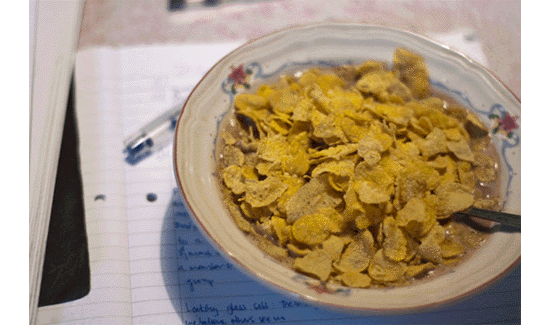
Back in 2008, two sisters from Virginia sold a cornflake in the shape of Illinois on the site. Yes really. The winner was revealed as the owner of a traveling museum who wanted to add the specimen to his collection. It sold for US $1,350.
It transpired that it wasn't the first cornflake that Monty Kerr from Texas had bought either; he'd once bought one described as the largest flake. Unfortunately, by the time it arrived, it had crumbled.
10. Do psychopathic personality traits translate into success?
Has the modern definition of success, and the extreme pressure to achieve it turned us into smooth talking, childish bullies who are only looking out for ourselves?
Are our ethics and our personalities changing in order to achieve a success which rewards our worst qualities and penalises our best?
Solidarity becomes an expensive luxury and makes way for temporary alliances, the main preoccupation always being to extract more profit from the situation than your competition. Social ties with colleagues weaken, as does emotional commitment to the enterprise or organisation.
Bullying used to be confined to schools; now it is a common feature of the workplace. This is a typical symptom of the impotent venting their frustration on the weak – in psychology it’s known as displaced aggression. There is a buried sense of fear, ranging from performance anxiety to a broader social fear of the threatening other.
Constant evaluations at work cause a decline in autonomy and a growing dependence on external, often shifting, norms. This results in what the sociologist Richard Sennett has aptly described as the “infantilisation of the workers”. Adults display childish outbursts of temper and are jealous about trivialities (“She got a new office chair and I didn’t”), tell white lies, resort to deceit, delight in the downfall of others and cherish petty feelings of revenge. This is the consequence of a system that prevents people from thinking independently and that fails to treat employees as adults.
--------------------------------------------------------
* Elizabeth Davies is a regular writer on interest.co.nz.
We welcome your comments below. If you are not already registered, please register to comment
Remember we welcome robust, respectful and insightful debate. We don't welcome abusive or defamatory comments and will de-register those repeatedly making such comments. Our current comment policy is here.