

Here's my edition of Top 10 links from around the Internet today.
We have a Monday-Wednesday-Friday schedule for Top 10. Bernard will be back with his version this Wednesday. We will have another guest posting on Friday.
As always, we welcome your additions in the comments below or via email to david.chaston@interest.co.nz.
See all previous Top 10s here.
1. A $1 trillion roll of the dice
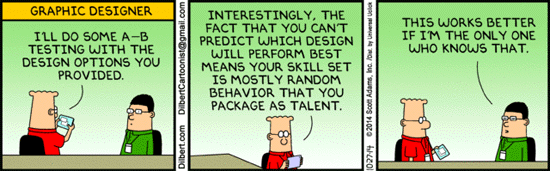
Japan has surprised markets with a major expansion of its money-printing program.
Japan is opting for another round of shock treatment, in a stark admission that the country’s economic revival plan is faltering.
It is now planning to print ¥80 tln per year (about NZ$1 tln).
That is about five times as much as the whole NZ economy.
The decision to do it is not unanimous; the Bank only got the ok to proceed after a 5:4 vote.
Let's hope they can quarantine the implications within their borders.
After insisting for more than a year that its aggressive monetary action was sufficient, the Bank of Japan on Friday unexpectedly announced that it would buy larger quantities of government debt. By injecting more money into the economy, the central bank is trying keep borrowing costs low, encourage spending and, ultimately, stoke inflation and growth.
The bold move helped push stocks higher around the world. The Standard & Poor’s 500-stock index rose 1.1 percent on Friday, and European equities ended the day up more than 2.5 percent.
In Japan, the Nikkei 225-stock index average hit fresh highs, jumping almost 5 percent for the day. The yen fell to its weakest level against the dollar in a month.
The central bank’s stimulus has been the cornerstone of a nearly two-year effort by Shinzo Abe, Japan’s prime minister, to reinvigorate the economy and end the persistent consumer price declines that have weighed on growth since the 1990s. But that plan, collectively known as Abenomics, has shown signs of strain lately, as economic output contracted sharply in the second quarter.
The central bank’s decision to ramp up its bond purchases was contentious. Four out of nine of the policy board members voted against it — a far closer margin than for any other decision by the central bank since Mr. Kuroda took over.
2. 'The end is still nigh'
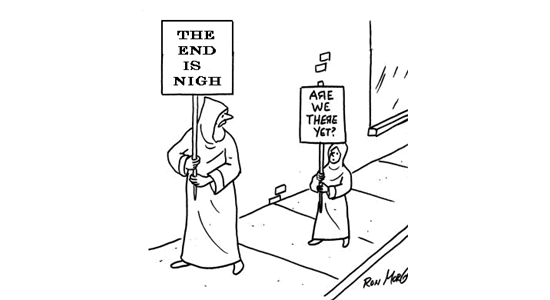
Nouriel Roubini is asking how long the global economy can remain aloft on a single engine.
The global economy is like a jetliner that needs all of its engines operational to take off and steer clear of clouds and storms. Unfortunately, only one of its four engines is functioning properly: the Anglosphere (the United States and its close cousin, the United Kingdom).
The second engine – the eurozone – has now stalled after an anemic post-2008 restart. Indeed, Europe is one shock away from outright deflation and another bout of recession. Likewise, the third engine, Japan, is running out of fuel after a year of fiscal and monetary stimulus. And emerging markets (the fourth engine) are slowing sharply as decade-long global tailwinds – rapid Chinese growth, zero policy rates and quantitative easing by the US Federal Reserve, and a commodity super-cycle – become headwinds.
Seems like a changed tune from an uber-bear who seven years ago wrote off any possibility of a recovery, especially by the US. But he still sees a sticky end ahead:
But serious challenges lie ahead. Private and public debts in advanced economies are still high and rising – and are potentially unsustainable, especially in the eurozone and Japan. Rising inequality is redistributing income to those with a high propensity to save (the rich and corporations), and is exacerbated by capital-intensive, labor-saving technological innovation.
This combination of high debt and rising inequality may be the source of the secular stagnation that is making structural reforms more politically difficult to implement. If anything, the rise of nationalistic, populist, and nativist parties in Europe, North America, and Asia is leading to a backlash against free trade and labor migration, which could further weaken global growth.
Rather than boosting credit to the real economy, unconventional monetary policies have mostly lifted the wealth of the very rich – the main beneficiaries of asset reflation. But now reflation may be creating asset-price bubbles, and the hope that macro-prudential policies will prevent them from bursting is so far just that – a leap of faith.
3. All talk, no action, sliding to irrelevancy
Last week, we linked to an idea about how Europe could get out of its stagnation funk. (See Europe's fiscal wormhole.) But there are those who don't think the EIB idea will fly, and are proposing their own.
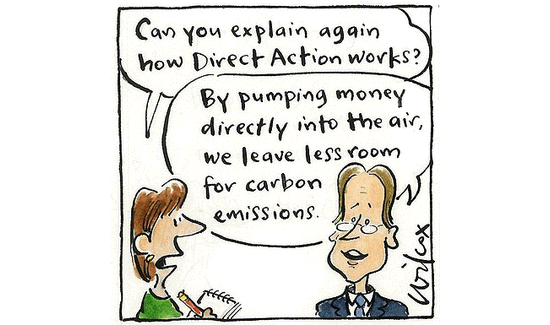
A French official, Jean Pisani-Ferry has proposed a typically French, typically grand three part idea. He says not enough risk is being taken by investors. Essentially, he want the taxpayer start and support big infrastructure projects that don't make commercial sense (not that he states it like that). I doubt the Germans will be keen.
The consequence, however, is that high-risk, high-return projects are more difficult to finance than they should be. If Europe wants to revive its economy and escape stagnation, it needs entrepreneurs to take more risk to innovate. But its financial system is undergoing a transition from a bank-based to a market-based system that involves risk aversion.
This is where the public side – both national governments and the EU – should step in and share some of the risk with private players. They should temporarily behave more like investors who scrutinize projects, contribute funding, and earn returns. Using the EIB and national development banks to this end would help overcome the current impasse.
4. 'It's not hopeless'
The IPCC today released its latest Report on Climate Change today. It may be a politically correct, bureaucratic body wrapped up in 'science', but it is still the best we have. It certainly is a lightning rod. Most politicians don't really listen to it - or only give it lip service - mainly because most voters are sceptical. (Green parties seem to attract about 10% support worldwide, a level they have been at or above for decades.) And then there's this ...
But that does not make the issue wrong, it is just the IPCC is a hopeless communicator. A bit like the UN generally.
Given the rest of the world looks like it won't respond properly, we are going to be in for some new changes in our climate. That means we must accept adaption. Going back to 'the old ways' is no solution (Green Party note). New Zealand can't change the world, but it can adapt.
It might be time to listen to the insurance industry. They can't change the world either or lessen the risks from climate change. But they can (and will) price the risks of the impending changes.
Or they might not price them at all - by removing cover all together.
Best to think about these risks seriously now. And that especially includes local and central Government.
This is from the English Telegraph:
The world is on course to experience “severe and pervasive” negative impacts from climate change unless it takes rapid action to slash its greenhouse gas emissions, a major UN report is expected to warn on Sunday.
Flooding, dangerous heatwaves, ill health and violent conflicts are among the likely risks if temperatures exceed 2C above pre-industrial levels, the report from the Intergovernmental Panel on Climate Change will say.
Yet on current trends, continued burning of fossil fuels could see temperature increases of between 3.7C and 4.8C by the end of the century, the report warns, according to a draft seen by the Telegraph.
Warming beyond 4C would likely result in “substantial species extinction, large risks to global and regional food security, impacts on normal human activities”.
Rajendra Pachauri, chairman of the UN IPCC, opened the Copenhagen summit by acknowledging the “seeming hopelessness of addressing climate change” but imploring policymakers to “avoid being overcome” by it.
"It is not hopeless," he said, calling on governments to make decisions “informed by the science".
Richard Black, director of the Energy & Climate Intelligence Unit, said the key question for those finalising the IPCC report was “what to say about the elephant in the room… that if the computer model projections are right, keeping global warming below 2C basically means ending fossil fuel use well before today’s children start drawing their pensions”.
5. No stress here
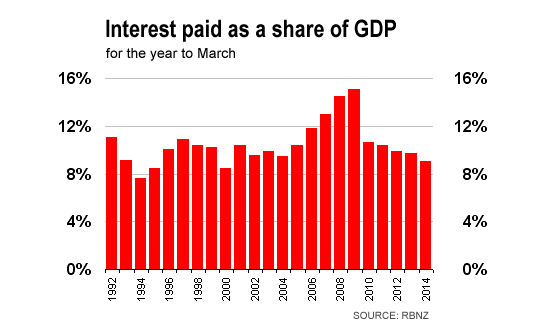
AndrewJ posted a comment over the weekend: "Some 32 per cent of new credit these days is used simply to pay off the interest on existing debts." It turns out he was quoting an FT story about China. Got me wondering how New Zealand fares on that metric, which is what the chart below shows.
But as usual with these types of eye-catching headlines, the FT only looks at the 'costs'; the interest income is there as well which effectively offsets the costs. In New Zealand's case, 2014 is the lowest level of drag from debt servicing interest in 14 years and the third lowest in 23 years. I would expect the March year to 2015 to be lower, even if our economy keeps growing at a slower rate to recently.
Offsetting the 2014 nine per cent cost of interest-to-GDP is the interest income the economy earns, which is 5.2% of GDP, making a net load of 'only' 3.8% of GDP. To be fair to the China data, I suspect their data needs the perspective of the income side as well.
6. Our turn soon?
The Americans are getting petrol prices that are at a four year low. US$3/gallon is equivalent to NZ$1.02/litre. Don't forget that 96 NZc of our price is in taxes (excise, and other stuff like ACC and GST).
This is from the CSMonitor:
US average gas prices dipped below $3 a gallon for the first time in nearly four years Saturday, according to automotive group AAA, and signs suggest prices could drop further. At $2.995 a gallon, Saturday's national gas prices average was just a hair below the $3 threshold, breaking a 1,409-day streak of prices above $3.
Prices at the pump have been falling consistently for most of a year, driven by a dramatic 25 percent drop in crude oil prices over the last 5 months. Oil prices are plummeting for a slew of reasons, ranging from cartel manipulation to a strong US dollar. But at its root, the falling price of crude – which determines the price of gasoline – is about supply and demand.
“In very broad terms, global production has outpaced consumer demand,” says Gregg Laskoski, senior petroleum analyst at GasBuddy.com, a website that tracks gas prices nationwide. “And that’s not just in the US; it’s in Europe and emerging markets, too.”
7. Personal income tax comparisons
Assuming an exchange rate of NZ$1 = AU$0.90 (which is what it is about today), here are the New Zealand and Australian income tax rates compared.
| Taxable income band | Australia | New Zealand |
| (in NZ dollars) | rate of tax | rate of tax |
| 0 - 14,000 | 0% | 10.5% |
| 14,001 - 20,200 | 0% | 17.5% |
| 20,201 - 41,100 | 19.0% | 17.5% |
| 41,101 - 48,000 | 32.5% | 17.5% |
| 48,001 - 70,000 | 32.5% | 30.0% |
| 70,001 - 88,900 | 32.5% | 33.0% |
| 88,901 - 200,000 | 37.0% | 33.0% |
| 200,001 + | 45.0% | 33.0% |
There is more to working out what tax you will pay in each country than just the tax rates and income bands and we have a calculator here that can help. But this comparison is revealing none-the-less.
8. The power to set our own tax policy
The German finance minister wants the our tax system to be part of a global system. While business no longer knows any borders, taxation has remained stuck in the era of the nation-state. The resulting tensions between fiscal sovereignty and globalisation can be resolved only through international standards and regulation, he says.
But are we really ready for some far away, non-elected body to set something as individual as our tax rates? Bill English might like the idea (along with you and me) of having multinational companies paying their 'fair share' here, but the rules that establish those shares won't have any meaningful element relating to what New Zealand wants or needs. And they are likely to undermine what we think is 'fair'. Just look at the table above - maybe you could see how to 'harmonise' the rates between NZ and Australia, but the chances are strong that Australia would dominate any negotiation. Now what would happen if you added in Europe to that mix? It would be a mess if Hr Schauble and co were involved.
Still, at a superficial level, he sounds sensible. And NZ has signed up to the recent OECD framework.
The agreement is based on the Common Reporting Standard, which was developed by the OECD. Under the CRS, tax authorities receive information from banks and other financial service providers and automatically share it with tax authorities in other countries. In the future, virtually all of the information connected to a bank account will be reported to the tax authorities of the account holder’s country, including the account holder’s name, balance, interest and dividend income, and capital gains.
Various measures are in place to ensure that banks can identify the beneficial owner and notify the relevant tax authorities accordingly. The CRS thus expands the scope of global, cross-border cooperation among national tax authorities. In this way, we can establish a regulatory framework for the age of globalization.
A “beggar-thy-neighbor” taxation policy, by which one country pursues tax policies at the expense of others, is just as dangerous as beggar-thy-neighbor monetary policies based on competitive currency devaluation. It leads to misallocations – and will ultimately reduce prosperity around the world.
Sounds good, but it won't be a big step to giving up the power to set tax rates. And the pressure from the big players will be enormous
9. An unexpected drop
The crackdown on fraud and corruption can result in some harsh penalties (including death) for those caught. For those who are not caught, they are avoiding the Chinese banking system, and that could have a harsh penalty for China itself.
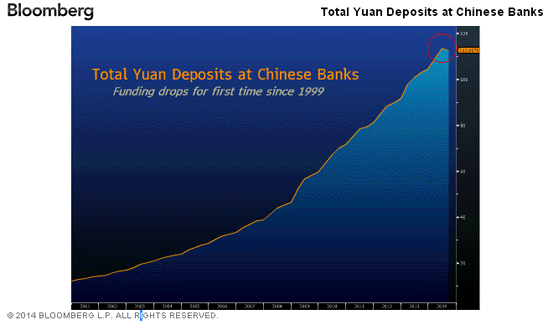
Chinese bank deposits have actually fallen following a crackdown on lenders manipulating their numbers and illegal means of attracting money. All up, that threatens to weigh on Chinese credit growth and may be holding back their economy. Bloomberg reports:
The lower deposit levels are likely to curtail credit as banks are prohibited from lending more than 75 percent of their quarter-end holdings, while a sustained drop could hamper government efforts to rejuvenate an economy forecast to expand this year at the weakest pace since 1990. The lenders may also come under pressure to tap more expensive financing.
"Low deposit growth is an accurate indicator of the state of free cash flow for consumers and businesses alike," Jim Antos, a Hong Kong-based analyst at Mizuho Securities Asia Ltd., said in a note. "The situation looks negative."
10. Shallow money trench
"The music business is a cruel and shallow money trench, a long plastic hallway where thieves and pimps run free, and good men die like dogs. There's also a negative side." - Hunter S. Thompson


We welcome your comments below. If you are not already registered, please register to comment
Remember we welcome robust, respectful and insightful debate. We don't welcome abusive or defamatory comments and will de-register those repeatedly making such comments. Our current comment policy is here.