
By Bernard Hickey
This week's Budget came and went without too much drama or debate about the central assumption around which everything else revolved.
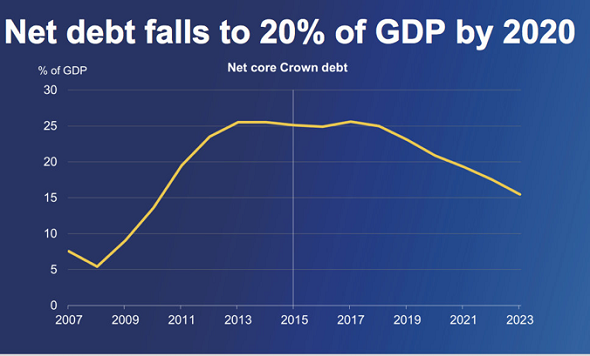
Finance Minister Bill English's guiding light for years has been the aim of reducing net debt to around 20% of GDP by 2020 from a peak of 25.6% next year. It forced him to cut back his new spending allowance next year from NZ$2.5 billion to NZ$1.5 billion. It also forced him to cut the Government's capital spending allowance this year to NZ$1.4 billion from NZ$1.7 billion as recently as December.
This focus on debt repayment limited the Government's options this year and looks set to do the same for two or three years to come. That means less potential for the sort of infrastructure investment that Auckland in particular and New Zealand in general needs to cope with the biggest migration shock in over 100 years and record high tourism. It also restrains the Government's ability to pursue its social investment strategy of investing heavily upfront to turn around the lives of vulnerable kids before they are locked in to generations of misery.
Instead, this Budget limited itself to doing the absolute necessities of fiscal life, which meant spending money reactively on health and education to cope with population growth, and the utterly necessary business of rebuilding Child, Youth and Family. The Government had virtually nothing to say or do in the Budget about dealing with the core problem at the heart of the economy, the government's finances, the financial system's stability and many of the nation's social woes -- Auckland's housing infrastructure shortage.
The Auckland Council made it perfectly clear last week that it could not pay for the NZ$17 billion of roading, water and other infrastructure needed to build all the extra houses around and inside Auckland that the Government is assuming and demanding be built. Ratepayers don't want to take on the extra debt to pay for it and the central Government's own rules about local government debt issuance are blocking the Council from borrowing the funds it needs to pay for this infrastructure.
Auckland's housing supply outlook, which remains woefully inadequate, is therefore stuck in an endless loop of claim, counter-claim and then nothing being done. The Government blames the Council for not allowing Auckland to build out and up. The Council blames the Government for not funding the infrastructure to build out and up. Meanwhile, the infrastructure is not being built and Aucklanders face rent inflation seven times faster than inflation, house prices nearing 10 times incomes and endless hours in traffic jams on an over-whelmed transport network.
Auckland and the economy needs a circuit breaker of debt-funded infrastructure investment and the only player big enough and financially strong enough to do it is the Government. Ultimately, it also has the most to lose if Auckland's housing crisis spirals further out of control. The Government faces a blow-out in rent subsidies and will have to pay for the longer term social effects of a generation growing up in garages and cars and being shunted through endless schools and foster homes and prisons.
Why won't the Government just borrow the money to break the Auckland log-jam?
The Government's concentration on debt repayment is having real world effects at a time when the real measure of investor concerns about debt, interest rates, are near record lows of about 2.7%. Bill English is worried that somehow international investors will lose faith in us if we have to borrow heavily again to deal with another Global Financial Crisis for earthquake.
There are no indications of that in what our credit ratings agencies say and English himself regularly trumpets New Zealand's falling net foreign debt and how Treasury's repeated warnings about a worsening current account deficit have been just plain wrong.
The Government's own forecasts show net debt will track down to 15% of GDP by 2023 and that solid economic growth and the effects of fiscal drag will keep GDP growing faster than debt. Instead, the Government said this week it will go out of its way to repay NZ$9.2 billion in the three years to 2020.
This seems perverse at a time when fund managers and international investors are screaming out for more Government bonds to invest in, not less.
The Government should stop jumping at debt shadows and just start using that money to show us the infrastructure.
We welcome your comments below. If you are not already registered, please register to comment
Remember we welcome robust, respectful and insightful debate. We don't welcome abusive or defamatory comments and will de-register those repeatedly making such comments. Our current comment policy is here.