

Today's Top 10 is a guest post from Martien Lubberink, an Associate Professor in the School of Accounting and Commercial Law at Victoria University. He previously worked for the central bank of the Netherlands where he contributed to the development of new regulatory capital standards and regulatory capital disclosure standards for banks worldwide and for banks in Europe (Basel III and CRD IV respectively).
As always, we welcome your additions in the comments below or via email to david.chaston@interest.co.nz.
And if you're interested in contributing the occasional Top 10 yourself, contact gareth.vaughan@interest.co.nz.
See all previous Top 10s here.
The cost of bad behaviour
1) Bad apples and groups.
I once was part of a team with this odd colleague. He had a strong belief in what we now call alternative facts, said “yes” but he did “no”, kept important information to himself, and thought and acted as if he was acting team leader. When he spoke, he used all sixty minutes of his allotted five.
It was a pain, especially sitting through team meetings. We did not want to be lectured about the flat world around us. Unfortunately, our real team leader did not know how to deal with this ‘bad apple’ – Instead, our manager left. Actually, all of us left. It was so bad that our team’s annual budget for farewell functions was fully exhausted by October(!) But the ‘bad apple’ stayed – no surprise.

2) Slackers, downers, jerks.
Professor Will Felpps of UNSW has published on ‘bad apples’ and groups. There is this funny section of the U.S. radio show This American Life where Will explains one of his studies: He ran an experiment with groups of students where he assigned an actor to each group. Unknown to the other students, the actor played the role of a slacker, a downer, and a jerk. Felpps’ study shows that having just one slacker or jerk in a group can bring down performance by 30% to 40%. One single person can take down an entire group.
If your group has a bad apple problem, then it is worthwhile listening to the first 13 minutes of this This American Life section, because it has this remarkable discovery around minute 11 of the show. Felpps reveals a surprising way to cure a group from a bad apple problem.
3) Why bad behaviour, and why won’t it stop?
It often amazes me to see how difficult people find it to recognise bad behaviour as such and then fail to take appropriate action. It also amazes me to see the efforts people make to over-analyse obvious badness - often to the point that no corrective action can be taken because relevant evidence has evaporated or got snowed under by irrelevant facts. Paralysis by analysis is often real.
4) Recognising badness, then what?
The first attack on the World Trade centre happened in 1993: a truck bomb exploded in the basement of one of the twin towers. With the benefit of hindsight, this attack did not attract the attention that it deserved. However, one person who realised the significance of the 1993 attack was Rick Rescorla, a former military man who became director of security for Dean Witter-Morgan Stanley in 1997. He had predicted the 1993 attack. He also expected that a next attack could involve a plane crashing into one of the towers.

Dissatisfied with normal emergency procedures, Risk started a three-monthly emergency evacuation drill that ultimately led him to save the lives of 2,687 employees who worked in the North tower on 9/11. Rescorla insisted that all Morgan Stanley employees participated in the emergency evacuation drill. This led to conflict with his superiors who did not want to waste valuable time. He also ignored instructions from the Port Authority of New York to remain seated after the second plane hit the north tower.
The story of Rick Rescorla shows how important it is to recognise bad behaviour as such and act decisively. And if you wonder why you worked off-site because of the Kaikoura earthquake, maybe it is because your firm lacks a person like Rick Rescorla.
5) Method acting – or just doing your homework.
But doing what Rick did is easier said than done. Many people are just clueless. They are inexperienced, lack the relevant knowledge to identify bad behaviour, or they rely on wrong information. Rick Rescorla did not suffer from any of these imperfections. He had was an experienced military man. He served in the British and the U.S. armies and was sent to Vietnam.
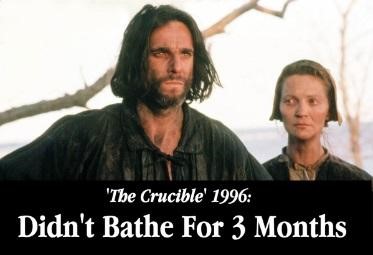
Following the 1993 twin towers attack, Rick grew a beard and attended morning prayers at Mosques. He spoke fluent Arabic to infiltrate in the Muslim community.
Agreed, method acting is over the top for most jobs, but there is nothing wrong in doing proper homework and using your intelligence to help your colleagues. A problem, however is facts.
6) The problem with facts.
The Financial Times this week offered a long-read that shows the efforts large companies make to confuse us. In The problem with facts, Tim Harford shows the strategies that Big Tobacco pursued to deliberately produce tobacco ignorance. For example, the dangers of smoking were scientifically documented in the nineteen-fifties. But thanks to cunning strategies of Big Tobacco, it took decades before effective measures against smoking were taken.
“The tobacco industry was the leading funder of research into genetics, viruses, immunology, air pollution,”… . Almost anything, in short, except tobacco. “It was a massive ‘distraction research’ project.”
The same applies to climate change. Big Oil companies realised that carbon emissions would make our planet warmer. In 1991 Shell Royal Dutch knew that our climate was changing at a ‘faster rate than at any time since end of ice age’. The company even produced a film - Climate of Concern - about climate change. But the film was left unseen. Uh oh!
Oil giant Exxon learned about climate change in 1981, but, according to the Guardian Exxon funded climate change deniers for many decades.
7) It takes a village.
A similar story applies to bank capital. There is ample evidence of the benefits of high bank capital ratios. See this recent speech by Claudio Borio. He shows that more bank capital is better for all of us. Borio makes it perfectly clear that “capital is the foundation of all lending.” More capital leads banks to lend more and create more liquidity. It puts banks in a stronger position competitively, and it enables them to survive a financial crisis. This all leads to higher bank valuations.
So why then do banks dislike capital? Professor Anat Admati, in It Takes a Village to Maintain a Dangerous Financial System, examines why many of us persistently contribute to a financial system that is inherently dangerous. She puts is it down to willful blindness. “The underlying problem is a powerful mix of distorted incentives, ignorance, confusion, and lack of accountability. Willful blindness seems to play a role in flawed claims by the system’s enablers that obscure reality and muddle the policy debate.”

So, if you want to know why some central banks claim that they did not see the Global Financial Crisis coming, then it is likely because there is this large village that turns a blind eye to big and important problems.
8) Willful blindness at the Spanish central bank.
In the same week that I taught about bank governance, news broke that current and former leaders of the central bank of Spain (Banco de España), including former governor Miguel Ángel Fernández Ordóñez, had been charged over the Bankia banking scandal.

Bankia is a large amalgamation of failed banks that floated on the stock market in 2010. Shortly after floatation, its share price collapsed. Spanish taxpayers had to rescue the bank, many retail investors lost their money.
Mergers almost always fail. The AOL -Time Warner merger failed in a spectacular way. Knowing that mergers tend to fail then begs the question: Who at the Banco de España would have thought that merging seven failed banks into one would work?
Insiders knew about the problems, that is for sure. Just look at what some of the internal emails revealed: “This is not working, it’s getting worse. … Bankia’s capacity to generate resources is deteriorating.” Bankia is a “money-losing machine”; Bankia had “very severe and growing problems of profitability, liquidity and solvency”. Bankia was “unviable”.
Which makes me wonder, what do about other prudential supervisors, are they well governed?
9) Blinded by a lack of experience?
I applied for a position at the central bank of the Netherlands in March 2008. It was the week that Bear Stearns was bailed out. At that time I lived and worked in the U.S. During the job interview, I asked my to-be managers to respond to Bear’s failure: would this, and other bank problems, affect Europe as well? I don’t remember the answer, but when I started my work at the central bank in July 2008, I noticed the naiveté of the Dutch. Where I had noticed UK’s Northern Rock and foreclosures in the U.S., the Dutch seemed oblivious. Only when Lehman Brothers fell, we all started realising there was something seriously wrong. It then took until April 2009, more than a year after my application, before bank regulators started to redraft bank rules and promised to:
“take action, once recovery is assured, to improve the quality, quantity, and international consistency of capital in the banking system. In future, regulation must prevent excessive leverage and require buffers of resources to be built up in good times;” (G20 London Summit – Leaders’ Statement).
What may have contributed to this delayed response is the accounting and bank regulation itself. Two import new sets of rules were introduced shortly before the crisis: IFRS and Basel II. Until the onset of the crisis, IFRS allowed banks to recognise gains with greater ease than old-style accounting. No supervisor had dealt with the rules in adverse economic conditions. Note that the Dow Jones stood at 14,000 in November 2007. In addition, Basel II may have allowed banks to estimate risks based on data that was free of crises.
It took a while for supervisors to figure out how to deal with the new rules in a crisis, when correlations increase and valuations drop. Supervisors may have just been clueless: they had two new measurement instruments, but lacked the experience to read them.

At one point during the crisis, the International Accounting Standards Board even reversed some of the IFRS fair value accounting rules, because banks and regulators were more comfortable with the old rules.
The new rules / measurement tools were weird too. There was a rule that required banks to add back to capital any fair value losses on assets that were held for sale. Such rules do not inspire trust in bank supervisors, who apparently lulled themselves into a false sense of security - thinking that banks were still well capitalised. They weren’t.
10) Bank governance is special.
Poor bank governance also contributed to the Global Financial Crisis. Checks and balances in the banking sectors were apparently ineffective, pay was excessive, accountability had taken a holiday. The Basel Committee responded to this by issuing Corporate governance principles for banks. These principles, however, do not necessarily reflect state of the art knowledge.
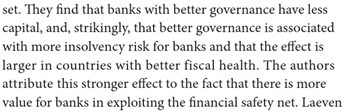
Professor René Stulz in this paper documents some interesting misconceptions about bank governance. Some of them conflict with the Basel governance principles. Professor Stulz critically evaluated the applicability to banks of traditional governance ideas. His article highlights studies that examine governance, where ‘governance’ refers to traditional ideas of governance that work for non-banks:
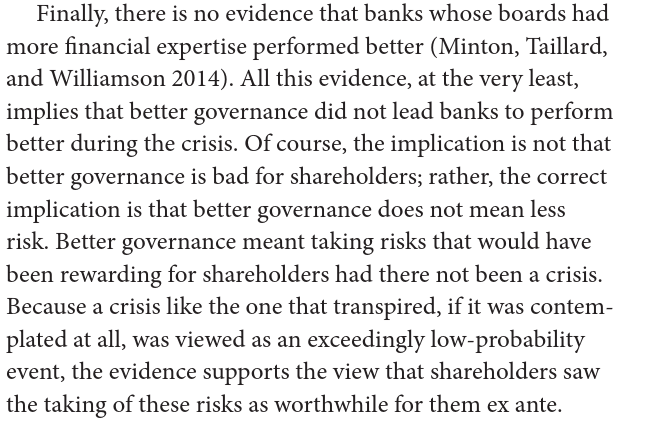
And where the Basel governance principles highlight the importance of board qualifications, Stulz shows this remarkable result:
We welcome your comments below. If you are not already registered, please register to comment
Remember we welcome robust, respectful and insightful debate. We don't welcome abusive or defamatory comments and will de-register those repeatedly making such comments. Our current comment policy is here.