
By Siah Hwee Ang*
The One Belt One Road Initiative spearheaded by China is starting to draw attention in New Zealand.
In part, this has been triggered by New Zealand signing the Memorandum of Understanding with China to work on ways to cooperate in the initiative, known as “OBOR” here and “BRI” in China.
Clearly, the signing of the MOU means that New Zealand needs to deepen its understanding of the OBOR.
So, how much do we know about OBOR?
Question: What does “One Belt” and “One Road” refer to?
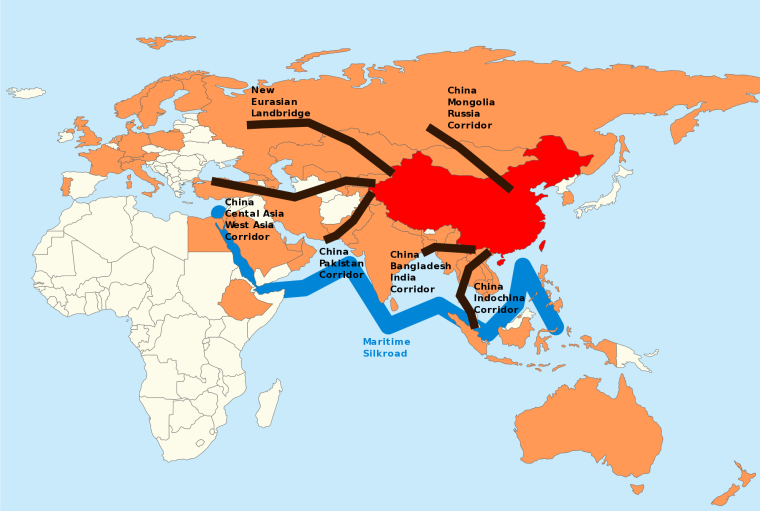
Answer: The Belt refers to the Silk Road Economic Belt that stretches across Central China, West Asia, the Middle East and all the way to Western Europe. The Road refers to the 21st Century Maritime Silk Road that links China’s eastern coast to Southeast Asia, then passes the southernmost tip of India and East Africa, before making its way to the Persian Gulf and the Red Sea.
Question: When was the OBOR proposed?
Answer: The Silk Road Economic Belt was proposed in September 2013 while the 21st Century Maritime Silk Road was proposed in October 2013.
Question: What are the goals of the OBOR?
Answer: The five major goals of the Belt and Road initiative are: policy co-ordination, facilities connectivity, unimpeded trade, financial integration, and people-to-people bonds.
When it was introduced, the OBOR was basically a white piece of paper with ‘an invitation to play’.
Despite initiating the OBOR, China has consciously avoided giving the impression that it is taking a leading role.
A China-led consortium would not have been able to get enough traction in an international arena that still feels uneasy about the Asian country’s rise to the global economic scene.
At the same time, the non-contractual approach is one that confuses most of the world, not just the more advanced economies.
So, the pick-up has been slow initially.
It is estimated that countries along the Belt and Road will create an ‘economic cooperation area’, accounting for 64.2% of the world’s population, 37.3% of global GDP, and 31.4% of household consumption.
The number of countries involved in OBOR has since risen from the initial set of around 60 countries. Projects with a combined worth of more than US$ 1 trillion have been earmarked for the initiative.
The Silk Road Fund, the Asian Infrastructure Investment Bank, and the BRICS New Development Bank are new funding mechanisms that were set up to support investments along the OBOR.
Developments have been going well along the Silk Road Economic Belt since 2014. There is now more trade between China and central Asia along the One Belt.
Early scepticism around the OBOR’s functions in the Southeast Asian region have resulted in the nations being slow to pick up on the One Road.
But there are signs of Southeast Asia nations working more closely with China to mutually benefit from the OBOR.
To make the One Road work, China will have to gain the trust of its Southeast Asian collaborators.
Major construction projects to build ports in Pakistan, Sri Lanka, Kazakhstan, Cambodia and Indonesia, as well as railway constructions linking China to Laos, Thailand, Myanmar and Tajikistan have been underway for the last couple of years.
In order for it all to make sense, two aspects of OBOR need to be made clear.
First: trade does not happen in space.
We are often too narrowly focused on trade numbers and lose sights of logistics, a necessary condition for trade.
Bad logistics can become a hindrance to trade.
In fact, the logistics world has not been doing too well, in particular with shipping.
It is infrastructural development that will enhance the logistics that OBOR seeks to contribute to.
This leads to the second point.
OBOR is not just about infrastructure. Its goals are broader than infrastructure. It is about connectivity in policies, facilities, trade, finance and people.
Any aspect of enabling these can be classified as a OBOR activity.
OBOR is ambitious.
It is not a myth, not is it unachievable. Indeed, in many ways a lot of companies are flourishing in the business of connecting, while others seek better connectivity for access to markets.
OBOR brings all of this, on a wider scale.
*Professor Siah Hwee Ang holds the BNZ Chair in Business in Asia at Victoria University. He writes a regular column here focused on understanding the challenges and opportunities for New Zealand in our trade with Asia. You can contact him here.
We welcome your comments below. If you are not already registered, please register to comment
Remember we welcome robust, respectful and insightful debate. We don't welcome abusive or defamatory comments and will de-register those repeatedly making such comments. Our current comment policy is here.