
Today's Top 10 is a guest post from Ben Davies, Sophie Hale, Kate Preston, and Dom White, research analysts at the Motu public policy and research institute.
As always, we welcome your additions in the comments below or via email to david.chaston@interest.co.nz.
And if you're interested in contributing the occasional Top 10 yourself, contact gareth.vaughan@interest.co.nz.
See all previous Top 10s here.
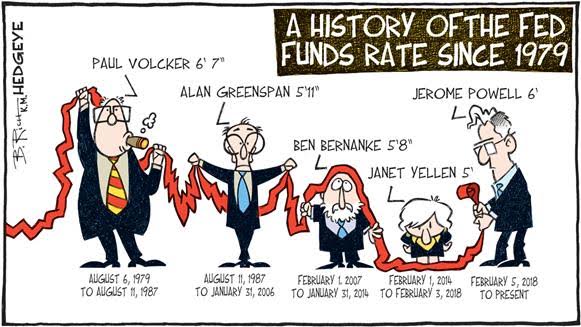
(Cartoon above from hedgeye).
1. FiveThirtyEight let their readers practice international trade. They started a bunch of trade wars.
Earlier this year, President Trump claimed that “trade wars are good, and easy to win.” The team at FiveThirtyEight tested that proposition by pitting their readers against each other in a series of simulated trading games. The results contradict the presidential advice: 58% of the time, trade war winners were worse off than they would have been under free trade. Moreover, readers became less cooperative and more retaliatory over successive iterations, epitomising the fragility of trade agreements in the modern era.
2. What makes a country good at football?

The World Cup this year was full of surprises, new technologies, and a familiar winner in France. Some countries, like France, seem to have continued success on the world stage and some do not. To investigate this, the Economist built a statistical model to try and discover the underlying sporting and economic factors that determine a country's footballing potential. The main variables incorporated into the model include: how poor a country is, the passion for football within the country, home advantage, and strength of opposition.
From this they developed a measure, using goal difference, to see which countries have over or under performed on the world stage. The issue they found was that these factors only explain 40% of the variation in goal difference between countries. Therefore, the success of a national team appears to be largely out of the control of football administrators. Nonetheless, the article provides four areas where administrators can help their cause.
The first is to encourage children to develop their football skills creatively. The second is to stop talented teenagers from falling through the cracks and develop a more robust scouting network. The third is to make the most of footballs’ vast global network. The last is for countries to prepare properly for each tournament. By improving on these areas, a country can apparently improve the quality of their national side but as with the randomness of football, it does not guarantee success.
Researchers examined over 120 years of historical data and found that these traits are no longer increasing, despite further continuous nutritional, medical, and scientific progress. This plateau is demonstrated for example in sports records and in highest life expectancy, where more people are reaching these limits, but little or none exceeding them. The authors highlight the damaging effects on human health of anthropogenically-driven environmental constraints. They suggest this may push up the costs (in both energy and investment) necessary to maintain performance levels in the future.
4. A new study should be the final nail for open plan offices.

The appeal of an open office plan has grown in recent times due to the expected increase in collaboration and teamwork. But a recent study has shown that this collaboration comes with its costs. Distraction to workers can reduce a worker’s ability to concentrate and their productivity.
There is also evidence that increased crowding and low levels of privacy can place strain on workplace relationships.
These issues can be reduced by planning out the collaborative space effectively. This includes improving the visual appeal of the office through: the layout, the availability of natural light, and views of nature. While employers are following the open plan trend, they need to be aware that they are trading privacy and productivity for collaboration.
Researchers in the UK conducted a qualitative analysis of participants opting to stand in normally-seated meetings, and found that many experienced psychological discomfort, with standing perceived as a violation of social norms, an appropriation of power or a misperceived challenging of authority. They encourage office managers to explicitly promote the acceptability of standing in the workplace as a health promotion strategy if it is to benefit wider workplace wellbeing.
6. Derek Zoolander, spherical cows, the Guardian, and econophysics.
Economists routinely endure criticism for using simple models to understand complex phenomena, with the usual charges being that we have “physics envy” or that our assumptions are “empirically false”. Such criticisms ignore the abstractive power of economic models, which this post by Chris Auld at Canada’s University of Victoria explains, along with the supposed distinction between economists and “Real Scientists.”
7. The Long-run Effects of Teacher Collective Bargaining.

It is not well understood how teacher collective bargaining can affect student outcomes. Many of the law changes in the US that would enable researchers to study this concept predated the collection of data on student performance that was linkable to the student’s school district. But this study looks at labour-market and educational outcomes in 35-49-year-olds that were at school around the time of the law changes.
The effect of duty-to-bargain laws, which are associated with increased teacher collective bargaining, are shown to have a negative impact on the outcomes of males. A decomposition by race shows that this effect is concentrated among African-Americans.
8. The trade-off between graduate student research and teaching: A myth?
Many graduate programmes are structured with the belief that teaching effort and research success are inversely correlated. These researchers found that graduate students were not hindered by training; in fact, investing in the training of graduate students did not reduce publication numbers or science communication skills, and may increase the students' preparedness for a research career.
9. From data to viz.

From Data to Viz purports to lead you to the most appropriate graph for your data. It links to the code that will allow you to build it and lists common caveats. This particular website has provided much discussion about how new methods for presenting data can be useful. It is especially relevant as we continue a conversation about whether the academic paper is a dying format.
10. And finally...
A joke from the very funny @KarlreMarks
So an economist walks into a bar. It's hard to tell what the punchline is without more data.
13 Comments
#4 I suspect the primary driver for Open Plan offices is cost. they are much cheaper up front than the traditional office spaces, and that cost is easily accounted for and quantified. There is the additional possibility that those who are imposing the open plan on staff are not impacted by it because they have their own offices, and thus have an "I'm all right Jack" attitude, expecting staff to just do as they are told.
When trying to concentrate on the task in hand, I would often get a fright when someone came to see me. So I attempted to counter that by putting a mirror next to my computer. That's how crazy open plan is.
But my reasoning was: if the bosses don't want productivity, that's their prerogative. I never stayed late. And would always go out for a walk at every smoko and lunch time.
I would often get a fright when someone came to see me. So I attempted to counter that by putting a mirror next to my computer.
Did you get a fright because you were browsing Interest.co.nz?
No you cannot surf the internet in an open plan office.
It’s common in our open plan office for people to surf the internet.
When I need to be highly productive on a task that requires concentration I work from home. For meetings and all the rest, I work in our open plan office.
Works out okay for me, but yeah, would imagine there's definitely an effect on productivity across most offices.
Number 6 is a piece of hokum.
Economists are taught (?) that at a certain price-point, a substitute will always be found, no?
And that growth forever is possible, no?
And that environmental impacts - be they depletion, acidification, Climat Change, soil degradation - are externalities, no?
And they use GDP as a measure, no?
Sorry, but that's hell-and-gone from physics and the laws of thermodynamics.
But the piece points to a bigger malaise in academia - the lack of appropriately-proportioned meshing of the results of single-discipline research. The best at this were Jay Forrester's mob at MIT, a current champion is George Mobus http://questioneverything.typepad.com/. We are well overdue in introducing this at major universities - it would have avoided the bewildered event that Victoria put on called 'Valuing Nature'. http://www.eventdynamics.co.nz/portfolio/case-study-2/ Of course, you can't. As we're rapidly finding out.
What you are essentially talking about is them being captured by "conventional wisdom" where the accepted standard of knowledge is often driven by personalities and not the evidence or even common sense. This is well illustrated in the film depicting Stephen Hawkings life, in one of his first lectures/presentations where he proposed a theory and the senior Faculty were in the process of rubbishing it when a Russian scientist stepped in a called him brilliant. The senior faculty walked out in a huff. Makes you wonder what would have happened if the Russian hadn't been there? And what other areas of commonly accepted knowledge are based on personality rather than researched data?
According to Kuhn, all. Conventional wisdom in that Kuhnian sense is just the current paradigm we are operating under. As it begins to be challenged/break down we enter a paradigm shift.
It happens all the time in science - and models get tweeked and changed to incorporate the new knowledge bit by bit - until we end up with a new paradigm (i.e., conventional wisdom) - then rinse and repeat.
I think you missed the author's major premise - that being that "false assumptions" are used in all scientific modeling, regardless of discipline. So in stating your list of questions above to him, I assume the author would likely agree that, yes, some of these assumptions, or matters taught within the economics discipline, may be falsifiable (in the Popperian sense) but that doesn't mean that they have no utility/usefulness in progressing our knowledge and thus, guiding our social choices.
That said, I didn't find the article itself very interesting/useful but I think that was the author's overall point/meaning.
1: No, economists are not taught that.
2: No, economists are not taught that.
3: Yes, but that does not mean economists think these problems don't matter. It means that they recognise that these problems will not be dealt with even in a perfectly functioning market, let alone a realistic one, and therefore that they need to be dealt with by other means.
4: Yes, they use GDP as a measure. Why not? It is a measure. It measures some things. It doesn't measure other things. I presume you don't use the temperature to assess how tall a building is, but that doesn't mean that temperature has no value as a measure.
Now we're getting somewhere.
So you acknowledge that ultimate, no-replacement scarcity can happen. By implication, it that increasingly scarce resource is essential to your 'economy', then you acknowledge that your 'economy' can be a temporary construct.
Growth not permanent? Assuming you're not weaseling and saying it's a bit up and a bit down, if growth is not a permanent state then default logic says it will cease. But that means that bets on tomorrow being bigger, would not be backed. That's shares, mortgage-repayments, pension funds - all bets on growth in the future. That's what I've been saying.....
And a better analogy for GDP would be measuring both the temperature and the height of the building to extreme levels of accuracy, while failing to ascertain whether it had a foundation.
I think along the lines of this fellow - https://dothemath.ucsd.edu/2011/07/can-economic-growth-last
And this lady puts it well too: https://www.theautomaticearth.com/2017/05/the-automatic-earth-primer-gu…
And here's an example of an in-depth study of height and temperature, minus foundation:: https://www.rbnz.govt.nz/-/media/ReserveBank/Files/.../2000mar63-1conwa…
And number 3 skates all round the elephant in the room - population. Good read, but.
We welcome your comments below. If you are not already registered, please register to comment
Remember we welcome robust, respectful and insightful debate. We don't welcome abusive or defamatory comments and will de-register those repeatedly making such comments. Our current comment policy is here.