

Credit cards are a modern convenience that looks ubiquitous.
You need them for paywave transactions, and when loaded to your mobile phone wallet, they become enticingly easy to use. They, along with other cards like debit cards, have transformed how we shop, from the weekly supermarket run to on-line buying and subscriptions.
Behind all this are two vast payment networks who harvest fees in a uniquely tax-free way, the very definition of bad corporate citizens. They advertise a lot to mask the toll they take on economies and the continuous payments activities.
And yet we all know credit cards are 'bad'; especially the interest charged when you don't pay them off in the interest-free period. Interest rates can range from 9.95% to 28.99% pa. This 'bad' is on top of the interchange fees and tax avoidance that goes on behind the scenes.
Prior to 2008, when short term interest rates went up or down, credit card interest rates tended to follow (with the usual lags of course when they went down). But when interest rates dived after the GFC bit, it was very noticeable that credit card interest rates didn't fall. Yes, there were a few more 'low rate' card offers in the market after about 5 years, but they were rarely promoted aggressively except by new entrants and challenger banks.
Even when challenged by buy-now-pay-later schemes, credit cards became rivers of gold for banks as well as the network companies. The push for paywave and its benefits became the focus. Now that interest rates are rising again, it will be interesting to watch how card rates change.
But is 'knowing this' affecting behaviour? Surprisingly, it might be.
Data from Centrix clearly reveals that having multiple credit cards is declining. And the sheer number of cards is falling too, even among people who only have one card.
Data from the RBNZ also shows that the amount being charged to credit cards might be rising, but the balances we leave on these cards are falling too. We are paying them off faster.
In the almost five years since the start of 2019, the number of active credit cards has fallen -8.7% to now 2.05 mln issued and active in New Zealand.
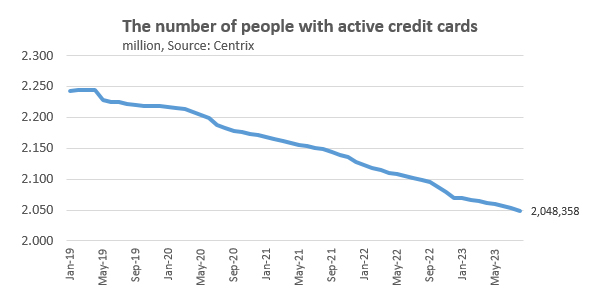
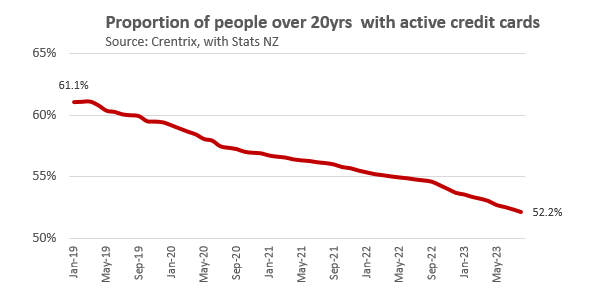
Of course, our population has risen over the period. Among the population aged 20 years and over, total card adoption has fallen more than -14%.
But that is only part of the story. The details show that the number of people with three or more active cards has dived from one in six, to only one in 13 now. The number with two active cards has also fallen from one in four to one in five over this same period. But the number of people with one card has risen and is up 14% to 1.45 mln since early 2019. But the growth has essentially disappeared since the onset of the pandemic and hasn't returned.
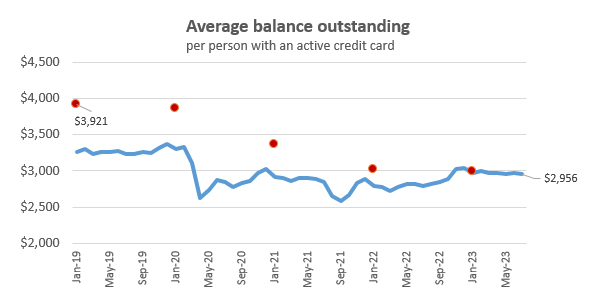
Folding in the RBNZ data that records overall balances due, we find that overall average balances are less than $3000 per person and haven't been shifting recently. So not only have the total amounts of credit card debt not been growing (C12) even if billings on them have been (C13), credit card holders have resisted the temptations and there is no overall signs of credit stress. For some, there will be, but not for most.
More than that, after accounting for inflation, which has been high in recent years, the inflation-adjusted balances have actually been falling.
The red points in the chart below are the Q2-2023 equivalent balance values adjusted for inflation using the RBNZ inflation calculator. In August 2023, the average balance owed on a credit card of $2,956 is -25% less in 2023 dollars than what was owed at the start of 2019. That is a large shift
That is confirmed by the RBNZ data that shows the proportions owed on credit cards that incur interest are now running at near all-time lows in data that goes back 23 years
We wish to thank Centrix for the access to their card number data for this analysis.
We welcome your comments below. If you are not already registered, please register to comment
Remember we welcome robust, respectful and insightful debate. We don't welcome abusive or defamatory comments and will de-register those repeatedly making such comments. Our current comment policy is here.