

The value of non-performing housing loans has topped the $2 billion mark and is running at an 11-year high, according to the latest Reserve Bank (RBNZ) loans by asset quality figures.
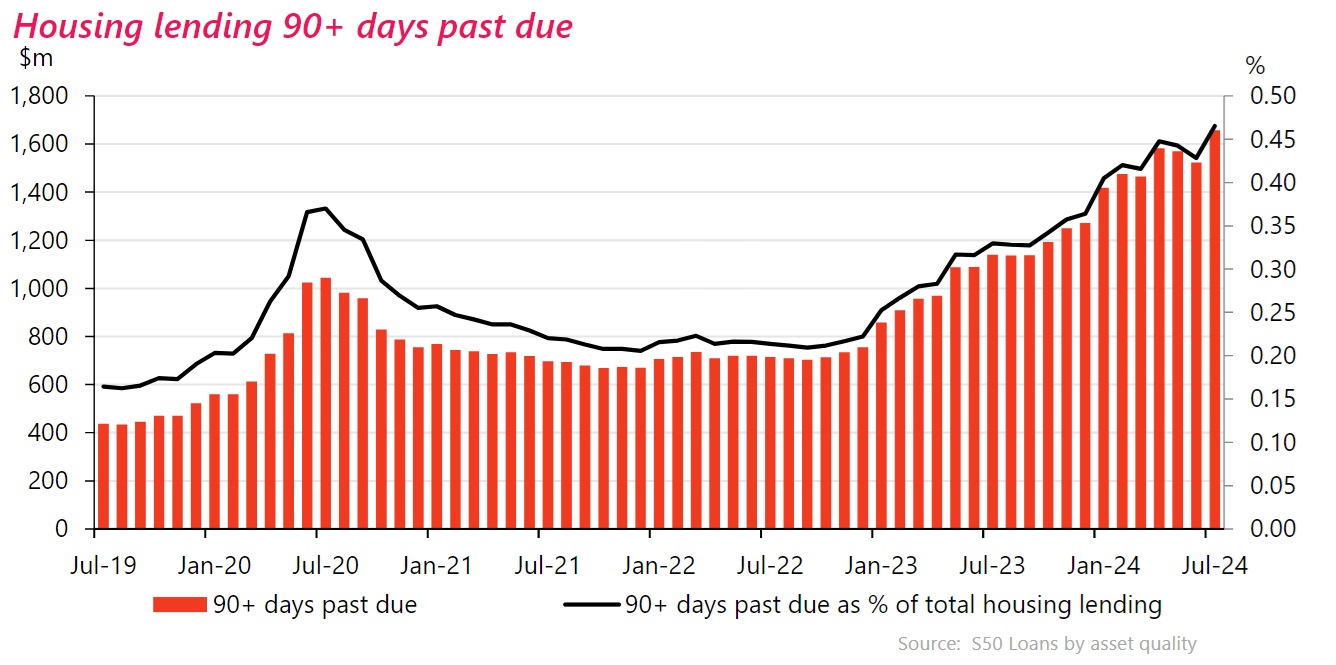
The figures show as of July a total of $2.048 billion worth of housing loans was non-performing - either categorised as 'impaired' ($391 million) or '90 days past due' ($1.658 billion).
In July the non-performing tally took a sudden jump, up $141 million (7.4%) after the total had appeared in recent months to be levelling off.
The increase in July was the biggest monthly increase since January, when the non-performing housing loan total had increased by $161 million.
With the latest increase, the total is now some 54.7% higher than it was as of July 2023. And if we go back two years the total is up some 152.8% ($1.238 billion).
What all this means is that the percentage of non-performing loans of the total outstanding mortgage pile ($356.335 billion) has now risen from 0.5% in June 2024 to 0.6% in July. It means the percentage of non-performing housing loans is now at its highest since July 2013, when it was also at 0.6% in the aftermath of the Global Financial Crisis.
The below graph from the RBNZ's asset quality summary, shows the 90 days past due figures.
In the immediate aftermath of the GFC our non-performing housing loans hovered around 1.2% of the total between 2009 and 2011.
So, we are a long way from that. But nevertheless, the troubled loans tally has risen pretty quickly from very low levels. In July 2022 the percentage on non-performing housing loans was just 0.2% of the total. So, effectively it's tripled in two years.
There's still nothing in these figures that is likely to be surprising either the banks or the RBNZ, however.
In its May Financial Stability Report the RBNZ stated that the country's banks were estimating that the non-performing housing loans ratio would reach 0.7% by the end of the year.
Will that still happen?
The RBNZ cut the Official Cash Rate on August 14 (from 5.5% to 5.25%). This cut came about a year earlier than the central bank had been forecasting as recently as May. In addition, the banks had been cutting ahead of the OCR drop in anticipation, after the RBNZ had explicitly changed to a much more 'dovish' position in its July statement.
Other RBNZ data shows that the country's mortgage holders are very ready and prepared for rate cuts.
As of July 2024 just over three-quarters of the whole outstanding mortgage pile was either on floating rates or fixed durations of no longer than a year. So, in other words, that's three-quarters of the mortgages by value that will get interest rate relief in no longer than a year.
This is not an accidental thing, either. Go back a year to July 2023 and just 63.3% of mortgage money was either floating or fixed for a term or less. So, folks have been deliberately 'going short' in recent months to ensure they get maximum impact once rates start coming down. Now they are about to get the reward.
And in fact, as of July 2024, nearly half of the mortgage money wass either floating or on fixed terms of no more than six months.
So, with banks starting to cut mortgage rates actively from July onwards, it means a substantial proportion of mortgage holders stand to get interest rate relief either by the end of the year or soon after.
The big question therefore is the extent to which the relief flowing through from lower rates will be sufficient to de-stress those who are getting into difficulties with their mortgage payments.
Elsewhere among the latest RBNZ data releases, it's worth noting that non-performing business loans have in July just blipped up to 1% ($1.225 billion) of the $125.83 billion outstanding. That 1% is the highest level since 2015. By some means of meaningful 'hard times' comparison, following the GFC that percentage got as high as 3% in 2011.
Among the businesses, it's the small and medium sized enterprises (SMEs) that appear to be particularly struggling. Another $41 million was added to non-performing SME loans in July, taking the total to $943 million, which is 1.2% of the $78.242 billion total. Twelve months ago that percentage stood at just 0.5%.
The RBNZ doesn't have specific data on SMEs going back to the time of the GFC, so, we don't have a direct comparison with how the small businesses were faring specifically at that time. But the current data series dates back to 2018 and the current 1.2% ratio is the highest in that time.
Again, time will tell the extent to which the rate relief that is now coming - and with more OCR cuts expected before the end of the year - will help people out.
We welcome your comments below. If you are not already registered, please register to comment
Remember we welcome robust, respectful and insightful debate. We don't welcome abusive or defamatory comments and will de-register those repeatedly making such comments. Our current comment policy is here.