

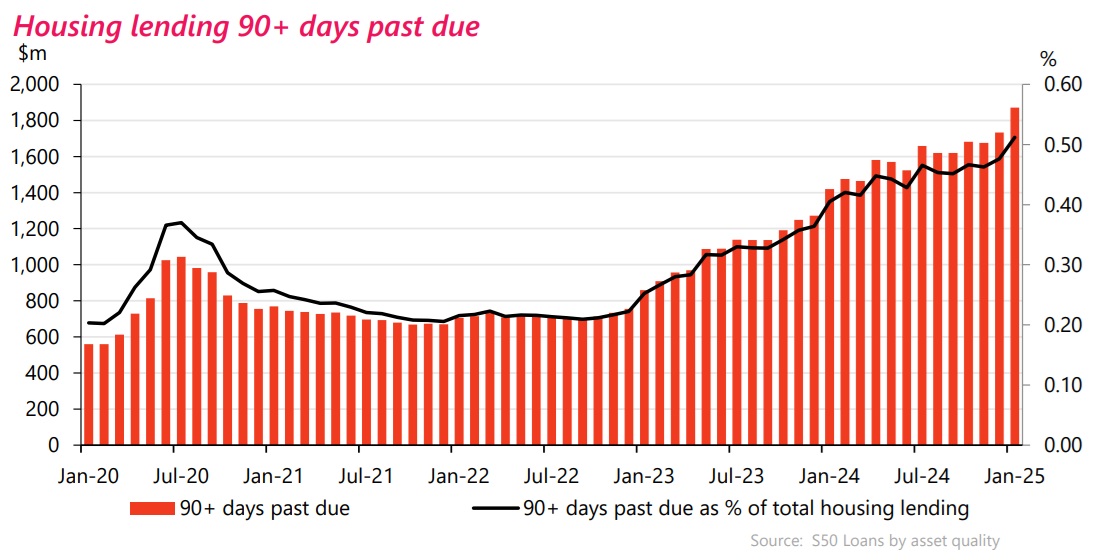
The value of non-performing housing loans rose by $165 million in January - the biggest monthly surge since June 2020 during the pandemic, according to the latest Reserve Bank (RBNZ) loans by asset quality figures.
The total of non-performing housing loans was $2.328 billion* as at the end of January.
Breaking the figures down; during January the amount of impaired loans rose by $27 million to $457 million, while the amount of 90 days past due, but not impaired, loans rose by $138 million to $1.871 billion.
The $2.328 billion total of non-performing housing loans makes up 0.64% of the $365.5 billion outstanding mortgage stock.
That 0.64% non-performing loan ratio figure is the biggest for housing loans since 2013, but is still some way below the 1.2% figures seen between 2009-11 in the post-global financial crisis period.
The latest spike in non-performing loans comes as bank mortgage rates are going down. About 55% of outstanding mortgages are due for an interest rate reset in the first half of this year, with over 82% of the total mortgage book due to be reset during 2025.
Relief is coming, but obviously not quickly enough for some.
While advertised mortgage rates have come down fairly swiftly, with fixed rates now down by anything up to 200 basis points from their peak highs, the yields banks are receiving are coming down much more gradually as loans take time to roll over and be reset.
The most recent yield figures available at time of writing were for December, which showed that the yield across the whole mortgage book was 6.29%, down only slightly from the peak figure of 6.39% reached in October 2024.
And in terms of the fixed rate mortgages, the yield figure in December was 6.33%, barely down on the peak of 6.34%, also in October.
Mortgage rates began rising in the second half of 2021 in response to soaring inflation and ahead of a big wave of RBNZ Official Cash Rate hikes that began in October 2021.
The non-performing loans figures didn't show a noticeable increase for about a year after rates started rising.
At the end of 2022 the non-performing loans figure was $850 million. However, since then it has risen by $1.478 billion (174%) to the current $2.328 billion.
It is notable that between the Christmas period and January in each of the last three years there have been big spikes in the non-performing housing loan figures.
In terms of banks' system-wide non-performing loans the ratio blipped up to 0.76% in January. That's just very slightly below the short-sharp peak seen in June 2020, but apart from that single month, the latest system-wide non-performing loan ratio figure is the highest seen since 2015.
For the record, the grand total of non-performing loans is $4.378 billion versus a total book of $576.43 billion.
*This figure was subsequently corrected from an initially published $2.38 billion figure.
We welcome your comments below. If you are not already registered, please register to comment
Remember we welcome robust, respectful and insightful debate. We don't welcome abusive or defamatory comments and will de-register those repeatedly making such comments. Our current comment policy is here.