
Despite the recent unexpected Official Cash Rate hold and the initial sharp financial market reactions to this split decision, many will just see it as a 'political decision' ahead of this Saturday's election. But it is a Quixotic call, tilting into inflation winds that are strengthening globally.
After all, some say, a hike would just be returning rates to a neutral level, thought to be between 3% and 4%.
A brief look back at history over the past generation (25 years?) would have backed this up.
However. there is always a 'but'.
You have heard us repeat this quote often - 'demographics is destiny', a savvy observation by Auguste Comte, a 19th century French philosopher. And just like continental drift, or climate change, these forces are relentless in their own way.
And in this way, demographics will mean that the neutral rate of interest won't be 3% to 4% for long.
Over the next generation it could well double, maybe even more if we make poor choices along the way.
To understand why, you first need to look at why the neutral rate on interest is where it is now.
Complicating the story is that the neutral rate is devilishly hard to measure. We only get to know what it is in hindsight. Decades of attempts to figure it out in real time have essentially come to nothing. But it is still very real.
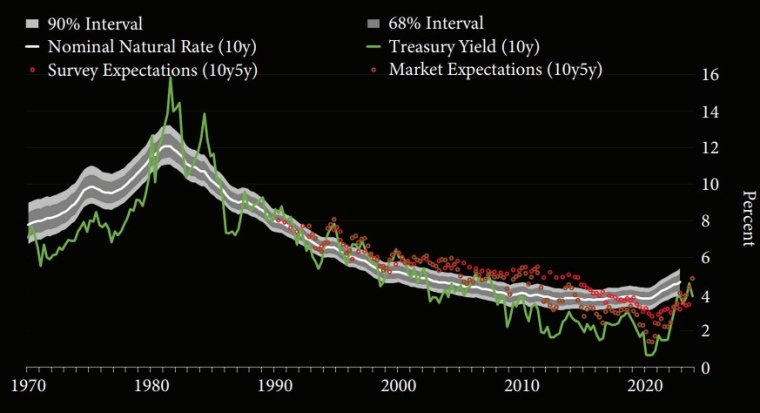
Hindsight shows that the global natural rate was over 10% in the 1970s and 1980s (two generations ago). And that was up from a very long term average of about 4%. It rose sharply as productivity gains started to fade and fiscal management started to fail. But then it fell as savings from the baby boomer era swelled, and this wall of investment funds gave rise to a generation of lots of money chasing underperforming real investment opportunities.
But from 2025, the picture is changing, not only here, but globally. A surge of ageing savers will want their money back to consume, either for pleasure or for healthcare costs. And they will want it just as the global population starts to shrink, undermining what has been a key driver.
More people and more out of poverty has been a 'miracle' of the past 50 years.
The surge in income in developing economies contrasts with the abject poverty that came before. Hundreds of millions of Chinese and Indians still have vivid family memories of extraordinarily tough times they never want to go back to. And they are responding with sharply reduced family sizes, with now an 'epidemic' in populations that are not replacing themselves - at the same time they can spend to maintain a higher standard of living.
This shift from 'investment' to 'consumption' will have profound impacts, and quite soon. 'Money' will become relatively scarce. And the cost of money will rise.
And with it, the natural rate of interest.
Every study into r* (the short-term real interest rate when the economy is at full employment and inflation is stable and on target) shows it is going to rise from here after bottoming out about now.
In New Zealand, the current expectation that r* is about 3.5% and it will change to 5% to 7% quite quickly should nothing else change, just on the tracking of demographic demands and weak productivity. There is about to be heightened competition for funding.
Driving that is the boomer shift to decumulation, reverse investing if you will. When you work you save for a rainy day (retirement) putting your savings to work in the economy. When you retire, the process works in reverse. And then, investors needing funds will need to pay more for that scarcer money. This is happening globally. The price of money is going up.
Twenty five years ago seems much closer than 25 years in the future. But as most readers will know, time is speeding up. So don't be surprised if by then the natural rate of interest is double what it is now. Plus the premium for being in New Zealand. Plus the premium as a borrower.
As a borrower, take fixed rate offers for as long as you can get. "Discounts" will become rare. As a saver, stay short because rates are just going up and up, long-term.
But know this. The path forward will not be smooth. There will be bumps and crises. There will be politicians promising they can return life into "what it was" (just as we have in this election). But they will never be able to beat the demography - or for that matter, the climatogaphy, another cost-inducing influence that will likely have its own equally tough impacts on r*.
There are a very wide range of literature about this trend. One easyish read is "The price of money" a 2025 book by Jamie Rush, Tom Orlik, and Stephanie Flanders, a group of leading economists at Bloomberg. A more technical read is this recent one by the Reserve Bank.
We are 'never' going back to 5% mortgages. And that will keep non-productive assets like housing and other real estate 'values' with capped or falling asset prices as populations shrink on these same demographic trends.
We welcome your comments below. If you are not already registered, please register to comment
Remember we welcome robust, respectful and insightful debate. We don't welcome abusive or defamatory comments and will de-register those repeatedly making such comments. Our current comment policy is here.