
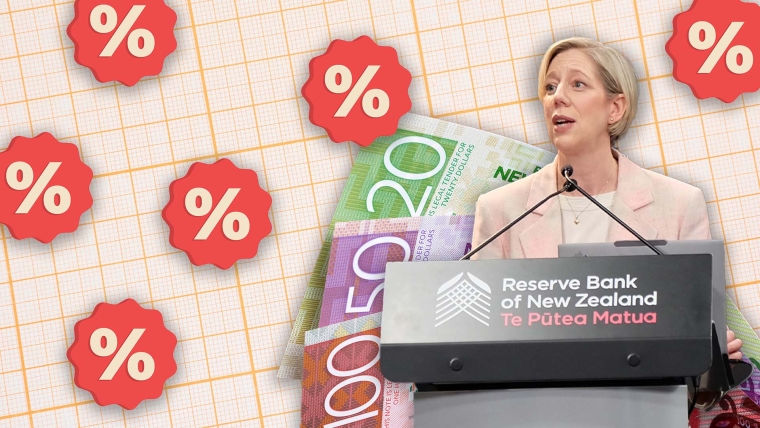
The Reserve Bank has left the Official Cash Rate (OCR) unchanged at 2.75% following a 4-3 vote by its Monetary Policy Committee members.
After two consecutive hikes, the streak came to an end on Wednesday with October's Monetary Policy Review. The decision to hold the OCR was not anticipated by bank economists and financial markets, as they expected the Reserve Bank (RBNZ) to lift the OCR to 3% to combat inflation and a weak NZ dollar.
While all committee members agreed on the overall outlook for inflation, they differed in how much weight should be placed on various risks and the timing of monetary policy response.
The New Zealand dollar fell 75 basis points against the US dollar, and 100 basis points against the Australian dollar following the RBNZ announcement.
When it came to the split vote, RBNZ Governor Anna Breman and fellow internal RBNZ committee member Rebecca Williams, plus external members Carl Hansen and Prasanna Gai voted to keep the OCR at 2.75%, saying the two recent OCR increases - in July and September - allowed the committee to take further time to assess their effects and economic developments.
Meanwhile external member Hayley Gourley, RBNZ chief economist Paul Conway and RBNZ assistant governor Karen Silk favoured increasing the OCR by 25 basis points.
These committee members argued core inflation has been "above levels consistent with headline inflation at the [2%] target mid-point for some time," increasing the risk of "inflation becoming entrenched in price-setting behaviour."
The RBNZ said the committee is focused on returning inflation to its 2% target mid-point over the medium term, "discounting temporary disturbances to inflation and avoiding unnecessary economic instability."
"Subdued growth in household spending is limiting the ability of some firms to pass on higher costs to restore profit margins. But the longer inflation remains high, the greater the risk of higher costs feeding into inflation expectations and price- and wage-setting behaviour, making inflation more persistent," the RBNZ said.
The RBNZ said the committee agreed that tighter monetary policy was likely to be required but remains conditional on the economic outlook.
Inflation expected to increase to 4.4% in the December quarter
Annual inflation, as measured by the Consumers Price Index (CPI), was 3.7% in the September quarter, largely driven by petrol prices, up 19.1%.
While the latest annual CPI figure was below 4.1% in the June quarter, a touch below many bank economists’ forecasts and below the RBNZ’s projection of 3.9%, the 3.7% figure continues to breach the RBNZ's target range of 1% to 3%, and has been touted as a "temporary reprieve."
The RBNZ said annual inflation for the December quarter was expected to increase to 4.4% - this was largely on the basis of current prices for oil futures.
"Direct effects of higher fuel prices will drop out of the annual inflation calculation in late 2027 if prices for refined petroleum products stabilise or fall. Members noted the high uncertainty around near-term inflation forecasts given high volatility in prices for oil and refined fuels."
"Disruptions to global oil supply, loss of refining capacity, and shipping disruption due to ongoing conflicts are putting further upward pressure on international refined fuel prices."
The RBNZ said sustained higher refined fuel prices and exchange rate depreciation could risk larger indirect effects on inflation.
"It could also increase the potential for second round price effects through wage- and price-setting behaviour. Pass-through, however, is state-dependent and continuing weak demand could limit these effects."
Daily exchange rates
Select chart tabs
This is the statement from the Reserve Bank:
The Monetary Policy Committee today voted 4 - 3 to hold the OCR at 2.75 percent.
Annual consumers price index inflation was 3.7 percent in the September quarter, down from 4.1 percent in June and lower than expected. To date, wage growth has been subdued, and medium-term inflation expectations have remained stable. However, core inflation measures have increased to around the top of the Committee’s 1 to 3 percent target band, and price increases have become more broad-based across the economy.
Global events are adding to near-term inflation pressures in New Zealand. Fuel prices have risen further because of ongoing disruptions in global energy markets, and the exchange rate has fallen by around 3 percent since early September. Annual inflation is expected to increase to 4.4 percent in the December quarter, largely reflecting current futures prices for fuel. Near-term inflation forecasts are uncertain given volatility in prices for oil and refined fuels.
The New Zealand economy continues to recover, although conditions remain uneven. Export-exposed parts of the economy are benefiting from high commodity prices, strong demand for goods exports and increased tourist numbers. But domestic demand remains subdued outside of exporting centres. There are some early signs of a recovery in residential investment, including in Auckland.
The Committee is focused on returning inflation to the 2 percent target mid-point over the medium term, discounting temporary disturbances to inflation and avoiding unnecessary economic instability. Subdued growth in household spending is limiting the ability of some firms to pass on higher costs to restore profit margins. But the longer inflation remains high, the greater the risk of higher costs feeding into inflation expectations and price- and wage-setting behaviour, making inflation more persistent.
Global growth has been resilient but is increasingly fragile given geopolitical tensions, high energy prices, financial stresses, and surging AI-related investment. New Zealand’s recovery could be stronger than expected but could also lose momentum if the global environment deteriorates or export strength does not flow through to jobs, incomes and household spending.
All Committee members agreed on the overall outlook for inflation. However, members differed in how much weight they placed on various risks and the timing of the monetary policy response. The Committee agreed that tighter monetary policy is likely to be required but remains conditional on the economic outlook.
Summary of Monetary Policy Committee meeting:
The Monetary Policy Committee is setting monetary policy to return inflation to the 2 percent target mid-point over the medium term, discounting temporary disturbances in inflation and avoiding unnecessary instability in the economy.
Inflation is above the 1 to 3 percent target range
Annual consumers price index (CPI) inflation is above the Committee’s 1 to 3 percent target range. Headline inflation was 3.7 percent in the September 2026 quarter, slightly lower than expected and down from 4.1 percent in the June quarter.
Higher fuel and related prices have directly increased inflation and flowed through to domestic prices via higher input costs. Annual tradables inflation fell from 4.9 percent to 4.3 percent in the September quarter but was slightly higher than expected. Excluding vehicle fuels, annual inflation increased to 3 percent in the September quarter. The pass-through of the initial surge in global prices to domestic price categories has so far been less than previously assumed. Impacts on short-term pricing behaviour appear to have been contained and medium-term inflation expectations remain well anchored.
Measures of non-tradables inflation are mixed. Non-tradables inflation was 3.3 percent in the September quarter, but this was weaker than expected and partly reflects elevated government charges.
Core inflation measures have risen to around the top of the Committee’s 1 to 3 percent target band, broadly in line with expectations. Price increases have become more broad-based since the June quarter. For example, on a weighted basis, 56 percent of items in the CPI basket rose by more than 3 percent in the year to September 2026. The Committee noted the importance of ensuring accurate and timely CPI weights, taking into account how changes in behaviour affect the CPI.
Inflation will remain elevated in the near term, driven by volatile tradable prices
Annual inflation is expected to increase to 4.4 percent in the December quarter, largely on the basis of current prices for oil futures. Direct effects of higher fuel prices will drop out of the annual inflation calculation in late 2027 if prices for refined petroleum products stabilise or fall. Members noted the high uncertainty around near-term inflation forecasts given high volatility in prices for oil and refined fuels.
Disruptions to global oil supply, loss of refining capacity, and shipping disruption due to ongoing conflicts are putting further upward pressure on international refined fuel prices.
The New Zealand dollar trade-weighted index has declined approximately 3 percent since the September MPS. Although global interest rates have increased, the decline likely reflects a confluence of factors in a highly uncertain environment.
Sustained higher refined fuel prices and exchange rate depreciation could risk larger indirect effects on inflation. It could also increase the potential for second round price effects through wage- and price-setting behaviour. Pass-through, however, is state-dependent and continuing weak demand could limit these effects.
Global growth has been resilient, but is increasingly fragile
The Committee noted that although geopolitical uncertainty remains elevated, GDP growth among New Zealand’s trading partners has been resilient. However, global economic conditions are becoming increasingly fragile and uneven across countries, reflecting differences in domestic demand, fuel subsidies, fiscal policy, connection to the AI investment boom, and exposure to elevated energy prices.
Global long-term interest rates have increased, partly reflecting high fiscal deficits in some countries and AI investment spending adding to private sector demand for capital. Inflation is also increasing in many economies. Some central banks have increased policy rates in response and market expectations for higher global policy rates have risen.
New Zealand’s economic recovery continues, but conditions remain varied
The Committee noted that GDP growth was more than expected through the first half of 2026. Business survey measures point to continued expansion in economic activity.
Incomes for households and businesses exposed to the export sector are being supported by elevated commodity prices, strong export volumes, and high international visitor arrivals. The export-led recovery is supporting activity, investment and employment in regions and industries exposed to primary exports, manufacturing and tourism. Some estimates suggest that international trade supports a quarter of New Zealand’s employment.
However, households and businesses exposed to domestic demand continue to face challenging conditions. Household consumption has been weak and the aggregate saving rate is estimated to be 3.7 percent, above the 10-year average of 1 percent. Employment growth remains subdued and higher prices will further reduce real incomes and purchasing power. House prices continue to decline, weighing on household sentiment and spending. However, residential investment has seen some early signs of recovery, including in Auckland.
The Committee noted that these mixed conditions and cost pressures are also apparent from RBNZ business outreach. Firms report elevated costs, but the ability to pass these on to prices varies across industries. Compared to June, fewer firms experienced and expected price increases in the September Quarterly Survey of Business Opinion, but the levels remain elevated.
Business investment intentions are resilient but focused on improving productivity and reducing costs, rather than on business expansion. Employment intentions remain weak, pointing to continued slow recovery in the labour market.
Domestic financial conditions are mixed
Domestic wholesale interest rates have risen, reflecting both increased market expectations of a higher OCR and higher long-term global interest rates.
However, some aspects of domestic financial conditions have eased with a lower exchange rate and declines in some term lending rates for households and businesses. Subdued credit demand and higher deposits have resulted in less pass-through of wholesale rate increases to both deposit and lending rates.
Risks to the global outlook are becoming pervasive
The Committee assessed that there are significant risks to the global economic outlook. Geopolitical events, high energy prices, high and rising public and private debt levels pose downside risk to global growth. There is uncertainty about whether the surge in AI investment will be justified by economic fundamentals.
Since the September MPS, financial stability risks have increased due to high levels of indebtedness and opaque and complex financing arrangements for some AI investments. Fuel subsidies are dampening the inflation impacts of higher fuel prices in some economies but are also contributing to weaker fiscal positions. Rising long-term interest rates could expose financial vulnerabilities, prompting asset-price adjustments and financial stress. The Committee noted that a global downturn could occur abruptly.
The Committee discussed the considerable uncertainty about the global inflation outlook. Energy prices remain vulnerable to developments in geopolitical conflicts, refining capacity, inventories, supply-chain adjustments and global demand. Freight and shipping costs could also increase further, adding to global inflation pressures.
Global risks could have significant implications for New Zealand, including through export demand, the terms of trade, the exchange rate and financial conditions. Higher global food prices, because of elevated fuel and fertiliser costs or adverse weather events, could also affect primary industries and increase export prices.
Risks to New Zealand’s economic recovery
Members discussed risks to New Zealand’s economic recovery. Members noted that the economy had shown resilience and could have more underlying momentum. Members also discussed the risk that strength in export-oriented sectors does not flow through more broadly to domestic economic activity. Persistently weak domestic demand or a softening in global demand for New Zealand’s exports could cause the recovery to lose momentum. Sudden geopolitical developments and financial stress could undermine consumer and investor confidence.
Structural changes are affecting the New Zealand economy as it adjusts to shifts in urban land use, AI adoption and the transition in energy use away from oil and gas. These changes could temporarily reduce productive capacity and slow the recovery as resources, including labour, move between sectors. At the same time, greater investment in technology could help firms manage costs and lift productivity. Changes in the housing market could further impact wealth effects on consumption and therefore the transmission of monetary policy.
Monetary policy is focused on the medium-term inflation target
When setting policy, the Committee is focused on the medium-term inflation outlook.
The Committee reflected on the impacts of the two recent increases in the OCR. Members noted that the indirect effects of the initial increase in fuel prices and second round price effects have been smaller than expected so far. Pass-through could occur later and be larger, particularly if higher global energy, shipping and food costs are sustained. There is uncertainty about the impact of recent cost increases on firms’ margins and implications for inflation persistence.
The Committee is vigilant to risks associated with changes in inflation expectations, and wage- and price-setting behaviour. To date, wage growth has been subdued, and medium-term inflation expectations have remained stable. Administered price inflation is also likely to remain elevated but was lower than expected in the September quarter.
Further OCR increases likely, but are conditional on the outlook
The Committee discussed the monetary conditions required to return inflation sustainably to the 2 percent target mid-point. The removal of monetary stimulus to date has supported forward-looking indicators of medium-term inflation remaining anchored.
The Committee acknowledged that the neutral interest rate has a wide range of plausible estimates. Members noted that the increase in global long-term yields may partly signal a higher global neutral interest rate, due to higher inflation expectations, war destruction and demand for capital to support AI investment. Higher global interest rates could bring forward a potential global downturn, and the neutral interest rate could decline rapidly in the event of an abrupt global adjustment.
Prasanna Gai and Anna Breman attached material risk to the possibility that the global environment could shift abruptly. It was therefore appropriate to account for such risks when judging neutral rates and the stance of monetary policy rather than relying on most likely or mid-point measures.
Members reflected on potential trade-offs associated with increasing the OCR at this meeting or waiting until the December MPS.
Members discussed that information arriving over the next six weeks could meaningfully change the appropriate policy stance in either direction. There is a risk that inflation becomes entrenched before conventional expectations measures respond, despite the previous two OCR increases. In addition, the world economy could tip abruptly into a downturn causing weaker inflation over the medium term. It is also possible that geopolitical escalation could drive fuel prices higher while weakening global economic activity at the same time.
All members judged that monetary policy must be robust to these risks. If domestic pricing pressures fail to moderate sufficiently or broaden beyond what costs and normal pass-through can explain, this could warrant further tightening. On the other hand, subdued pricing pressures could require holding at future meetings. And if the global economy turns sharply down, materially weakening demand and the inflation outlook, this could alter the desired stance, including leading to monetary easing.
All members agreed on the overall outlook for inflation. However, members differed in how much weight they placed on various risks and the timing of the monetary policy response.
Anna Breman, Carl Hansen, Rebecca Williams and Prasanna Gai favoured holding the OCR at this meeting as two recent OCR increases allow the Committee to take further time to assess their effects and economic developments. Actual inflation was lower than expected, reflecting smaller indirect effects of higher fuels prices, and medium-term inflation expectations and wage growth remain consistent with returning inflation to the target mid-point. These members judged that although a broader range of items exhibited significant price increases, this was largely expected. A salient issue is whether businesses are taking the opportunity to increase their margins, which does not appear to be the case so far. These members emphasised the risk of a weak recovery, particularly in household consumption and investment. They favoured pausing at this meeting to observe and assess demand and financial conditions.
Hayley Gourley, Paul Conway and Karen Silk favoured increasing the OCR by 25 basis points at this meeting. These members emphasised that core inflation has been above levels consistent with headline inflation at the target mid-point for some time. This increases the risk of inflation becoming entrenched in price-setting behaviour as the conflict and its consequences endure, including through higher freight and shipping costs. These members put more weight on the fact that aggregate growth has been resilient despite challenges for many businesses and households. Acting now would guard against sustained inflation pressures and potentially reduce the risk of needing to do more with interest rates later. Overall, this warrants an increase in the OCR to around the mid-point of the neutral range.
The Committee decided by vote to hold the OCR at 2.75 percent
The Committee is focused on sustainably returning inflation to the 2 percent target mid-point over the medium term, while avoiding unnecessary instability in output, employment, interest rates and the exchange rate.
On Wednesday 28 October, four members [Anna Breman, Carl Hansen, Prasanna Gai, Rebecca Williams] voted to hold the OCR at 2.75 percent and three members [Paul Conway, Hayley Gourley, Karen Silk] voted for a 25-basis-point increase to 3 percent at this meeting. All members agreed that tighter monetary policy is likely to be required, but remains conditional on the economic outlook.
We welcome your comments below. If you are not already registered, please register to comment
Remember we welcome robust, respectful and insightful debate. We don't welcome abusive or defamatory comments and will de-register those repeatedly making such comments. Our current comment policy is here.