
By Amanda Morrall
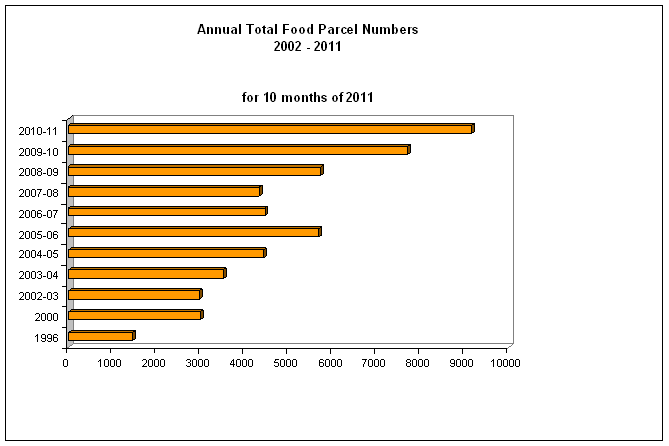
Auckland City Mission, a supplier of emergency food parcels to 70 distributors, is reporting close to a 20% increase in demand over last year, pushing usage to an all time high.
For the financial year ending this month, Auckland City Missioner Diane Robertson has conservatively estimated the number of food parcels at 9,000.
That's up from 7,700 the year before, which saw a 2,000 year-on-year increase before that as well.
Robertson said food banks across the country are experiencing similar demand with families struggling to keep up with the cost of living on incomes that were stagnating or else not keeping up with inflation.
She said demand on food banks has become so voracious that food banks and social agencies running them are exploring the need to change mandates so they can work toward finding systemic cures rather continuing to present as a band-aid solution.
Hunger a "chronic" condition
"We're at risk now of becoming institutionalised so we need to start thinking about better solutions. At the end of the day (food parcels) are a relief measure and we should provide them to people in extreme need, but if it’s going from crisis to chronic we need to look structurally at different sorts of responses."
Contrary to the public perception of food banks having an open fridge policy that could be used and abused at will, Robertson said the criteria was strict with parcels reserved for the most demonstrably needy.
"We only provide food to people who have exhausted every other avenue. We do thorough checking and screening and we have limits for how many times they can come. It's actually quite hard to get a food parcel. The process is rigorous."
In the course of working out the legitimacy of need, Robertson said mission staff spent time with applicants analysing their income, household make-up and levels of debt, social welfare entitlements and such with the aim of helping them to become more self-sufficient.
For many turning up at the food bank's doorstep, debt was the crippling factor, she noted.
Debt driving hunger
"There's simply not enough money to go around and food is seen as a discretionary item.
"A lot of them end up coming because the debt they owe in proportion to their incomes is very high, and low level incomes, relative to the rising cost of living, are increasing. People are sinking deeper and deeper into poverty, they have less or no assets and we have new people coming into the system who've lost jobs due to the recession.''
Where eating healthy was once dismissed by nutritionists and healthy experts as a luxury some couldn't afford, the rising cost of fruit and vegetables has given credence to that suggestion.
Healthy food guide editor Niki Bezzant said current food prices mean eating healthy is a conscious economic choice people have to make. She argued the benefits of doing so were, in the long-term, advantageous in terms of procuring better health outcomes.
Since the Auckland City Mission first started keeping records, food parcel issues have grown from 1,457 in 1996 to a projected 9,000 for the year ending June 2011.
Robertson said the 9,000 number was extremely conservative and would realistically be well in excess of that.
She said the Salvation Army, the other main provider of food parcels, has recorded a similar rise in demand over the same period of time, a trend that is consistent nation-wide apart from Christchurch where demand had sky rocketed.
University of Auckland lecturer Susan St John, speaking at a recent economic analysis of Budget 2011, said food bank usage was a barometre of economic distress and a sign that ''all was not well in New Zealand." (For further commentary click here.)
She said tax policies by National had failed to bring any relief to low and middle income earners who were struggling to make ends meet.
"We're marching in the wrong direction socially, morally and economically.''
'Raise the minimum wage'
Green Party co-leader Metiria Turei said raising the minimum wage would be a logical first step in helping to alleviate increasing reliance on food banks. Also, increasing the income of beneficiaries, who were high users of the food bank.
While Labour has proposed exempting fruit and vegetables from GST, Turei said it was doubtful those savings would be passed onto consumers.
She said the Greens were proposing a tax rebanding instead, where the first NZ$10,000 of income would be tax free. She said that would free up more money for food among low-income users now forced to rely on food banks.
Robertson said less than 1% of food bank users were unemployed. Just over 18% were employed and the rest were on benefits. Of those on benefits and heavily in debt, she said the debt was mostly owed to Housing New Zealand and Working for Families a consequence of advances they needed to make ends meet.
"The cost of living is so high, people just can’t keep up,'' said Robertson.
As part of an overall fix, Turei said housing affordability needed to be urgently addressed in New Zealand, removing subsidies to landlords and imposing a capital gains tax on properties outside the family home.
It's estimated that by 2016, the Government will pay $NZ3 billion in accommodation supplements.
"About half the people who rent in the private market are getting an accommodation supplement,'' said Turei.
We welcome your comments below. If you are not already registered, please register to comment
Remember we welcome robust, respectful and insightful debate. We don't welcome abusive or defamatory comments and will de-register those repeatedly making such comments. Our current comment policy is here.