By Suhaimi Mohamad
According to the Organisation for Economic Cooperation and Development (OECD), New Zealand won't be taking home any gold medals in the savings department. Not this year, or even next.
Relative to other OECD countries our household savings rate is just too anaemic to get on the podium or even close to it.
(See the chart below for a more comprehensive ranking).
Although we've come a long way since 2006, when the savings rate was a pathetic negative 8.93%, in a year's time we're predicted to cross the finish line around 1.6%.
A negative saving rate, as you'll most likely know, indicates that households spend more than they earn in the course of a year.
While we can boast of some Olympic victories over our neighbour, they have us beat,. hands down, in the savings department.
In the same period, they've gone from a savings rate of 2.4% to an expected rate of 9.1% in 2013.
Germany by comparison (a model of savings discipline) has remained more or less consistent; 10.6% in 2006 to 11.7% for 2013.
|
|||||||||||||||||
| 2006 | 2007 | 2008 | 2009 | 2010 | 2011 | 2012 | 2013 | ||||||||||
| Australia | 2.4 | 4.5 | 6.1 | 10.4 | 8.9 | 9.7 | 9.6 | 9.1 | |||||||||
| Austria | 10.4 | 11.7 | 11.5 | 10.7 | 8.3 | 7.5 | 7.5 | 7.5 | |||||||||
| Belgium | 10.8 | 11.4 | 11.7 | 13.7 | 11.2 | 11.2 | 10.5 | 9.5 | |||||||||
| Canada | 3.5 | 2.8 | 3.9 | 4.6 | 4.8 | 3.8 | 3.3 | 3.0 | |||||||||
| Czech Republic | 6.1 | 5.7 | 4.8 | 6.1 | 5.7 | 4.2 | 3.9 | 4.3 | |||||||||
| Denmark | -2.3 | -4 | -3.7 | -0.4 | -0.2 | -1.3 | -0.9 | -1.8 | |||||||||
| Finland | -1.1 | -0.9 | -0.3 | 4.1 | 4.1 | 2.2 | 1.4 | 0.6 | |||||||||
| Germany | 10.8 | 11 | 11.7 | 11.1 | 11.3 | 11 | 11 | 10.6 | |||||||||
| Hungary | 7.2 | 3.3 | 2.7 | 4.5 | 2.5 | 3 | 3.2 | 3.7 | |||||||||
| Ireland | -0.9 | -0.1 | 5.5 | 10.1 | 8.9 | 9.4 | 8.3 | 7.3 | |||||||||
| Italy | 9.5 | 8.9 | 8.4 | 7.1 | 5.3 | 4.5 | 4.3 | 4.5 | |||||||||
| Korea | 5.2 | 2.9 | 2.9 | 4.6 | 4.3 | 3.1 | 2.9 | 3.1 | |||||||||
| Netherlands | 6.1 | 6.9 | 5.9 | 6.4 | 3.9 | 5.5 | 6.4 | 7 | |||||||||
| New Zealand | -8.9 | -4.0 | -4.5 | -2.2 | 0.1 | 0.8 | 1.3 | 1.6 | |||||||||
| Norway | -0.5 | 0.8 | 3.4 | 6.6 | 6.1 | 8.0 | 8.9 | 7.6 | |||||||||
| Poland | 6.1 | 4.6 | -0.3 | 6.8 | 6.4 | 3.9 | 4.7 | 4.9 | |||||||||
| Slovenia | 11.7 | 10.3 | 9.4 | 9.1 | 10.0 | 9.0 | 7.6 | 5.7 | |||||||||
| Sweden | 4.9 | 7.2 | 8.9 | 11.2 | 8.5 | 9.7 | 10.7 | 9.4 | |||||||||
| Switzerland | 11.4 | 12.6 | 11.7 | 12.0 | 9.9 | 11.4 | 12.1 | 12.0 | |||||||||
| United States | 2.6 | 2.4 | 5.4 | 5.1 | 5.3 | 4.7 | 4.3 | 4.0 | |||||||||
A number of factors have contributed to our low savings rate including high house prices, relatively immature retirement savings schemes, social welfare and inward migration transfers, - all of which are highlighted in this Reserve Bank of New Zealand paper on household savings and wealth in New Zealand. I won't get into macro economics and monetary policy. Instead, let's look at some practical ways we can boost individual savings. I'll even let you in on my own secrets and savings habits.
How to save
Savings I believe comes down to perception, determination and knowledge.
I know most households are struggling to cope with the high cost of living and barely have any spare change after paying the mortgage, utility bills, buying food and meeting other outgoing expenses. But in small ways there is always room to save.
My recommendation is to begin with a simple savings plan. Don't just talk about it. Get it down on paper and discuss with your partner or other family members what your objectives are, and how you plan to get there in a specified period. Start with a plan that you can achieve that's not too ambitious. Review your progress regularly and make any necessary revisions as you go along.
Baby steps
If you are new to the savings game, start by saving a small amount so it's not overwhelming. Make it a regular habit by putting aside a set amount each week or month from your pay packet. At the beginning, the impact may be insignificant but don't be discouraged. Savings requires discipline, determination and purpose and is best viewed as part of a bigger long-term plan.
In this regard, the New York Times has an interesting interactive calculator to visualise the impact of adding 1% more into regular savings. It's a savings expanding experiment. Go on try it.
Spare change
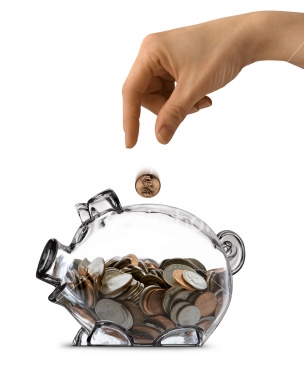
As long as I can remember, I have been a saver. It started when I was a primary school student and my sister gifted me a piggy bank. It's a habit I've retained through adulthood and continue to do now for the benefit of my kids.
Instead of feeding my pocket change into a box, I now do it electronically.
ASB Bank has a product called Save The Change that automatically takes the change from my purchases and puts it into savings accounts, split between my two children. It's a brilliant and painless way to save. You don't get the satisfaction of hearing those coins clink against the porcelain but the effect is the same. Two years on, the piggy is getting fatter, slowly but surely.
We welcome your comments below. If you are not already registered, please register to comment
Remember we welcome robust, respectful and insightful debate. We don't welcome abusive or defamatory comments and will de-register those repeatedly making such comments. Our current comment policy is here.