
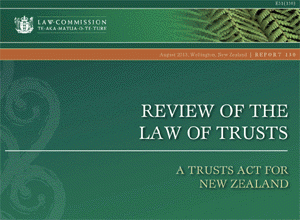
The Law Commission is recommending a new law to govern trusts that it says would spell out the core characteristics of a trust and requirements for creating a trust.
It says the Act it's proposing would make it clear what was, and what was not, a trust. It would also provide a summary of the basic obligations that trustees owe to beneficiaries.
"Under provisions recommended by the Commission, if a trust has purportedly been established, but the reality is that the person who established it continues to manage the trust assets as if they are their own personal property, the new Act would make it clear that the court could find that a trust has not in fact been established," said Law Commission President Grant Hammond.
He also said the Commission was emphasising that its recommendations don't undermine legitimate uses of trusts, with the new Act preserving the flexibility and usefulness of the trust.
"The Law Commission is recommending a new Act clarifying the legal rights and duties of New Zealanders who use trusts to manage their assets," said Hammond.
"If enacted, the new Trusts Act would be relevant to tens of thousands of New Zealanders who use trusts as an alternative way of holding and managing property or other assets. It is estimated New Zealand has up to 500,000 trusts used for a variety of purposes ranging from owning the family home, through to use in business, by charities, and by many, including Māori, to hold land and other assets collectively."
Hammond noted trusts form core a part of New Zealand’s economic, social and legal infrastructure, meaning it's vital for the law on trusts to be clear and accessible to ordinary people who use them. The current law was outdated with much of it difficult to understand.
“The nature of the trust relationship and its legal implications are not always well understood by the parties, which is not surprising given the age and complexity of the current law," said Hammond.
“While people are entitled to hold and dispose of their property as they wish, those setting up trusts cannot simply receive the benefits of the arrangements, without also having to take on the essential features of the trust that confer those benefits."
Hammond said it was in the public interest to both have a modern statute giving trustees and others guidance as to how a trust should be managed, and to increase the accountability of trustees.
The Commission is also recommending giving the Family Court a wider ability to deal with trusts in order to do justice when resolving relationship property disputes when couples separate.
"Under the proposed reform, the Court, where necessary, would be able to include the relationship assets that have been placed in a trust by one partner in the property to be divided between the couple," Hammond said.
See the Commission's full press release here and its full report is available here.
17 Comments
...I see a shambles in law heading right this way. If assets have been gifted to a trust they are then the property of the trustees. The trustees having no beneficial rights to them, but are able, within the terms of the deed, to distribute at their discretion.
How can a court then come on in and say sorry...these assets are not yours after all..we think they should belong to xx over here. The 'theft' being ultimately to deprive the final beneficiaries of the assets when the trust vests.
If it is going to acceptable when an ex partner wants this to happen.....what about a creditor?
I am afraid one can't have it both ways. The assets are either the legal ownership of the trustees or they are not.
If assets have been gifted to a trust they are then the property of the trustees.
I'd have thought they were the property of the beneficiaries - managed by the trustees on behalf of the beneficiaries?
kate. Not so. The ownership is with the truteess (hence their name appears on legal docs and such). The have equitable ownership, but not beneficial (ie they cannot benefit from the ownership - only the bene's can). Most do not undederstand trust concepts - by way of example,most people think a trust is an entity, when in fact it is not a legal entity at all. It is ownership held by a number of people (the trustees), held on behalf of others...more like a partnership in fact. The IRD recognise it as an entity for tax, that's all.
Right. I agree that most people who are not trustees likely do not understand the concepts - but surely the Law Commission does! So the question is - what problem are they and the government trying to solve? Why does trust law need reform, I wonder?
Just a guess but I'm thinking perhaps the government's interest relates to wanting access to those assets in the event the settlor needs government care/assistance in future. In other words, they want the boomer generation to pay for their own aged care. And indeed if that is the purpose/reason for the review, then they should be up front about it - because that would be a major change.
It's not residential care related. They already have the power to capture assets moved into a trust, as do our benefit system. I suspect a bit to do with the screams from a spouse when they wake up to the fact she (usually) did not intially care that farm boy Joe didn't actually own the family farm (or business or hse)... but wakes up one day to the fact she is due zilch. And being a cynic, any changes will be a fine job creation activity for our lawyers - I understand works a bit slow these days
A court has the _responsibility_ to step in, when requested to do so by any _involved_ party, to ensure law and public interest are upheld.
The courts can overrule when a contract or arrangement appears to favour one party over another in a matter which would be considered not in the public interest (or illegal).
Public interest is often seeing that one party can't use mechanisms, advantage, force or secret information to gain an unfair advantage. This does -not- mean the Court is responsible for watching -your- back or making sure you're -safe- or -fairly- treated. What it means is that if a party is trying to take advantage deliberately and through nefarious means (eg lying on company disclosure document which are a _legal document_ and are supposed to, by law, be a fair representation of the companies position.
Or in the case of a Trust, the Trust is setup to provide use of assets for beneficiaries (something which if done properly is a Good Thing for New Zealanders to rely on)
But, if it's done to hide assets from taxation (unfair to other taxpayers, and tax evasion- illegal things are almost always considered not in the public interest!) or to stop one party being allowed their share of common assets (using a system to rip off partners is not going to be a Good Thing for all New Zealands and will reduce peoples' trust in such arrangements), or in order to hide property which should be by normal endeavours considered common property (it isn't a Good Thing to have a system where some NZers can hide stuff from others who are entitled to an interest in that property.)
Likewise trading Trusts have to be careful. There are already legal identities available for carrying out incorporated business. The incorporation laws and guidelines exist for good reason. A trading Trust would have to ask if it has it's customers interest at heart, it's trustees or it's beneficaires - it often risks failing it's Test of purpose in such dilemma. Remember a Trusts purpose is -not- to advance the Trusts interest (that's what a company does), nor is it there to work with or help the Trustees (thats a business), nor is it to serve a segment of the community or interested parties through endeavours (thats a Charity). A Trust holds assets and distributes for the benefit of beneficaires.
Often a trading Trust would be best holding shares in a company but talk to your lawyer and accountant about the fine print on that.
I am not a legal or financial advisor. Seek independant help in such matters. always.
""Under provisions recommended by the Commission, if a trust has purportedly been established, but the reality is that the person who established it continues to manage the trust assets as if they are their own personal property, the new Act would make it clear that the court could find that a trust has not in fact been established,""
Weird, that's already happening and has been a core factor in the activity of trusts for over 20yrs (as I know of it), and as far as I know has been a core principle of Trust legal philosophy (points) for the entire time Trusts have been available (going back centuries to the times of the crusades!).
The settlor provides the assets.
The trustee manages the assets and benefits.
The beneficiaries receive what the trustee decides.
hat why public trust offices have always been such hotbeds of dispute. The manage other peoples' assets for someone else, but aren't held responsible for their performance to anyone - and can often set their own "service" reimbursement/renumeration/honorarium
(as usual, not a lawyer, not a financial advisor)
My understanding of the current trust law is that one is not meant to be the settlor, trustee and a beneficiary. Many NZ trusts appear to have the settlor being a trustee and a beneficiary.
If you are the settlor, trustee and beneficiary then it could be considered to be a sham trust and if challenged in court it could be found that a trust has not in fact been established.
In Australia there is a practice of setting up bloodline wills and Trusts that work together.
Like cowboy above I am not a financial advisor or lawyer - so people should seek appropriate advice from someone suitably qualified.
""Under provisions recommended by the Commission, if a trust has purportedly been established, but the reality is that the person who established it continues to manage the trust assets as if they are their own personal property, the new Act would make it clear that the court could find that a trust has not in fact been established,""
Weird, that's already happening and has been a core factor in the activity of trusts for over 20yrs (as I know of it), and as far as I know has been a core principle of Trust legal philosophy (points) for the entire time Trusts have been available (going back centuries to the times of the crusades!).
The settlor provides the assets.
The trustee manages the assets and benefits.
The beneficiaries receive what the trustee decides.
hat why public trust offices have always been such hotbeds of dispute. The manage other peoples' assets for someone else, but aren't held responsible for their performance to anyone - and can often set their own "service" reimbursement/renumeration/honorarium
(as usual, not a lawyer, not a financial advisor)
How about stopping people putting assets into trusts so that when they enter a rest home they pay their own way rather than my taxes.
Some trusts pay a lot of tax. Most of the problems with trusts were during the GFC, where people hid their assets in trusts while exposed to huge debts, how the hell they managed to do this escapes me, my bank wants all the security it can get, that includes trust assets.
Most trusts are well run, many people found themselves accidental millionares due to rocketing house prices and obviously, then got concerned about divorce, student loans, son in laws blowing it etc, things that in the past were worries of the upper class and asset rich, cash poor farmers.
I havn't thought far enough ahead to rest homes. I have paid a lot of tax but I admit, I had alot of assets. The whole thing is going to go tits up before I get there anyway. Im just going to have to settle with being nice to my children and keeping my fingers crossed that I die well.
Yes, our son married the daughter of a dairy farmer who had sold the farm asset at the peak of the market - so had a tidy sum in trust. The parents (trustees) wanted our son to sign some kind of legal document before the marriage. It caused quite a bit of difficulty for the kids. They didn't want to offend her folks, but neither did they look on the assets in trust as having anything to do with them. They were more of a mindset intending to make their own way in life. Neither of them felt the parents trust should dictate how they structured their own marital relationship. It felt to them that signing the paper was asking them to plan for an eventuality that they didn't want to start out/base their relationship on.
Which made me think at the time - perhaps the best way to nominate beneficiaries is to skip a generation - i.e. make the beneficiaries the granchildren - not the children. That way the settlors (i.e those who owned the assets in the first place) don't have to offend future daughter and/or son in-laws.
Thats the general idea, you get the income from the assets to do as you wish but the assets are kept safe for the next generation, good in theory.
In theory there is no difference between theory and practice. In practice there is.
.....that's the bizarre thing though kate...they set up the trust becasue they don't 'trust' their kids, yet are happy for the trust to vest in 80 years or at an earlier un-specified date and let the assets pass to someone they have never met.
I sympathise with your son... I bet he is expected to work his butt off for the in-laws as if he is an owner. Many partners slave away in isolation on farms, yet are owners of nothing. However, the situation they find themsleves in is of their own making - they should refuse to be a spouse in such an arrangment right from the start (or get a market salary instead). The suggest amendments seem to be an attempt to correct a situation created by ignorance... or love!!
Posthumous recognition, the greatest illusion with which the devil deluded mortal man.
No, by the time our son married their daughter - the farm had been sold - and both our son and their daughter have non-farming educations and careers. And they are doing very well off their own initiative. That was their point - they didn't want their life/relationship to be dictated to by somone elses 'stuff'. :-)
Sometimes Kate it's their own stuff. Not somebody elses. Seen a few pre-nuputial agreements presented over the years. You would not want to be within 10 km of one of those negotiations.
And the farmers. !! There are still a few old blokes around who think it is all theirs. And the woman they have loved for fifity years and who has slaved that time beside them, well she does not own anything. You should see some of the wills those old guys concoct.
We welcome your comments below. If you are not already registered, please register to comment
Remember we welcome robust, respectful and insightful debate. We don't welcome abusive or defamatory comments and will de-register those repeatedly making such comments. Our current comment policy is here.