

The Salvation Army is calling for policymakers to look beyond ramping up the supply of housing, and pay more attention to ensuring the right types of houses are being built where the demand is greatest.
The organisation said, in its 2020 State of the Nation Report published on Wednesday, that in 2018 and 2019 there were more building consents issued for new dwellings compared to the number of dwellings required to meet the demand from population growth.
In Auckland, building consents issued surpassed demand from population growth in 2015-2019.
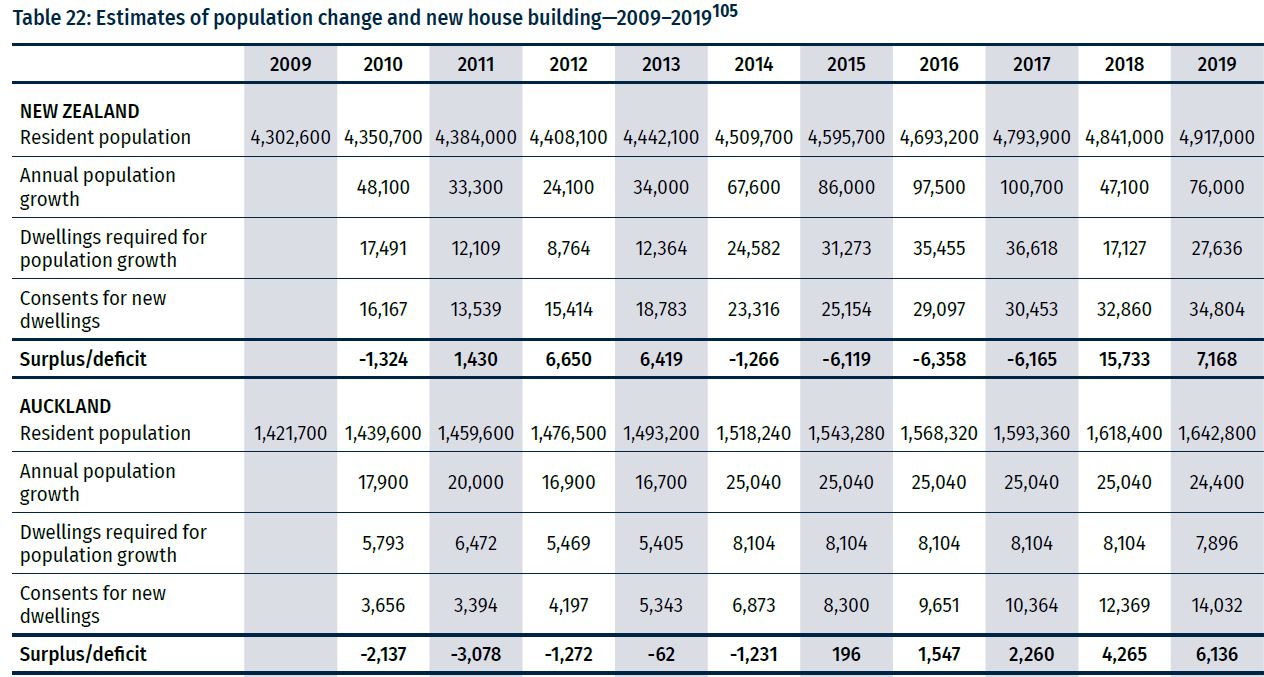
“We do not believe that this means there is suddenly an excess of total supply over demand in Auckland, but that the new building may now be catching up with the population growth and beginning to reduce the overall shortfall in supply,” the Salvation Army said.
Yet with the number of people homeless and unable to afford accommodation on the rise, despite this increase in supply, the Salvation Army said: “The crucial issues are incomes levels, housing costs and distribution, and not necessarily housing supply…
“The real housing problem in Auckland might in fact be about unaffordable house prices, income levels and a resulting potential bias against low-income tenants.
“We may be seeing a strongly differentiated market, catering well for those who are already homeowners, but not necessarily for low-income families.
“To address this, a more comprehensive and ambitious social housing building programme is needed in both Auckland and other areas around the country.”
Importantly, the Salvation Army noted that its consents/population growth comparison had in previous years shown more deficits. However revisions to Statistics New Zealand’s population data had turned some of these into surpluses.
“A more accurate picture will emerge when StatsNZ releases its final population figures for Census 2018, later in 2020,” it said.
Government response expected
The Government is on Thursday expected to unveil a $300 million investment over the medium to long-term in transitional housing, emergency housing and people at risk of homelessness.
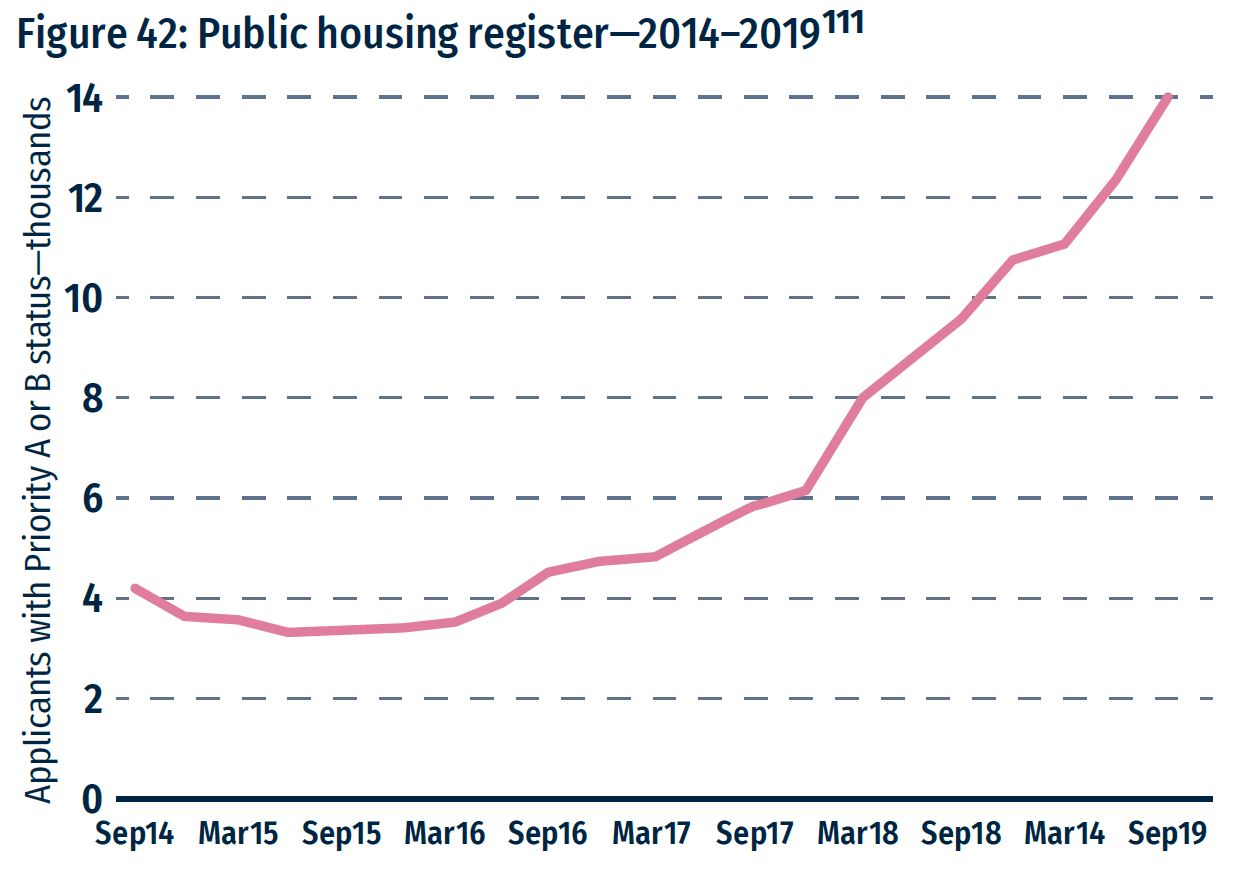
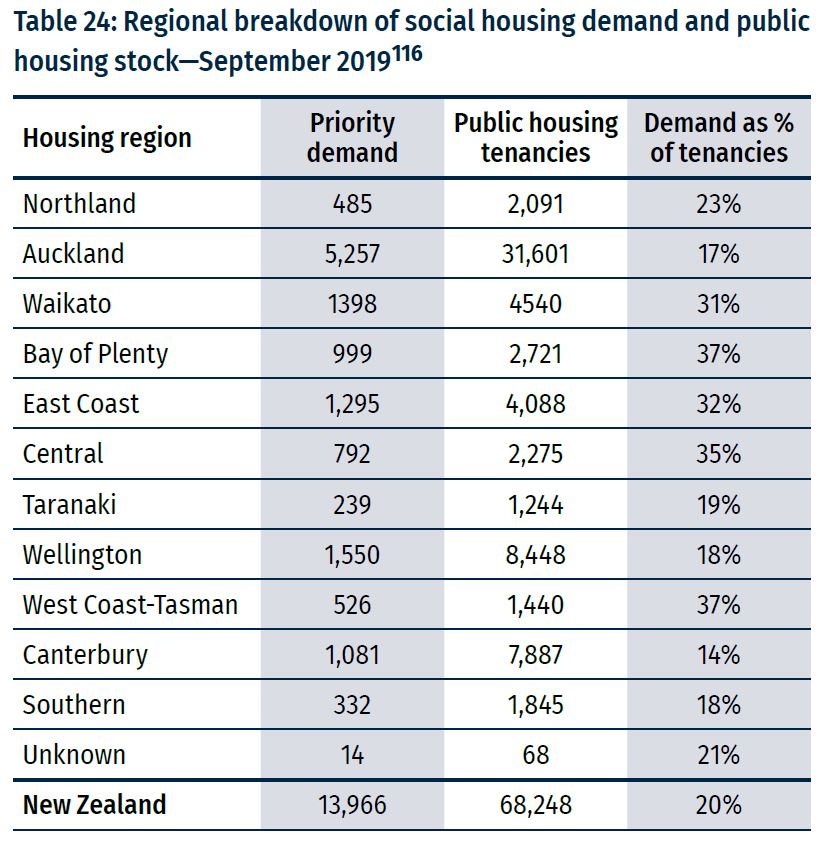
The country’s public housing waitlist is climbing over the 14,000 mark.
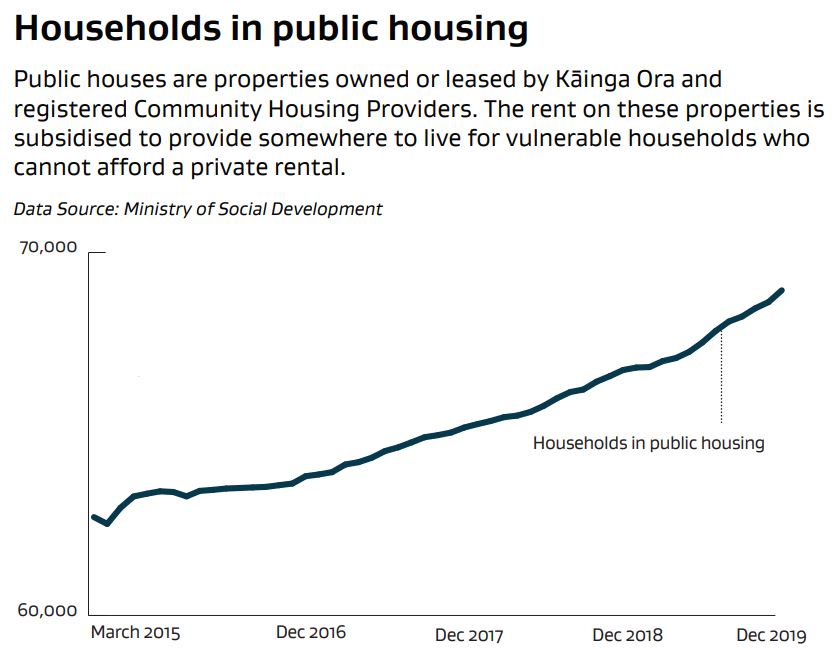
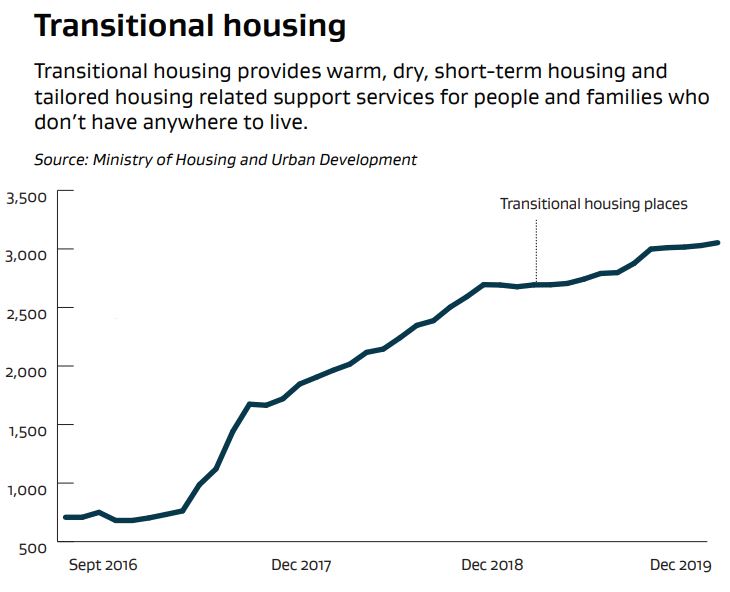
As at December 31, there were 68,970 households in public housing and 3,043 households in transitional housing.
Meanwhile 422 community houses and 2242 state houses were under construction or about to start being built.
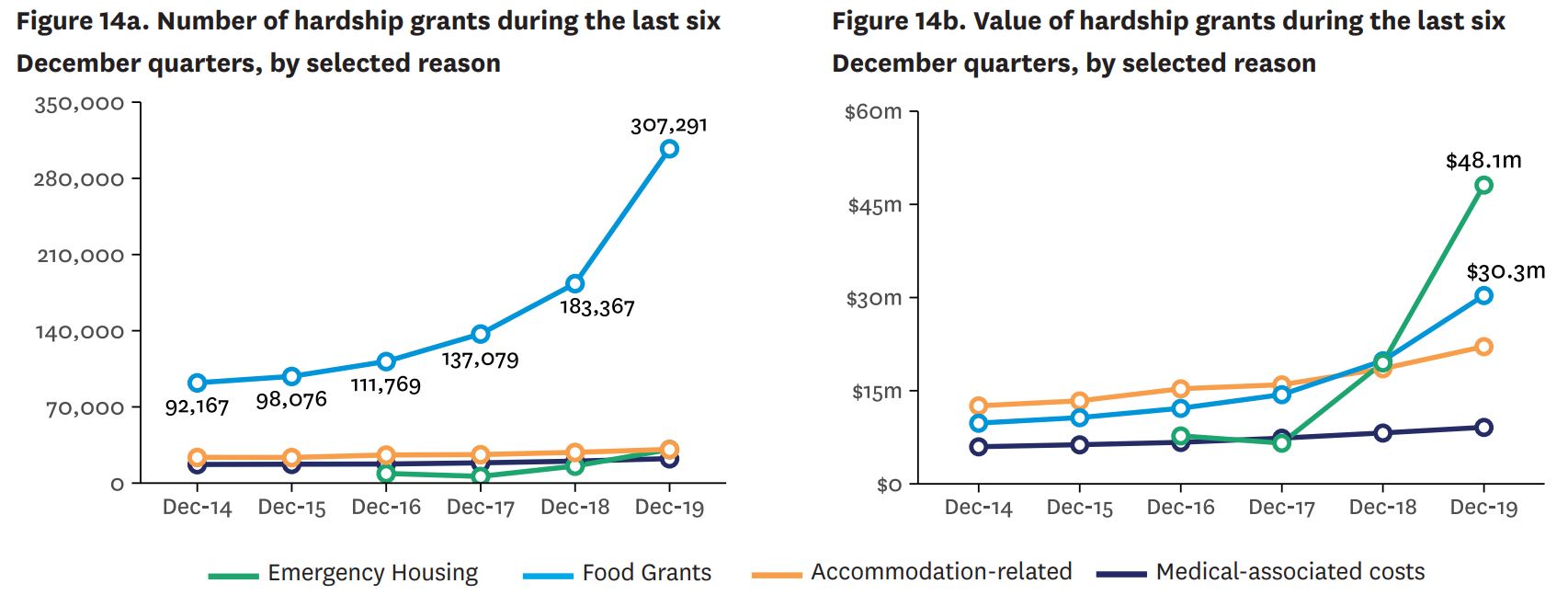
The number of Emergency Housing Grants issued by the Ministry of Social Development has increased five-fold in the past two years. Nearly 31,000 grants were issued in the December 2019 quarter at a cost of $48 million.
The Salvation Army said the stock of state-owned social housing is most inadequate in the Central North Island from Waikato to Manawatu (excluding Taranaki), as well as in the West Coast-Tasman region. It said supply is most adequate, but still not enough, in Auckland, Wellington and Christchurch.
“Clearly more emphasis needs to be given to building additional public housing in regions with high levels of demand relative to available stock,” it said.
Asked about the techniques the Government uses to match demand with supply, Housing Minister Megan Woods said: “State housing is very much matched to where we have demand. We know our waiting list; we know where we need houses. It’s also where we have land that we’re able to redevelop."
110 Comments
It's almost as if the prices expand to match the supply of debt.
If you want prices to come down start by dispatching the banksters.
Yes, but the supply of debt doesn't necessarily translate into increased debt consumption/housing spend. That's why we cram 50k - 100k a year of additional residents into the country, to push the demand side of the equation. There's our silver bullet that no politician wants to deal with, for vested interest's sake.
Our government's coffer has grown much faster than the economy since the mass migration charade began.
That's reason enough to not hold your breath for any political party in NZ to kill the goose that lays the golden egg, or in this case shut the door that brings in the billions in tax dollars for pollies to splash on their voter base.
The Sallies almost get it right. The supply of housing will not impact the price. This is caused by a lack of regulation, by the authorities still trying to believe in the 'free market' despite the obvious distortions. This will only be fixed when the Government gets it's collective head out of it'a ass and starts to do its job by regulating the market.
The government needs to be regulating all markets, this is what they were elected for. A UBI and prices of all goods and services fixed so that everyone gets the same, this is how successful economies operate.
But I thought under neoliberalism we want a free markets model? Let supply and demand take care of any imbalances that have distorted a market away from equilibrium?
You forgot the /sarc tag, or were you actually serious?
Probably 70% sarc, but still questioning the moral/ethical nature of neoliberal economics under a democratic government. Appears that now that it has worked for one part of society, that politically we use free markets when it suits some of the voting segment best, then other times when it doesn't. If we want free markets, we should have free markets, and there should be no accommodation supplementation for people living in housing provided by the private market - its distorting equilibrium. Rents/house prices are too high and without government assistance, those values would fall back to the real free market equilibrium point.
The 'free markets' have never ever been truly 'free' as they have always, and will always be manipulated by the players. The theoretical balance of supply and demand can only work when regulation stops manipulation.
You are partially correct when you say Governments selectively apply regulation, but you are completely wrong when you say "Rents/house prices are too high and without government assistance, those values would fall back to the real free market equilibrium point." People are still on the streets when the Accommodation supplements don't cut it, and rents do not come down. The players in the market are relying on our societal socialist principles to come into play through the accommodation supplements to subsidise their business investments (in rental properties). And because the Banks are financing a lot, if not all, of those investments the Government will not move to regulate because they are afraid of causing a crash (which many ministers will get burnt in too). Another area of this market; a number of commenters on this site have regularly pointed out that there are a number of distortions in the building market that have an impact on costs so there a a significant need for regulation in a lot of areas. I live in hope!
Regulation is the only way to stop manipulation, the government needs to set the price, to prevent the manipulators setting the price. Even at road side stalls, I recently had to pay $20 for 500g of mouthwatering cherries which is an outrageous price for famished commuters to pay. I have already lodged 4 complaints.
so you really want soviet style country? whoever controls the price every thing, will also control the ideas, what you can and cannot read, watch eat etc.
Nice try but, YAAAAAAWN
Supply and demand only works when consumers have a choice, and can walk away from a bad deal. When people have a need for shelter, they don't have a choice.
Yes but we are meant to be living in a free market economic model - where if the market is broken, it should fix itself. But our current welfare and tax regulations have distorted the market behaviour - property investors/landlords think that they win no matter what - because as you say, people need a roof over their head and don't have a choice. If we taxed the hell out of landlords/property speculators, instead of middle income earners picking up the costs via PAYE, then I think the distortion would remedy itself. But our current welfare/tax settings are encouraging the gap between the rich and poor to get wider - with one class of our society, exploiting another. Its wrong, but too many have done too well from it and they think its normal and a right so now it will be difficult to change that behaviour that has become a part of our society. 'Buy a rental mate to get ahead'.
And to boot, we exacerbate it by subsidising property investors with middle class welfare benefits.
Well said, I am now of the belief that this will take at least a generation to sort itself out, if it gets bad enough there will be civil unrest - pretty much inevitable on the current path.
You're on the right track but the tax regime is based on standard business rules, and property specific taxes may result in unintended consequences, but the investors will still manipulate the market. Regulation over and above taxation is also requred
Alternative accommodation isn't that bad. It also allows you to spend that money in some cool ways.
Agree with you there! I have some friends who live in a van, they don't even need to work full time because its so cheap for them, they work 6 months and travel 6 months (while doing their art, which is how they really want to get ahead)
I'm moving out of my apartment soon. Will be renting a friends garage for storage and living in my truck as a bit of an experiment. I reckon its far less stressful when it's not your only option.
A UBI or citizens dividend funded by land tax is the solution. You can't fix the price of goods and services though, otherwise productivity will be distorted.
The govt does not want house prices to drop, nor do the banksters, nor do the boomers. They will do everything possible to avoid any drop - creating credit, increasing immigration, restricting supply, placing regulatory hurdles - you name it, they will do it.
I have lost faith in all the main parties to anything to help anyone but us boomers - so I'm going TOP. We need a disrupter. And don't tell me it's a wasted vote....Nat/Lab etc have shown what a waste they are.
TOP will be a waste too. Fundamentally they are rooted in capitalism, which has been proven to be a failure just as much as communism is.They want to tax everything and the greatest impact of that will be on the middle and low economic groups. The wealthy however will find a way to avoid the taxes because the laws allow it.
suggest you look at their tax policies, quite a different approach. How do you avoid a tax on capital (in the form of housing in particular).. throw a sheet over it and tell the taxman he's imagining things?
Taxing a property based on "capital value" is just stupid BS. True value can only be determined when a buyer and seller come together and agree on a price. And just because my neighbours house sells for a price, does not mean my own's has a comparable value. Owning my own home does not create an income stream for me, it creates liabilities. So yes the taxman is imagining things!
And taxing the hell out of people doing the actual work is just plain worse bs and needs to change, especially when some of that tax is handed back to be passed on to the owners of the capital. Pure bs.
Those "doing actual work" are paying for those not "doing actual work". 15 billion pa/288m pw. Ever wondered why we bother focusing on the minuscule and not the major spend. Change that and you have your answers to the tax conundrums
...no Murray, the current tax system is stupid, the housing situation is stupid, the welfare system is stupid. If you wanna be stupid, then keep voting for the stupid parties that keep it stupid. Stupid.
You seem to be (deliberately?) missing the point.. its a tax on capital, not an income tax. It has nothing to do with generating an income stream, although it would divert investment away from capital appreciation assets to assets that do generate an income stream.
As for your comment about True value not being assertainable until a sale, are you saying the entire valuation profession (in all asset classes) is nothing but hokum?
Like most TOP supporters, it appears you don't know their policy. TOP themselves claim it to be an income tax. It is a tax on imputed (imaginary) income. Income tax would be paid on an asset's actual income OR imaginary income (risk free rate of return), whichever is higher. Pure insanity.
Ask a TOP supporter to explain what income you derive from your family home or recreational boat and you are in for a beautiful display of mental gymnastics.
I don't find it difficult - now tell me what you don't follow --
Invest $500 k in the bank your income is interest and taxed and your rent is not tax deductible.
Invest the $500k in a home, your income is the accommodation provided. This is not taxed.
Tax on $500 k at 33% is $16,500. That's how better off a home owner is tax wise.
And yes, lest set a threshold so the odd boat and toy is omitted. But we have real markets for boats remember. No specuvested like houses.
The fact that you don't find it difficult just means you are skilled at mental gymnastics.
The utility/enjoyment you get from your house or boat is not income (I actually agree with Pragmatist's statement in this regard - you are taxing the capital itself because the income is non-existent). In the same way that the utility/enjoyment you get from going for a walk on the beach or growing your own veggies is not income. What about brushing your own teeth instead of paying someone to do it for you? By your logic this is also imputed income.
If asked to fill in a generic form that asks for your income, you would need have a very special world view to think to include in your answer the utility you get from your house, boat, bike etc. The one tenuous string of hope for this argument is that imputed income is referenced in the national accounts, but this is irrelevant for reasons I won't get into. As an aside, you paid tax when you earned the $500K income to purchase the house you reference above. Same with the boat, in addition to paying tax again at the point of sale in the form of GST.
Imagine a piece of factory equipment sitting idle due to issues associated with the Corona virus. TOP wants to tax the imaginary income that this piece of equipment should theoretically be earning based on its value. It clearly is earning no income whatsoever.
Due dilgence - not. We are talking housing and tax bias, not tooth hygiene. This is pretty simple stuff and the tax bias is not disputed by anyone versed in tax. The opposition to it is for other reasons, mainly political and self interest (your problem I suspect).
The tooth hygiene analogy demonstrates the logical inconsistency in your argument. And we are not just talking tax bias as it relates to housing - TOP proposes to tax the imaginary income from all major assets, not just housing.
I am reasonably well versed in tax and can tell you the logic behind this type of tax is widely disputed by experts. It is not favored because it is logically flawed, difficult to implement/enforce, unfair and would result in terrible economic outcomes (such as capital flight, low productivity, low/negative growth and worsening unemployment).
Please address my point regarding the idle piece of factory equipment. What "income" is it earning that should be taxed as proposed by TOP?
Rastus, take your perspective a step further to see just how silly it is. Two people renting properties in the same street. One person has a rental agreement that sets the rental at $200 per week, the other $500. Should the first one be taxed on the $300 difference (benefit) he is getting over the other? Every home owner pays rent, it's just made up in rates, insurance, maintenance and so on. Its just not paid to a landlord.
Slaps face. You shouldn't be on a finance site mate.
Great rebuttal dismantling the argument put forward (sarcasm)
Seriously Rastus? That's the best you can do? You are trying to justify why someone who owns a home should be taxed on the value of that home. You utterly refuse to recognise the liability that the home generates to the home owner, or the sacrifices that owner has made to become a home owner, and when the flaws in your argument are pointed out you resort to name calling? Speaks for itself really.
Murray, you are 100% correct. I could rant for days about how illogical and harmful TOP's proposal to tax the imaginary income from all major assets is. Luckily the latest polling shows them down to only 0.6% if an election were held today.
*Thump Thump Thump* "Sir open up! High Court Bailiffs"
"Y-y-y-y-es?".
"Hello sir, we are here to execute a High Court Summons due to unpaid taxes on your personal book collection. We require payment in full today or we will seize items of value to put towards repaying this debt"
As I've posted before, give it 10 years when the boomers are incoherent and dribbling over their PJ's in the Summerset Village. Perhaps, then politicians will do what is right for NZ in 20 or 30 years time +, not just what is going to extract maximum financial value for the retiring babyboomer generation in the short term.
by then, me and a lot of my peers will be past childbearing age - a lost generation?
Get out of Auckland and Wellington. Cheaper and higher disposable incomes elsewhere. You can afford to have kids there. Cities are population sinks propped by more fecund provinces.
Speak for yourself Rastus Boomer but not for me. Have worked and paid for everything all my life. Now it is time to lie back and enjoy all what I have work for without having other people holding their hands out. Leave the BOOMERS alone.
As soon as the Government increases benefits to help the homeless, landlords deliberately increase rents by that amount thus taxpayers are subsidizing landlords again!!
Since the vast majority of the politicians in parliament are in fact landlords... no conflict of interest at all when they increased accommodation supplements!
No question in my mind it increases housing cost. Rent tends to cap at affordability levels and so do house purchases which would explain why Auckland rents and house prices have hardly moved for a couple of years while the rest of the country catches up
Too many low income people allowed to come here, too many people ripping off the system because we are recognized as a soft touch country, banks believing they are too big to failure and successive Governments allowing the housing system to be allowed to be used as a commodity to be traded with unbalanced benefits rather than a basic human wright. People immigrated to NZ in the 1800s to get away from feudalism to an egalitarian society. We are going full circle again.
Too many coming here, fullstop. We now have immigrants with large portfolios, renting houses back to locals unable to buy themselves a home, that is so wrong, I cannot even begin to stress how wrong I believe that is.
Winston will sort it out by slashing immigration.
Hahahahahahahahaha!
In spite of the meme of greedy Boomers hogging all the property, I don't know any who own more than two (including the one they live in).
I've got family members in the property industry in Auckland, and the scenario you mention of recent immigrants owning dozens of properties is very true.
And meanwhile I work with a (white, NZ born) boomer with I think 8... and know several others with at least 4. Lets stop trying to rile up xenophobia/racism.
I cannot even begin to stress how wrong this comment is.
I think We're at tipping point now, kianga ora is ramping up its builds bigtime condensing 1 big statehome property into multiplexes of 3 to 4 per section, so there is a lot of supply coming and not before time, I am sick of making vast wealth transfers to opportunistic immigrants who have bought old hotels purposefully to rent to MSD as emergency accomodation. Having said that, if it wasn't govt policy in former years to sell off HNZ homes there wouldn't be the need for emergency hotel accomodation either.... next issue to deal with is the community housing organisations based in Australia that are ever increasing their rents but not adding new stock because they don't want their ability to charge market rates impeeded....crooked much?
the worst policy ever brought in was market rents for social housing, so we pay a benefit then because of market rents we top it up and this was done so that private landlords could compete with social housing.
what a daft idea in the end its all our taxes and i would rather supply the house free and pay a lessor benefit to cover food electricity and clothing (on a card), anything else needed you should be able to earn up to 5K before you are penalized.
social housing and benefit should be so you can survive not make a lifestyle
Isn't it just transferring PAYE from income tax payers into the hands of property speculators?
Property speculators / beneficiaries, yes.
You're right, the landholders are the biggest beneficiaries of our economy.
and guess whom were some of the biggest beneficiaries of the whole setup . none other than those that proposed it and voted for it for both major parties, even ex prime ministers owned rentals talk about a conflict of interest
Yes, I think the ‘market rentals’ policy might be the most short-sighted and destructive of the last 30 years. Very wide-ranging damage done wrt poverty, social mobility, health, homelessness... thanks Nick Smith
There's so much wrong with this reasoning but I'd just highlight the fact that being social housing a consequence of overpriced housing you could also see it as a subsidy to housing speculators right? I guess it is just matter of tweaking reality to your own interest.
I've suggested this before...perhaps the solution is to be cruel to the kind.
Cut off all accommodation supplement payments, let people live in the streets for a while, and watch our landlord friends panic when they can't pay their mortgage on the rental.
We can't keep feeding a sick dog.
Incentives should be to increase productivity and standards of living - not to encourage more people into this landlord'ism/welfare system. Any ideas on how we could achieve that would be great - but less towards accommodation supplementation and more towards R&D, business lending. At present, it would appear, that we are encouraging the poor to be poor and the landlords to be landlords - and all we're doing is transferring tax from the middleclass income tax payers, to property speculators - and not to improve the lives of those who actually need it.
Accommodation benefit needs a rethink. My daughter gave birth this week and she will take a year off work. A logical society would have had her saving for this event but the accommodation benefit goes from generous to zero once she saves $8k (16k with her partner). A logic society would have her move from top price Auckland rental to a quiet place out of the city but then her accommodation allowance would be cut dramatically.
First step in reform is to allow for rational savings (say $40k) and make the reduction in the benefit pro rata not 100% and secondly remove all the four regional areas - this would mean poor people in remote areas of NZ receiving more but what is wrong with that - haven't we a regional development minister with $3b to play with? And there should be no accommodation to help pay mortgages.
I agree with Lapun, the way the abatement/welfare regime works is a disincentive toward behaviours that we should be encouraging. It's nuts. For example, it discourages sole beneficiaries from cohabiting as a means to reduce accommodation costs; it discourages job seekers to take on part-time or casual/seasonal work; it nullifies pay rises employers give to those on the WFF benefit, it discourages people from provincial living where accommodation costs are a bit lower, and I could go on.
There needs to be a plan to wean us off the ever increasing costs of both accommodation benefits and WFF benefits. Targeted benefits where abatement thresholds apply does alter behaviours, and not for the better.
Thanks Kate, wish I could express myself as well as you do.
Exactly. And that's what the people who whinge about "Why are there thousands on the dole when I can't find kiwifruit pickers!!!..." don't understand. The inflexibility of the welfare system is a trap in itself. It punishes those who try to work part-time or temporary jobs. Madness.
I'm a lurker on a Winz Advice Facebook page, and it's incredible how many people on there are finding it difficult to find affordable properties to rent. It's almost like flatting has become a foreign concept....."oh, it's only for students" ....etc
The number of people waiting for a state house has more than doubled under the COL which shows how a committed socialist government can have a huge impact on demand.
The Titanic didn't sink the moment the captain said full steam ahead (National on housing speculation).
Nice try, alt right troll. We all know National was refusing people the chance to get into a state house but the CoL and caring has given more people the chance to be on the waiting list. This is what we voted for, more state housing and more empathy for everyone.
Mediocre troll is mediocre.
Their report shows there is a housing surplus in Auckland.
So we could have surplus housing, with reduced immigration, with interest rates returning to historical averages into the future?
There is no reduced immigration only an ever longer bureaucratic queue of applicants. It is a deeply subtle policy to get any really talented immigrant to choose another country while leaving us with the checkout operators, fuel attendants, liquor store managers, fast food operatives, etc who cannot get into another country.
Hmm...I don't know. We've imported a few very highly skilled people over the past year, in the company I work in. No problems getting them in, as none with the skills / experience were available in NZ. Perhaps there are two queue lanes operating?
That was true, I got in that way myself. However there is a queue that is getting longer very quickly - just in the last year or so and reputedly there are two lanes with the govt job lane getting priority.
Immigration is a contentious issue - like the road speed some want higher and some want lower however every thinking person must agree that control by bureaucratic delay is both bad and unnecessary.
I should have mentioned I've recent knowledge - my son in law got in last year; it is not the time taken or even the dumb queries that are the trouble - it is the ages spent 'waiting for an application to be assigned to a case officer'.
INZ compares very badly with the NZ Passport office - they are prompt - they treat people as people.
Here we go again.
This is exactly what the medina multiple highlights, ie the higher the multiple, the more dysfunctional the housing market. Auckland has a high median multiple, we have a dysfunctional market.
That's why you can talk all you want about now having a surplus, yet housing is becoming more unaffordable and inequity is rising.
And the Demographia report highlights that what causes the majority of that dysfunction, namely land zoning restrictions.
Jurisdictions that have less zoning restrictions allow supply to equal demand in developer real-time, so they have no surplus or undersupply. There is no boom or bust, just a steady-state property market that increases only at the rate of inflation. House prices and rents are affordable.
Article yesterday on increased building costs suggests that increased regulatory burden on housing in last 10 years could be up to $140k per house. (assuming building costs would have otherwise tracked with inflation)
Some increase in costs by way of more insulation and airtightness requirements will add costs above the rate of inflation, but most of it is due to bureaucracy and monopoly advantage.
To us this cost is waste, to them that get to charge it, it is revenue.
Theres been huge changes in construction complexity in the last 5 years, foundations and retaining particularly more so, christchurch type tc3 seisemic foundations are becoming the norm nation and rigid air barriers that sort of thing. Its what is required to live healthily and safely.
Or you know, on the street if you can't afford that. Surely it'd be better to have a lesser quality house someone can afford than a really super-designed one that they can't?
That, of course, is the only option we have under the present system ie poorer quality but still at a high price.
What happens in jurisdictions with more open land zoning, is that any extra (legitimate) cost at the front end is discounted off the back end. The back end in development is the land as it was originally the first input cost.
There is a limit to this discounting back, which is to the lands next best use if it hasn't developed eg if you are buying rural land for development, then it cannot buy it for less than the real land value, otherwise, the owner will just keep farming it. But you wouldn't have to pay much for than the rural land value in less restrictive zoning jurisdictions if you wanted to purchase for development.
And since the price of all land is set at this rural fringe, all other land going back into the center is priced relative to that.
In NZ we have unaffordable housing everywhere because of the restricted fringe which gives a monopoly to those few owners and they can demand more than its rural land value and therefore our developments are a cost-plus approach, without regard to the efficiency of the input costs.
But but but then councils won't be able to control absolutely all property development!!! It'll be carnage I tells ya!!!
What's an extra cost to us is extra revenue for them.
FOMO
https://www.ccn.com/dow-rallies-on-fed-liquidity-as-bulls-ignore-fomo-b…
God forbids if the market turns - will be bloodbath all over and NOW Fed and others do not have any choice but to put cheap and free money in the market - They are at ransom by their own doing.
FOMO in stock and also in House is a real threat now.
On the housing front, went to an onsite open home yesterday and a house went 15% above its reserve (had 5 bidders of which two drop out soon but three asians just kept raising their hand as if that was the last house in market :). Vendor was jumping with joy so I guess .......THEY are back in market and have found a way to manipulate (As the saying goes that give them sometime and will find a way/loophole to manipulate). So more stock will be more for them to speculate. FHB is finished specially in Auckland and even if buy now for FOMO will have problem in future whenever the rate goes up (Though not in near future but moratge is normally for 25 to 30 years ).
Delay the consequence but cannot avoid by pumping money.
In stock market in 2019 many did well by increasing their profit between 30% to 70% so FOMO is greater this year and also the belief that whatever wrong may happen will be bailed out by Fed and government so everyone is ready to take chance desite the warning indicators - though everything at this stage looks like the party will continue - even major event like Coronavirus has not dampened the momentum.
I used to help the Sallies and the City Mission by providing blankets, bedding etc and also by working there, simply stacking clothes and other items. I noticed the same people gathering outside, sitting on the footpath and one day I asked what they were doing there? "We're waiting for you guys to finish so we can get some clothes", I asked them if they wanted to helps unload the clothes from the vans, sort them and hang them? "Nah, we'll wait" they replied. That was the last day I helped. We have to accept that some people, maybe 5%, just don't want to do what is needed to have a better life
I agree , BUT that is a small number, the numbers that are below the poverty line now are much much greater and many of them are very grateful for the help.
the help they need is more than just stuff though they also need support in how to manage todays world,
im sure your time down there has helped shape your thoughts
now I always ask myself before I buy anything do I really need this or just want it, it saves me from buying a lot of stuff
I don't know the numbers living in poverty, is it much more than about 5% which, in my opinion, roughly represents the amount of people not willing to do what is needed to improve their own life
Auckland sales in 2019 LOWER than in 2009 (22,477 v 22,835.)
Consents 2010-19: up 78,000
Stock hence up about 14% (STILL no stock figures for 2018 from Stats NZ, for Auckland)
Pop of Auckland up 204,000 2009-19.
Cannot assume that its 3 people per dwelling I am afraid.
Look at what is consented - more and more 2 bed townhouses and retirement flats.
Not 3 bed places with gardens.
Meanwhile rented accommodation costs rise 3 times faster than wages.
Plus, fewer State houses now than 10 years ago.
Plus more iniquitous tax regime.
I see this as two issues at play, one is overall affordability and the other is the divergence in net wealth.
Yes pointless if we are importing thousands of people every year to "work" in liquor stores and as uber drivers.
Where's TM2?
He stated that he is providing a good social service by renting his many rental properties out to people.. Need buying many more obviously.
Interesting how the figures show Auckland's housing supply starting to go really positive from 2016 on - pretty much in alignment with those that predicted the Unitary Plan would be needed to increase housing supply. Seeing as I've been right with all my house market predictions for last 2 decades will be having celebratory beer tonight. Would be fascinated to know what happened to the commentators from 12+ years ago who gloated about selling their full site Mt Eden villas for high 700's at the market peak?
Depends, if they moved to Tauranga they will have done well and if they moved to the Gold Coast they will have not.
We have the Gnats to thank for really pushing council on the Unitary Plan.
They did do a couple of good things for housing (SHAs were another)
So this Unitary Plan idea, it was to enable more affordable housings to be built - right?
Not just more unaffordable houses?
State housing at reasonable rent is the only way to fix this.
A hand up not a hand out is what is required.
$500/$600 hundred a week on rent is preventing people getting ahead even those that have 2 incomes.
If this problem isn't fixed there will be a version of the Arab spring in NZ in the years ahead.Hopefully with less violence and stupidity but there will be something imo.
If Kiwibuild $2 billion investment = 600 houses built in 2 years.
New initiative $300 million = 90 houses get built 2 years from now?
1) World wide low interest rates driving up asset prices
2) Houses treated as commodity assets due to the lack of a capital (gains) tax or land tax
3) Governance failures by successive government running very high per capita (one of the highest in the world) immigration rates (as an aside this is expensive vs a per net zero carbon target) aimed at driving gdp growth rather than gdp/capita and total welfare/capita growth
4) An inelastic RMA
5) There is little low income housing available due to all of the above
6) There is no profit to be made in low income housing - it has to be provided by the state
7) Governance failure by successive governments / local governments to provide sufficient low income housing
8) Failure again by this government - the latest infrastructure splurge is mainly roading & PT (billions) whilst we have the longest ever waiting list for accommodation and only a $300 million investment in housing
9) NZ has a strategic governance failure and deserves much much better
What a brilliant, sensible link Chairman Moa. The Scandinavians are certainly the most advanced and sensible countries on this earth by a country mile. I'm ashamed of my Anglo-Saxon background with its still class-ridden, money-grabbing, wealth-disparity ethos.
Labour's stupid, National's stupid, NZ First are really stupid. Who do you vote for out of this lot?
You just have look at the Brexit nonsense; and the poms still think they rule the world. And the other so-called superpowers: the Russians need a corrupt dictator, the Chinese need an authoritarian dictator, the Americans (USA) need a fascist half-wit. Their populations are half-wits to allow this situation to arise. Why don't we just allow Scandinavian immigrants? A stupid suggestion because they wouldn't want to come.
I seriously advocate that we volunteer to become a colony of one of the Scandinavian countries, if one of them would have us which I doubt. And I'm not joking.
haw haw ...what a hornets nest this has stirred up today, in one's St Mary's Bay backyard. The proletariat out there just have no idea what my ilk are up to....and I must say with all the bickering and squabbling going on just detracts from what is "really" happening ....its all about the great "Transfer of Wealth" don't you know and it's working so well ....haw haw
As for you Boomers, you are doing a damn fine job of keeping those beautiful banks in business, with all those juicy mortgages on your investment properties....while our fine government (doesn't matter which one to me or my cohorts ...haw haw) are keeping those accommodation supplements flowing like liquid honey, straight into the landlords pocket ...which of course goes straight to mortgage interests payments and back to the bank .....haw haw ! It's like you do all the work and we line our pockets with your spoils .....haw haw.... while moi and my pals are orf playing polo or what not ...haw haw.
Then you get all excited saying "look, look !" my Avondalay 3 bedder, 60 year old weatherboard, ex state house is worth a cool million (in NZD haw haw ! ) ...oh oh I can move up the "property ladder" ..must "keep up with the Kardashians" ....only to find your dream home of a 4 bdm renovated villa, in that most beautiful suburb of Kingsland is now worth 3 mill ......haw haw. So my little cherubs, what do you have to do to attain your Kingsland "palace" ....haw haw .....it's time to "up that mortgage" by a cool 2 mil or so ...no problem to me, as you come cap in hand to your bank saying "please, please can I have some more" it's like a drug to you, an "opiate of the boomers" so to speak haw haw ....so the cycle grows and continues .....and me and good chums just get richer ....and that deserves the biggest HAW HAW !
Anyway, get back to your work and stop dilly dallying around on your PC and earn those glorious dollars for that landlord, so they can forward it on to moi !! .....must dash, one has an appointment with a gin trolley and a bottle of "The London No. 1 Original Blue Gin" ......just devine on a hot, sunny February afternoon from my chaise lounge on the balcony with exquisite harbour views .....toodle pip for now.
What was that about? WTF, I haven't a clue!
Good Evening Chairman Moa, esteemed guests, ladies and gentlemen ......just partaking in a little light banter ol' boy, with a touch of sarcasm .....make of it what you will.....have a lovely evening ....toodle pip for now
The salvation army is struggling like the rest of us without complete up to date statistics.
As a larger supplier of housing to middle and lower income people I can see the government and the likes of Salvation army are saying the private market should look after the 400,000 private rentals that get no subsidy of Accommodation supplement and leave the other 200,000 rental dwellings that get AS for the government to provide. According to reliable statistics at the moment there are around 65000 social houses some of which tenants pay market rent (non deserving tenants). I ask how does anyone believe any government can do that job. I say let the private market continue doing a great job and help those of us housing the poor do a better job.
This confirms what I have been saying for quite a while, while we are building at record numbers, we are building the wrong houses, just those for which it is expected a higher return. Good news for those that need a home is that overseas money is pretty much done, even for new construction homes and at some stage not too late many of those luxury apartment buildings will go on sale.
We welcome your comments below. If you are not already registered, please register to comment
Remember we welcome robust, respectful and insightful debate. We don't welcome abusive or defamatory comments and will de-register those repeatedly making such comments. Our current comment policy is here.