
Housing prices may have peaked in March and begun a slow decline, according to the Real Estate Institute of New Zealand's House Price Index (HPI).
The HPI for the whole of NZ peaked at a record high in March and then declined in April and May and is now 2.4% lower than in March.
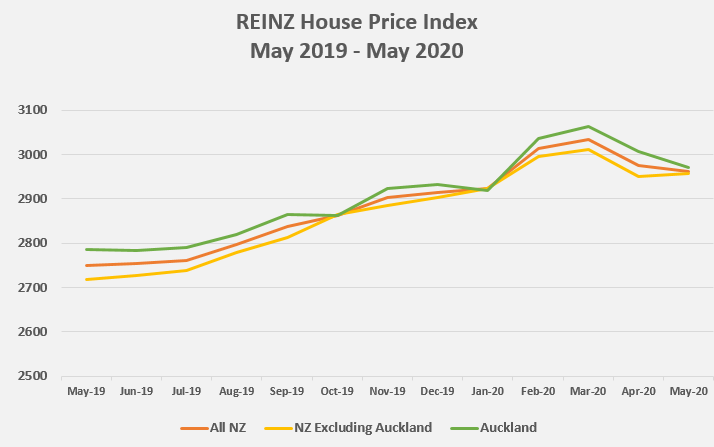
The graph below shows the monthly trends in the HPI for all of NZ, Auckland, and all of NZ excluding Auckland, from May last year to May this year.
The three sets of figures all show a remarkably similar trend, rising steadily from August last year to January this year, then rising strongly in February and peaking in March, before declining again.
The HPI was developed by the REINZ in association with the Reserve Bank and is considered a more accurate overall measure of housing price trends than either median or average selling prices, because it adjusts for differences in the composition of housing types that are sold each month.
The table below shows the movement of the HPI for cities and districts 28 districts throughout the country, from its peak in March until the end of May, and the percentage change in that time.
Of the 28 districts recorded, only four registered a gain between March and May: Papakura in south Auckland +0.9%, Rotorua +1.9%, Lower Hutt +0.2% and Invercargill +2.0%.
The remaining 24 districts all posted declines, with the biggest decreases occurring in Queenstown-Lakes -5.8%, Waitakere (west Auckland) -4.3%, Palmerston North -4.1%, Auckland City (the central suburbs that previously fell within the boundaries of the former Auckland City Council pre-amalgamation) -4.0%, and Upper Hutt -4.0%.
However, although the figures suggest a reasonably consistent trend, it should still be treated as a tentative one.
The real estate market was severely affected by lockdown restrictions in April and May, resulting in sales numbers that were well below historic norms.
It could take another month or two before it becomes clear whether the decline in prices evident in April and May was a temporary blip or part of a longer term trend.
Commenting on the HPI figures in a Home Truths newsletter, Westpac Chief Economist Dominick Stephens said the decline in prices was expected.
"New Zealand is staring down the barrel of a severe recession and house prices always fall during recessions," he said.
"We expect house prices to decline less severely than during the Global Financial Crisis, but more severely than the early 1990s or late 1990s recessions."
The comment stream on this story is now closed.
| REINZ House Price Index | ||||
| March - May 2020 | ||||
| March | April | May | Change March-May | |
| New Zealand | 3034 | 2975 | 2962 | -2.4% |
| NZ excl. Auckland | 3010 | 2951 | 2956 | -1.8% |
| Auckland Region | 3063 | 3006 | 2970 | -3.0% |
| Rodney | 2919 | 2987 | 2882 | -1.3% |
| North Shore | 3119 | 3088 | 3017 | -3.3% |
| Waitakere | 3247 | 3111 | 3108 | -4.3% |
| Auckland City | 2949 | 2855 | 2830 | -4.0% |
| Manukau | 3192 | 3181 | 3154 | -1.2% |
| Papakura | 3181 | 3297 | 3209 | 0.9% |
| Franklin | 3206 | 3098 | 3187 | -0.6% |
| Whangarei | 3114 | 3077 | 3108 | -0.2% |
| Hamilton | 3277 | 3138 | 3231 | -1.4% |
| Tauranga | 2851 | 2899 | 2846 | -0.2% |
| Rotorua | 3622 | 3584 | 3692 | 1.9% |
| Hastings | 3218 | 3049 | 3168 | -1.6% |
| Napier | 2917 | 2800 | 2878 | -1.3% |
| New Plymouth | 3222 | 3049 | 3153 | -2.1% |
| Palmerston North | 3223 | 3090 | 3092 | -4.1% |
| Wellington Region | 3039 | 2992 | 2971 | -2.2% |
| Porirua | 3126 | 2887 | 3080 | -1.5% |
| Upper Hutt | 3534 | 3402 | 3394 | -4.0% |
| Lower Hutt | 3320 | 3389 | 3325 | 0.2% |
| Wellington City | 2739 | 2733 | 2661 | -2.8% |
| Nelson | 2468 | 2541 | 2437 | -1.3% |
| Christchurch | 2480 | 2436 | 2426 | -2.2% |
| Queenstown Lakes | 2731 | 2737 | 2572 | -5.8% |
| Dunedin | 3740 | 3704 | 3649 | -2.4% |
| Invercargill | 3312 | 3349 | 3379 | 2.0% |
We welcome your comments below. If you are not already registered, please register to comment
Remember we welcome robust, respectful and insightful debate. We don't welcome abusive or defamatory comments and will de-register those repeatedly making such comments. Our current comment policy is here.