
By David Norman and Shane Martin
• The covid-19 pandemic has impacted employment and preferences about where people choose to live or work.
• Auckland Council has requested that the three yearly revaluation of properties be delayed a year to allow the re-establishment of the market. At current low sales volumes post-pandemic it is extremely challenging to show the medium-term trajectory of the market or credibly revalue properties.
• Auckland currently uses a capital value (land value plus improvement value) based ratings system to collect property rates. The variable component of the rates bill is based on the capital value of the property.
• Given the accelerated change in how people live and work, the challenging financial environment that councils are in from the covid-19 shutdown, the timing of the property revaluation process, and the incentives to more efficient use of land that a switch would provide, one option may be to switch to a land value based rating system.
• A land value based system would see around 59% of Auckland households pay less in rates.
Auckland’s changing patterns
The lockdown, aimed at preventing further spread of the covid-19 virus, brought much of the city to a halt. Up to 40% of economic activity could not occur under Level 4. At the same time, thousands of office workers who had previously faced the daily commute into the city centre suddenly had no option but to work from home. Technological deficiencies were unearthed and dealt with as a matter of urgency.
With open homes cancelled, people staying in their bubbles, and less job security, house sales plummeted by 70% in April compared to a year ago and remained down almost 50% in May. This makes it hard to infer any medium-term patterns from these sales data, much less infer the value of the entire housing stock.
Back at Level 2 and Level 1, workers travelling into the city centre have reduced. Many office based businesses have chosen to adopt a model that includes more working from home and a smaller office footprint. Workers’ preferences for warmer drier homes will also likely strengthen now that they are spending many more hours in them.
These potential changes mean it makes little sense to undertake a property revaluation today; leaving this until we have a better understanding (and more data) on the new economic realities is likely to deliver more credible valuations.
But the impacts of the covid-19 lockdown are widespread. Auckland Council is not immune from these challenges, with an estimated hit to revenue of over $500 million. This means more than ever, pressure exists to deliver development that uses existing or new infrastructure capacity efficiently, and maximises the number of homes the region delivers to house Aucklanders.
Capital based vs land based ratings systems
Auckland’s current property rates system uses capital values (CV) to determine the variable component of a property’s rates bill. This approach, is widespread in New Zealand, but does not incentivise the most efficient use of land. Land owners who use land efficiently by developing on it, pay higher property rates, because the more improvements you add, the more you pay.
Another challenge with a CV based rates system is that because it does not incentivise land development, it creates less certainty about when development contributions and additional rates revenue will be received by councils. In times of financial challenge, the right incentives need to be in place to encourage uptake of new infrastructure soon after it is put in place.
In summary, a land value (LV) based rates system approach has several strengths:
1. It incentivises efficient use of land and doesn’t reward those who do not develop their land.
2. It is easy to administer.
3. It is difficult to evade.
4. It doesn’t distort production in the economy – land is fixed and a tax on it won’t mean less of it is produced.
5. It better aligns timing between infrastructure provision and take-up of that infrastructure.
6. It is progressive. Those with more valuable land pay more.
Who thinks this is a good idea?
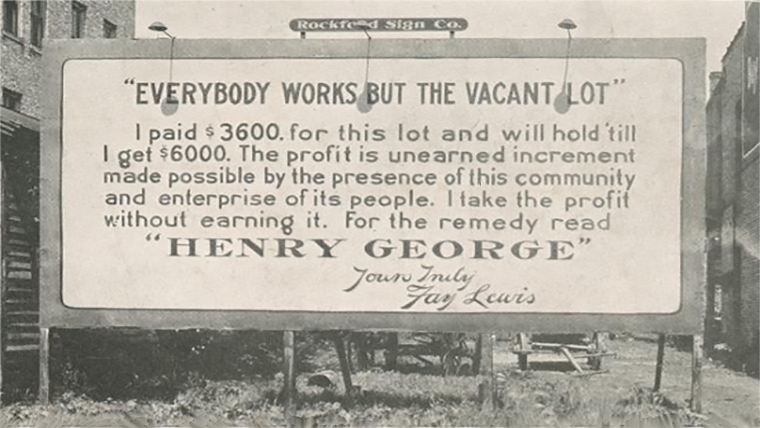
The economic advantages of an LV based system have been understood going back at least as far as Henry George, a 19th century economist.
In New Zealand, support from economists for an LV based tax is widespread because of its advantages. An LV tax was favoured by the Tax Working Group that the 2008-2017 National-led government instituted and is favoured by a wide range of academic and think tank economists from the left and the right.
Internationally, support is strong for an LV based tax as well. Here are a few quotes:
• The Financial Times: “In theory, it is not just an excellent tax but the best of all possible taxes. Once the initial valuations have been done, it is phenomenally easy to collect and all but impossible to avoid. It also discourages speculation and stops in its tracks the endless cycle of investment in land and property purely to rent it out. It promises no more property boom and bust. But, as it is not collected on any improvements made to land or to buildings on land, it does not discourage productive activity. Instead, it encourages people to bring idle land into use, to improve land they own and to be as productive as possible.”
• Mirrlees Review of the UK tax system published in 2011: “Taxing land ownership is equivalent to taxing an economic rent—to do so does not discourage any desirable activity. Land is not a produced input; its supply is fixed and cannot be affected by the introduction of a tax.”
• Lincoln Institute of Land Policy: “After surveying the experiences of taxing jurisdictions around the world, we conclude that LV taxation is more than an intriguing and attractive idea. It is a form of taxation that has actually worked since the nineteenth century at national, state and local levels of government… Proposals to tax LVs more heavily than improvement values can find support in both historical experience and economic theory.”
If it’s so good, who uses it?
Several jurisdictions overseas have adopted a rates system based on LVs. In fact, more than 30 countries have some experience with separately estimating LV and taxing it, including New Zealand.
In New Zealand, LV rating was used to some extent in the former Auckland councils of Waitakere, North Shore, Rodney, and Papakura. On amalgamation, a requirement was put in place that until the 2012/13 year, CVs were to be used.
Overseas, a number of developed economies use an LV based tax system to varying extents.
Pure land tax systems
• Denmark
• Singapore
• Taiwan
Land taxes with other objectives
Some Australian states have used land taxes. e.g. NSW and Victoria. The objective appears to be to tax speculative investment on multiple properties, rather than encouraging the best use of all land. In both NSW and Victoria, the primary residence has been exempt from an LV based tax.
Mixed land value – capital value tax systems
In Pennsylvania in the United States, several municipalities use a mixed tax that applies a higher rate of tax on land, and a lower rate of tax on improvements, the so-called “two rate” system. This mix appears to be a compromise, with the tax rate on land being 1.6 times to 44 times higher than on improvements, with most in the range of four to seven higher than on improvements.
The biggest challenge to greater uptake appears to be political. The Economist magazine puts this well:
The bigger barrier is political. LVTs would impose concentrated costs on today’s landowners, who face a new tax bill and a reduced sale price. The benefit, by contrast, is spread equally over today’s population and future generations.
In Pittsburgh, for example, after a review of LVs that saw strong increases in the value of some land, political controversy ensued. The entire land tax was disestablished after lobbying from those with valuable land. New Zealand councils are fortunate in having a well-established revaluations process, and a robust process for those who wish to contest property valuations.
Is there proof that a LV tax works better?
Theoretically, the argument in favour of an LV system over a CV system is easy to make. But can we show that an LV system encourages more of the much-needed development than would be the case if CVs were used within the same jurisdiction?
The Pennsylvania experience is helpful here. A study of 15 municipalities with two-rate systems and 204 municipalities without, found that two-rate systems had higher rates of construction.
A separate study of Pittsburgh and economically similar cities nearby showed that Pittsburgh experienced a sharp rise in building activity relative to comparators despite its falling population in the 1980s. One factor explaining this difference was the introduction of an LV oriented tax.
But Auckland is not Pennsylvania
LV oriented tax systems have worked well in a US state that experienced slow growth over the 14 years analysed – just 0.2% per year on average across Pennsylvania during that period. Meanwhile, Auckland grew by around 2% a year over 17 years.
If anything, this implies that an LV ratings base would likely be more effective in encouraging efficient land use in Auckland than in Pennsylvania. Growth in residential LVs has likely been higher in Auckland given its relative growth rate, and certainly much faster than growth in improvement values. This makes the skewing of the current tax system in favour of under-used land all the larger, which a switch would overcome.
The Pennsylvania study also provides some scale to the question of how much incentive a switch to an LV based system might offer. Notwithstanding the earlier comments that the incentives to develop under-used residentially-zoned land through switching to an LV based rating system are likely to be higher in Auckland than in Pennsylvania, that study does provide some sense of the scale of the likely change. In Auckland, a further 650 dwellings could be consented each year, on top of the average of 14,800 consented in the year to April 2020, assuming the supply elasticity of a change in tax regime estimated in the Pennsylvania study. This would be an increase of 4.4% in dwellings consented each year in Auckland.
Two further idiosyncrasies in Auckland
In Auckland today, those who use residentially-zoned land for farming purposes are given a discount of up to 20% off their residential zone rates. The rationale is that these land holdings don’t use the services that developed properties do. But the infrastructure services have to be there regardless of whether the land owner chooses to use them.
Further, residentially-zoned land in more rural oriented (as opposed to rurally-zoned areas) areas receive a 10% discount on their rates, the argument being that they don’t have access to the same level of services that urban residentially-zoned areas do. Economics counters that while it is undoubtedly true that land in rural-oriented residential areas have access to a lower level of services than those in urban residential areas, this is already reflected in lower land values.
In Auckland, the largest 0.1% of properties zoned for residential use but used in less efficient ways (farming or lifestyle) accounted for almost 8% of available residentially-zoned land in 2020.
What a switch would mean for Aucklanders
We analysed the impact of switching from the current system that uses a mix of uniform general rates and CV based rates to a scenario that:
1. Assigns all rates based on LV
2. Removes the 20% discount for using residentially-zoned land for less efficient purposes
3. Removes the 10% discount for residentiallyzoned rural properties.
Our analysis was limited only to residentially-zoned properties used for residential or rural purposes and re-assigns the residential rates take for the 2019/20 year by applying the same rate per dollar value across all land parcels included in the analysis. Analysis was using the 2017 residentially-zoned property valuations.
Key findings
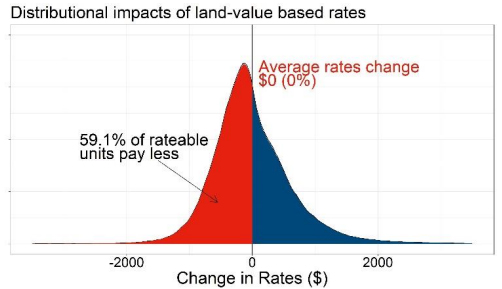
• 59% of Auckland residential ratepayers would pay on average $476 less a year.
• A further 12% of ratepayers would receive a rates bill increase of no more than $200 (less than 10%) a year. On average, their increase would be less than $2 a week.
• Many retirement villages and apartment complexes would see their rates fall as they are using their land efficiently.
• The 5% of properties that would receive the biggest dollar increases have LVs of $2.85 million on average, but improvements are typically only 12% of the property’s value. This compares to 29% across all residentially-zoned properties in Auckland. These high LV but low improvement value properties are being used inefficiently.
• In contrast, the 5% of properties that would receive the biggest dollar rates decreases have improvements worth over 57% of the property’s value – they are being used quite efficiently.
Would this be hard to implement?
First, it’s important to point out that the any switch to an LV oriented system would require consideration of a wider range of factors than those encompassed here to meet obligations of the local Government Act. But an LV oriented system would be administratively relatively easy and cheap to implement. We were able to calculate the revised rates bills for each property in a few hours after receiving the current valuations and rates bills, for example. These figures could then be easily uploaded for use in bill notifications.
Introducing a step-change in a year in which new valuations are implemented would make the task administratively easier as a review is being done anyway.
One way to overcome upfront challenges could be to introduce a gradual switch to an LV based system, perhaps over five years as set out in the example table below.
| Contribution to rates bill calculation | ||
| Land value | Improvements value |
|
| Current system | 100% | 100% |
| Year 1 of change | 100% | 80% |
| Year 2 of change | 100% | 60% |
| Year 3 of change | 100% | 40% |
| Year 4 of change | 100% | 20% |
| Year 5 of change | 100% | 0% |
The benefits of this approach would be:
• It would still be relatively easy administratively.
• The suddenness of the change would be reduced, meaning those with under-used land would have the opportunity to consider their options.
• The change would occur across at least two three-yearly revaluation process, which would provide an opportunity for those who dispute the value of their property to have their say through a routine process.
On the cost side, this gradual approach would mean one of the key benefits of a switch to an LV based tax – increased housing production – could be delayed for a few more years.
* David Norman is chief economist at the Auckland Council. Shane Martin is a senior economist at Auckland Council. This article was first published here. It is here with permission.
We welcome your comments below. If you are not already registered, please register to comment
Remember we welcome robust, respectful and insightful debate. We don't welcome abusive or defamatory comments and will de-register those repeatedly making such comments. Our current comment policy is here.