

The much anticipated decline in residential property values appears to have started in February, according to the latest data from Quotable Value (QV).
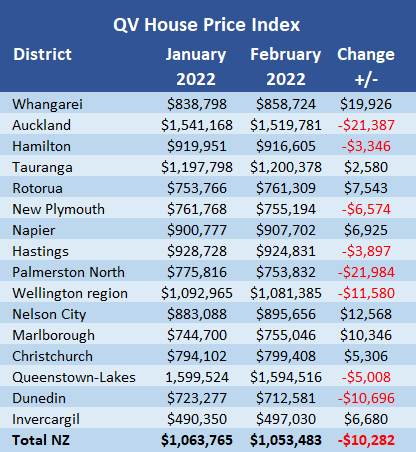
According to the QV House Price Index, the average value of all homes throughout New Zealand declined to $1,053,483 at the end of February from $1,068,765 at the end of January. That's a decline of $10,282 for the month.
That reflects falls in average dwelling values in Auckland, Hamilton, New Plymouth, Hastings, Palmerston North, Wellington Region, Queenstown-Lakes and Invercargill, while average values in all other districts continued to rise, although generally at a slower pace than previously.
The biggest monthly decline was in Palmerston North where the average dwelling value declined by $21,894 in February, while the smallest decline was in Hamilton at $3346.
In Auckland the average dwelling value fell $21,387, and in the Wellington Region it was down $11,580.
The slide in values appears to be particularly well established in Hamilton, Queenstown-Lakes and Dunedin, where average values have now declined for two months in a row.
However given the very strong growth in values that occurred last year, the drop in values so far has been comparatively gentle. Although the national average dwelling value dropped by just over $10,000 in February, it would still need drop by more than $50,000 to go back under $1 million.
That may not be as unlikely as it seems.
The QV House Price Index is a rolling three month average, and house price growth, which feeds into the HPI's average value calculations, was particularly strong up until the end of last year.
That means the value falls evident in February's figures would have been mitigated to a significant degree by the strong price growth still evident in December.
"The strong December numbers are masking what's really happening out there," QV General Manager David Nagel said.
"There are less buyers out there now, with the tightened credit rules and rising interest rates taking a number of first home buyers and investors out of the market altogether.
"Increased listings from both new builds and existing homes are providing the dwindling buyer pool with ample choice and this is putting downward pressure on prices.
"It's taking a lot longer to sell a house this year, with open home attendance and auction clearance rates significantly impacted.
"While part of this may be attributed to Covid-19, primarily we're seeing a residential property market that has peaked and is searching for the new equilibrium, Nagel said.
That makes it likely that the slide in average property values that began in February will intensify over coming months and spread to other districts that are currently still showing growth in values.
The comment stream on this story is now closed.
We welcome your comments below. If you are not already registered, please register to comment
Remember we welcome robust, respectful and insightful debate. We don't welcome abusive or defamatory comments and will de-register those repeatedly making such comments. Our current comment policy is here.