

House prices may have already fallen further than some figures suggest, according to the Real Estate Institute of New Zealand's latest House Price Index.
Many measures of housing prices are based on figures such as medians or averages.
While these can provide a useful indicator of price movements in the market, they can also be influenced by changes in the mix of properties being sold from month to month.
For example if the top end of the market is more buoyant than the middle and/or bottom of the market, that can push up median or average prices even if the prices of individual properties aren't moving much.
That appears to be what is happening in the housing market at the moment.
The REINZ's national median house price was up by 0.6% in March compared to February, which followed a 0.6% rise in February from January.
On their own, those numbers suggest prices have continued to rise at a relatively modest pace since the beginning of this year.
However the REINZ's House Price Index tells a different story.
The HPI adjusts for differences in the composition of sales each month, to give a better idea of overall price movements.
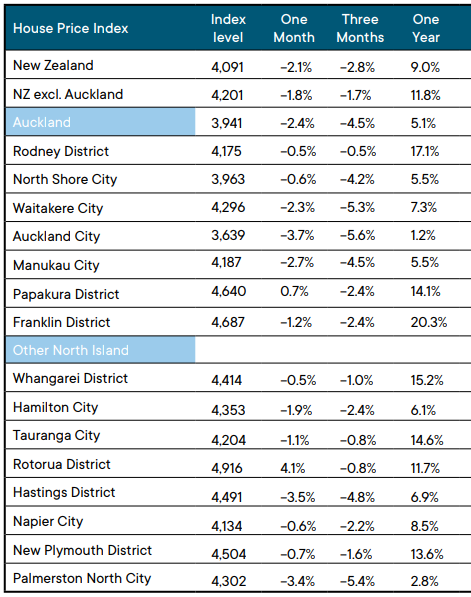
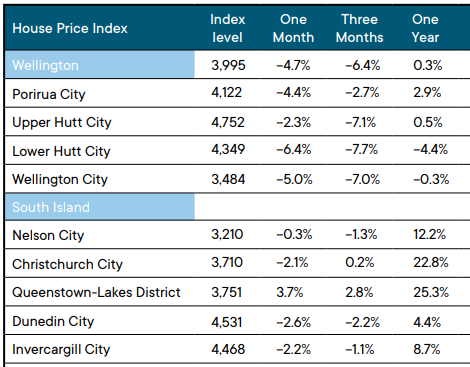
The national HPI showed a 2.1% decline in March compared to February, with all but two regions (Otago and Southland) showing declines.
The HPI figures also suggest that prices has already been in decline for the last few months, with the national HPI in March down 2.8% compared to three months earlier.
But perhaps the most telling figures are those showing how much the HPI has declined from its market peak in each region.
The timing of market peaks varies form region to region but for most it was around November last year.
Nationally, the HPI is down 4.3% from its peak, with the biggest falls occurring in the Auckland and Wellington regions with the HPI down 7.8% from its peak in both regions.
Otago is the only region where the HPI is still increasing, finishing on a record high in March.
And over the three months to the end of March the HPI had declined in eight regions, increased in three and was unchanged in one.
That suggests the decline in prices is now widespread and is gathering pace.
The table below shows the movement in the HPI in the main cities and urban districts over the last year.
The only places where the HPI didn't decline last month were Papakura in Auckland, Rotorua, and Queenstown-Lakes.
However picking how far and how quickly prices might decline from now on is of course fraught with difficulty.
As ANZ senior economist Miles Workman noted in his report on the latest REINZ figures, identifying the factors affecting prices, such as rising interest rates, tighter credit and the removal of interest deductibility for investors, is pretty straight forward, but gauging the likely timing and magnitude of house prices falls isn't so easy.
"The animal spirits component of the housing market can be wild," Workman said.
"FOMO (fear of missing out) appears to have given way to INPT (I'm not paying that), aka FOOP (fear of over-paying), aka FOBAP (fear of buying at peak).
"No matter the acronym, it's all the same: animal spirits have changed direction, and that has the potential to surprise even the best house price models," he said.
REINZ House Price Index March 2022
We welcome your comments below. If you are not already registered, please register to comment
Remember we welcome robust, respectful and insightful debate. We don't welcome abusive or defamatory comments and will de-register those repeatedly making such comments. Our current comment policy is here.