
The housing shortage has eased considerably over the last couple of years but there is still a way to go before supply and demand are properly back in balance, according to Westpac' NZs latest Economic Bulletin.
The report by Westpac Senior Economist Satish Ranchhod says New Zealand's population increased by about 11% between 2015 and 2020, but over the same period housing stock increased by just 7%.
"That left us with around 75,000 too few homes," Ranchhod says.
While the shortage of homes was felt most intensely in Auckland, it became increasingly widespread throughout the rest of the country as well, with the average number of people per dwelling rising strongly in all regions over the last decade.
But a lot has changed over the last couple of years due to the Covid-19 pandemic.
Border closures mean net migration gains, which had averaged around 60,000 people a year, turned into a net loss of 7600 in the year to February, while the number of new homes being built increased to record levels.
The report estimates the housing shortfall has been reduced by around 30,000 homes over that period, from 75,000 pre-pandemic to about 45,000 now.
So although the shortfall has been declining, there is still a way to go before it is eliminated and supply and demand get back into balance.
"Over the next five years, New Zealand will need to build around 130,000 new houses every year to address the existing shortfall and keep up with the needs of our growing population," says Ranchhod.
"That's equivalent to building 26,000 new homes a year.
"Right now, consent issuance is running at nearly double that pace, with around 50,000 new dwellings consented over the past 12 months."
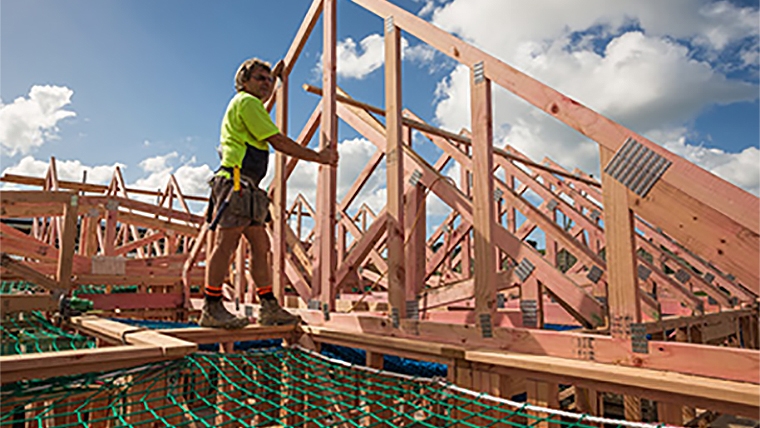
"Although shortages of materials and labour are providing a brake on how quickly housing developments are being completed, we're still looking at a period of rapid home building over the next few years," Ranchhod says.
On the population growth front, the report says net migration flows will probably remain negative in the short-term, as young New Zealanders who put off travel plans start to head overseas again.
But longer-term, it will turn positive as migrants start heading to NZ again.
However likely changes to immigration rules will probably see net migration numbers remain well below previous highs.
The report estimates the net migration inflow will probably settle at around 30,000 people a year, down from 50,000 to 60,000 a year pre-pandemic.
The effects of higher rates of home building and lower migration have been strongest in Auckland, and the report estimates Auckland's housing shortage has fallen from around 35,000 homes at the start of the pandemic to about 15,000 now.
"There is still a way to go, but that is a massive turn-around after a decade when the pressures on the housing stock in our largest city had become increasingly pronounced," says Ranchhod.
"With building activity continuing to ramp up, the underbuilding of homes in Auckland that developed over the past decade is on track to be largely eliminated by the end of next year. In other parts of the country, population growth has not fallen to the same extent. As a result, housing shortages in areas outside of Auckland are being eroded more gradually.
"Even so, building levels have lifted across the country, and the existing shortages look set to be largely eliminated in the next four to five years," the report concludes.
The comment stream on this story is now closed.
- You can have articles like this delivered directly to your inbox via our free Property Newsletter. We send it out 3-5 times a week with all of our property-related news, including auction results, interest rate movements and market commentary and analysis. To start receiving them, register here (it's free) and when approved you can select any of our free email newsletters.
41 Comments
At the rate people are leaving the country there won't be a shortage by Christmas.
✈️✅
Forward looking people can see where this place is heading.
I read lots about lots of people leaving but is there any statistical evidence of this yet?
https://www.stats.govt.nz/information-releases/international-migration-…
It's difficult to read into - but comparing against last years stats is a good start
"F**K Donald Trump, I'm off to Canada"...... yeah right.
Agree with this one - I know more people leaving NZ than looking to buy houses rn
If you not in a position to buy a house in Auckland (majority of 20-30s) Whats the real value of staying here in NZ when you can move to Aus, earn more and pay less on food/rent.. no brainer
You also have the advantage of being somewhere that hasn't completely lost the plot with wokeness and identity politics yet. ✅
hasn't completely lost the plot with wokeness
I see some Govt Ministers in NSW were told at a "Diversity and Inclusion' course not to use the word "mate" in conversation any more which is about as woke as you could get in Oz!
Their politics does make for some amusing YouTube fodder. See the Honest Government Ads from Juice Media.
Nonsense, Toye.
Auckland's population is steadily increasing - and projected to reach 2,000,000 by the year 2030.
TTP
key word 'projected' - that's about as relevant as looking at 'asking price'.
I think it was Tony Alexander who reported a recent 9000 person flight this year from the 09
There are no stats to support this, only estimations and projections.
Meanwhile, back on planet earth...
https://www.stats.govt.nz/news/aucklands-population-falls-for-the-first…
Was just about to post that. Auckland population is currently decreasing, but hey, why bother with facts when you can make up your own claims and use them to say someone else is wrong.
Not that I imagine the fine staff of interest.co.nz have any spare time for it, but this site would really benefit from warning labels on comments that are clearly incorrect, ala twitter.
There is already a warning label, it says "TTP".
It seems this is only estimated, I was going to post this too but there doesn't seem to be any stat report to back it up. Maybe I'm reading it wrong, who knows. 📉
This is interesting, a short while back all the new builds were sold before they were completed, I am seeing quite a few newly completed houses with for sales signs out the front.
Im not sure if that says anything about the housing shortage or current market conditions, but to me is a significant change
How about we stop importing our labour force? Maybe, just maybe, we shouldn't view life purely in economic terms as homo economicus and rather conclude that it has been a net negative for our society given the stagnation of wages, competition for housing, the inflation of asset prices, the low productivity etc because of this plantation economy mindset of throwing more and more warm bodies at problems rather than investing in capital to increase productivity?
Unfortunately Capitalism will never let this happen.
Get rich. Own properties / businesses / investments / etc. Want to control your wealth. Donate to politicians / government to maintain status quo. Threaten to take your business overseas / close down nz operations if they no play ball. Own the media / narrative. Have connections in high power roles. Shape public perception. Sheeple agree that no capital gains tax is in the interest of the majority. In reality it benefits probably 10,000 kiwis vs 5 mil who won't. Laugh at how dumb the system is. It's designed so that when you get rich, you only ever get richer.
There's a handful of people who get rich and powerful that do good, but most are driven by greed.
Oh well. Better than tiling a field for 12 hours a day.
Total garbage. Totally misinformed views here from Westpac.
If we half immigration? We'll keep an eye out for signs of easing, like prices dropping permanently, but I think we are grossly underestimating the shortage. Many thought border closure would moderate prices but actually they rocketed.
Maybe the prices have nothing to do with the alleged shortage?
Maybe the powers that be threw the kitchen sink at the housing market to prevent any moderation?
In the medium to long-term, significant developments in Drury and surrounding areas will help to mitigate housing shortages and the issues that come with it. Importantly, in the same area is significant industrial and business development that means commute distances can be done by walking, cycling and lessen the number of cars on the roads. Practical networks and connections will be key, as well as the needed infrastructure.
Drury housing plan: Locals react as development ‘the size of Napier’ gets green light | Stuff.co.nz
Development: 330Ha
Napier: 10,505Ha (more or less)
Exaggeration: Priceless.
The quote has come from a local living there, and the media have used it as an attention grabber. However, the development size is significant, including the population growth. I have just seen the announcement by the PM and Immigration Minister which is supposedly enabling immigration settings to bring in the skills NZ needs to grow, with some settings to manage and enable wage growth - businesses will like this announcement.
Yes, I'm aware the quote came from a Mr Wardell, but it still passed Stuff's "duh clickbait" check as if it was even close to fact.
IMO Stuff are about a year away from headlines like "You Won't Believe What Your Favorite PM Is Up To Now!" (yes, with American spelling and incorrectly capitalised words) and the article saying she's preparing for an election.
Westpac forecasts off the hook, some of their senior management have moved into investment banking and they don't know anything about that either.
Its also a quality of information input affecting output
I dont see it the same. There are over 32000 houses for sale on trademe alone compared to 18000 at the start of february. The number of rentals available has also increased using the same comparison.
1148 in Tauranga on TM, seems to have peaked. Pretty high by all accounts for down here. Should be pretty inteersting in the coming months because the market has well and truely stalled and asking prices are still not trending down. Honestly though, half the time people don't actually need to move, they just get "Bored" I think, just stupid short times between sales of anything from 1 to 3 or 4 years tops usually. Real Estate agents must just love NZ with all the pointless buying and selling that goes on here.
Trying to guesstimate the level of shortage, or oversupply, of housing should be taken with a massive grain of salt. I saw no economists saying Spain was biulding too many houses prior to their property colapse, and the same can be said for Ireland. In hindsight these economists are quick to point out "over supply" etc once it all falls appart, but before hand, not so much.
While I do think it's clear there has been a shortage of building for many years in NZ, I also believe there is a much bigger quantity of unoccupied houses, especially in Auckland, than anyone cares to admit. Talk to residents of just about any street in Auckland and they can point out at least 1 or 2 empty houses. These unoccupied dwellings are likely owned by offshore investors and if global financial stresses suddenly see these investors all decide to liquidate, which could well happen, we could go from shortage to oversupply in a matter of weeks.
I walk by an ~$8 million house almost daily that has been sitting empty since I've been here (7 years now). It's a big mansion right on the beach, clearly leaky and in a very neglected state. There really should be a land value tax or empty homes tax in NZ, especially in areas that are supposedly short on dwellings. Many other empty and neglected houses in the wider area. Not empty for just a couple of months, but for years.
I personally don't like to call it a housing shortage. I firmly believe that there are enough houses in Auckland (and in NZ) for everyone.
The so-called housing shortage is a misnomer of sorts. We have enough overpriced houses for the upper middle classes & above, we just don't have enough social housing for the poor. The 20,000+ families waiting for a state house is were the problem really lies. Govts have not built enough social housing on their own land partly because the poor people already accommodated in their outdated building on that land don't want to move out. And, when you consider that one old state house could be replaced with 3 or more new state houses, a solution is close at hand, but needs co-operation from all sides. If the govt spent less on welfare & more on state houses a solution wouldn't be that far away, but that assumes that the govt would be adopting a sensible approach, which certainly seems well beyond this govts potential.
Our politicians & their decision making are at the lowest ebb that I've seen in my 60 years here.
Quack! See. Even the speaker agrees.
Underbuilding of social housing has been a problem for a while now. Times have changed since John Key had stable state housing to grow up in, and Paula Bennett got her first with a housing corp loan and benefit to pay the mortgage.
We've seen successive governments increase landlord benefits rather than increase building adequately.
However likely changes to immigration rules will probably see net migration numbers remain well below previous highs.
Errr... Westpac thinks there’s some sort of political consensus on NZ’s longterm migration policy? Labour don’t even know what their policy is, and teams blue and yellow seem keen to get things back to pre-Covid settings as soon as possible to recapture some of that Key magic. David’s article yesterday was more on the mark.
There is not a shortage of houses. There is a shortage of buyers who would, could or should buy them. The prices for current new builds can not be justified for anyone who would be contemplating borrowing at current interest rates to buy either as occupier of landlord. While there is no prospect of capital gain in the medium term and very possibly a capital loss. The potential occupier can rent a better quality house for a lower cost than servicing the mortgage and related housing expenses. The potential landlord will be competing for tenants with other landlords who purchased earlier at lower cost and can charge lower rents.
The most reliable way to track people's flows is via https://www.customs.govt.nz/covid-19/more-information/passenger-arrival…
This is extremely accurate, passport in passport out, cant be manipulated and if you go back to March 2020 we have about 170,000 less people here. Its updated 9am most days
What housing shortage?
I don't buy the lower migration figures. Over the next two decades we are going to.move increasingly into a global warming scenario. This will increase demand for scarce resources in.populated parts of the world, this will increase conflict, and we will start seeing an exponential rise in migration from places that are struggling to the point of becoming uninhabitable, to places that can better manage these environmental change, even though they will not be immune.
I expect NZ will become increasingly in demand from certain places, and it will have a major impact socially, culturally. Not necessarily a bad thing but certainly different. I think the 10 million.population will be exceeded.
We need a population strategy aimed at maximising net wellbeing per capita (economic+social+environmental)
This should set the immigration rate
You can build as many houses as you like, but if people can't afford to buy them what's the point? They'll just sit empty.
We welcome your comments below. If you are not already registered, please register to comment
Remember we welcome robust, respectful and insightful debate. We don't welcome abusive or defamatory comments and will de-register those repeatedly making such comments. Our current comment policy is here.