


The ability of first home buyers to save a reasonable deposit is likely to have a bigger impact on their ability to get into a home of their own than falling interest rates.
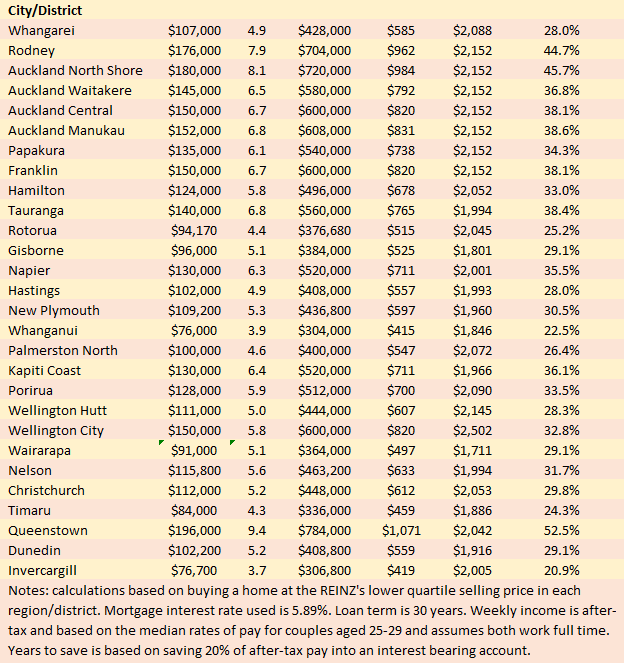
Interest.co.nz's latest calculations show typical first home buyers should be able to afford the mortgage payments on a lower quartile-priced home almost anywhere in the country at current interest rates, if they are able to scrape together a 20% deposit. However, that affordably drops away sharply if they only have a 10% deposit, particularly if they are looking to buy in the upper North Island. (See the note below explaining how the calculations are made).
We also measure how affordable the mortgage payments are for couples earning the median rates of pay for people aged 25-29.
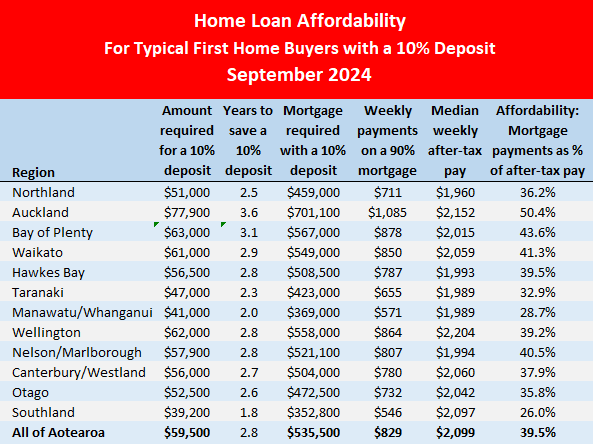
At the national level, that would give a young couple a combined, after-tax pay packet of about $2100 a week, although there are regional differences.
Mortgage payments are considered unaffordable if they take up more than 40% of their take home pay.
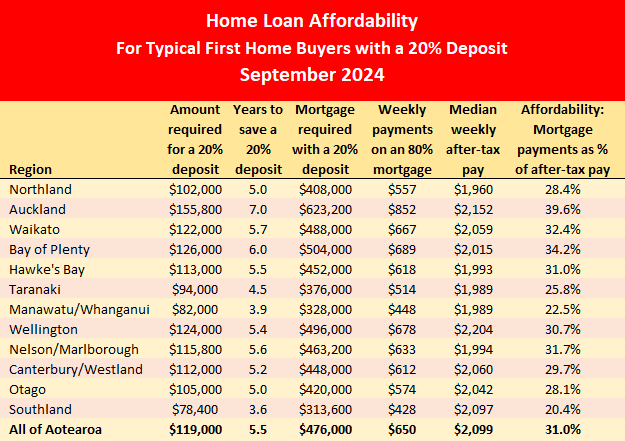
On that basis, there are only three districts in the country that are considered unaffordable for first home buyers on average incomes if they have a 20% deposit. They are; Auckland's northern suburbs of Rodney and the North Shore, and the tourist mecca of Queenstown.
So in almost all of New Zealand, the problem first home buyers face isn't not being able to afford the mortgage payments, it's being able to get together a 20% deposit.
That will range from having to find $76,700 in Invercargill, the country's most affordable housing district, to $196,000 in Queenstown, the country's most expensive.
Across the Auckland Region, a 20% deposit on a lower quartile-priced home averages out at $155,800, which interest.co.nz estimates will take typical first home buyers seven years to save if they set aside 20% of their take home pay into an interest bearing account every week. That doesn't take into account any inflation in house prices that might occur over that period.
That will push many first home buyers to attempt to buy their first home with a low equity loan. But even that option will require a reasonable chunk of cash for a deposit.
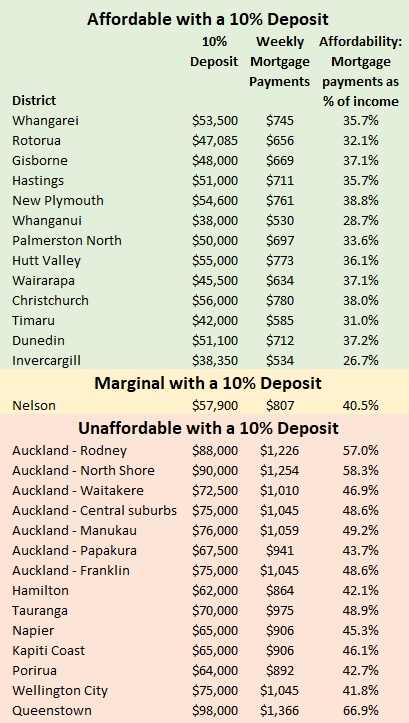
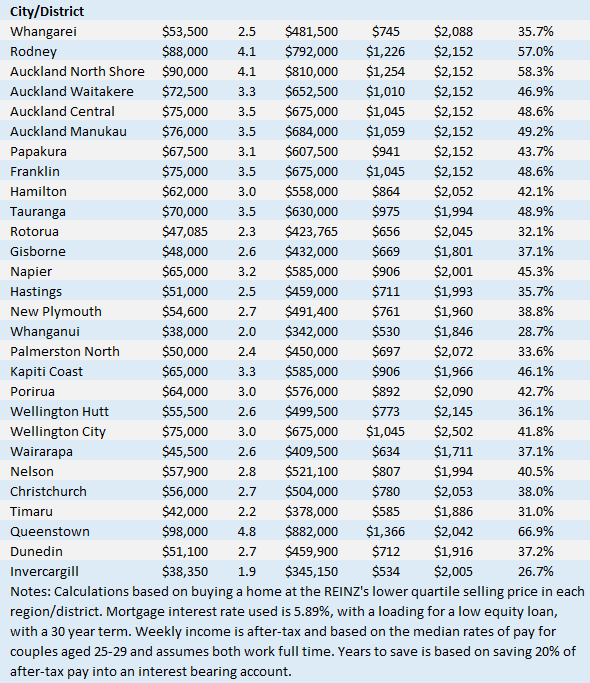
A 10% deposit on a lower quartile-priced home will range from $38,350 in Invercargill, to $77,900 in the Auckland region and $98,000 in Queenstown.
The trouble with that option is a low equity loan is much more expensive than one with a 20% deposit, not only because more money is being borrowed, but also because banks charge substantially more for low equity loans to cover the extra risk involved.
And that pushes the mortgage payments into unaffordable territory for many parts of the country.
With a 10% deposit, mortgage payments become unaffordable for all of the Auckland region, including its most affordable districts of Papakura and Franklin on its southern flank.
Hamilton, Tauranga, Napier, Kapiti Coast, Porirua, Wellington City and Queenstown are also on the unaffordable list for low equity buyers.
So where is it still affordable for first home buyers on average incomes to buy a home if they don't have a 20% deposit?
Their mainstream options are likely limited to Whangarei, Rotorua, Gisborne and New Plymouth in the upper North Island, Hasting, Whanganui, Palmerston North, Hutt Valley and Wairarapa in the lower North Island, or anywhere in the South Island except Queenstown, although Nelson is marginal and Christchurch is at the upper end of affordability levels.
But if aspiring first home buyers want to buy into the main centres of Auckland, Hamilton or Tauranga, or in central or northern Wellington, they will need higher than average incomes or access to a big chunk of cash or both.
The comment stream on this article is now closed.
Note: How we calculate the Home Loan Affordability Report:
| Calculations are based on buying a home at the REINZ's lower quartile selling price in each region/district. The mortgage interest rate used is 5.89%, with a loading for a low equity loan (where applicable), with a 30-year term. Weekly income is after-tax and based on the median rates of pay for couples aged 25-29 and assumes both work full time. Years to save is based on saving 20% of after-tax pay into an interest bearing account | ||||||
We welcome your comments below. If you are not already registered, please register to comment
Remember we welcome robust, respectful and insightful debate. We don't welcome abusive or defamatory comments and will de-register those repeatedly making such comments. Our current comment policy is here.