

Home ownership became even less attainable for first home buyers in November, as prices at the bottom end of the housing market continued to climb further out of reach for young people on average pay rates.
In fact home ownership is now the most unaffordable it has been since interest.co.nz started compiling its Home Loan Affordability Reports in January 2004.
The heart of the problem is that house prices are continuing to increase at a greater rate than incomes, and that problem is now becoming so severe that it is increasingly pushing home ownership out of reach for people not just on low wages, but on average wages as well.
And the problem is no longer just an Auckland one, it is spreading to other parts of the country as well, with little relief in sight.
The Real Estate Institute of New Zealand’s national lower quartile selling price increased by $20,000 in November, rising from $650,000 in October to $670,000 in November.
In Auckland the lower quartile price continued its climb towards the million dollar mark, rising from $930,000 in October to $970,000 in November, a $40,000 increase in a month.
The lower quartile price is the price point at which 25% of sales would be below and 75% would be above, representing the most affordable end of the housing market.
House prices rising much faster than wages
The problem facing prospective first home buyers is that house prices have risen much faster than wages over the last few years, pushing the amount needed for a deposit or to meet the mortgage payments on a lower quartile-priced home into unaffordable territory for those on average wages.
Over the last two years the national lower quartile selling price has increased by $220,000, from $450,000 in November 2019 to $670,000 in November this year.
In Auckland the lower quartile price has risen by $275,000 over the same period, from $695,000 in November 2019 to $970,000 in November this year.
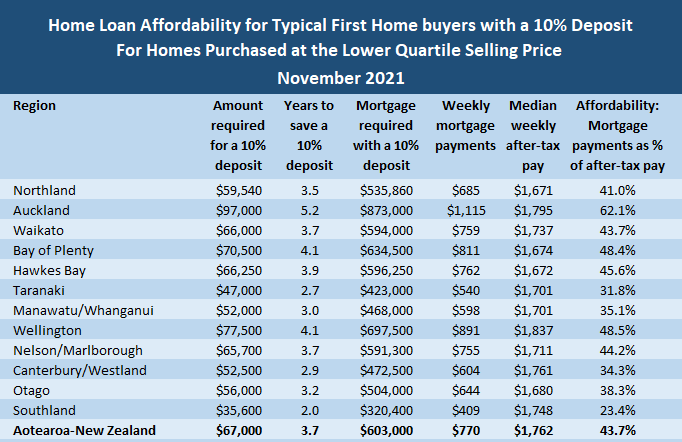
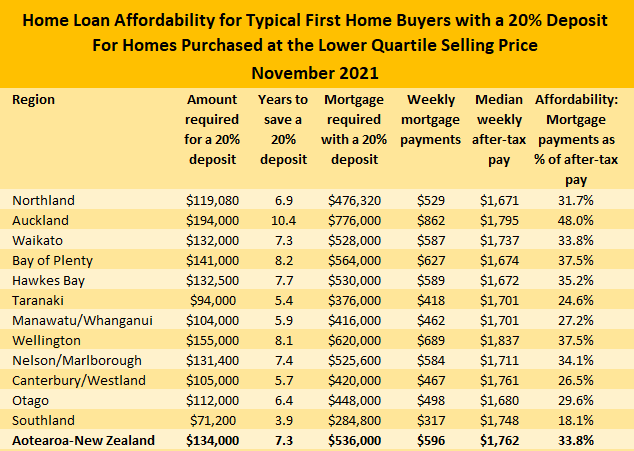
That in turn has pushed up the amount required for a 10% deposit on a home at the national lower quartile price from $45,000 to $67,000 over the two year period and you can double those figures for a 20% deposit.
It has also pushed the amount needed to be borrowed for a 90% mortgage from $405,000 to $603,000.
The effect that has had on first home buyers has been complicated by movements in mortgage interest rates.
Initially, over the period from November 2019 to August 2020, the effects of the higher house prices and the resulting bigger mortgages needed to buy them were largely offset by falling interest rates, which meant although first home buyers would have needed to borrow more to get into their own home, there was very little change in mortgage payments over that period.
But from September 2020, lower quartile house prices started increasing faster than interest rates were falling and this started having a dramatic impact on mortgage payments.
That situation was made worse when mortgage interest rates started rising from the middle of this year.
The average of the two year fixed mortgage rates charged by the major banks bottomed out at 2.52% in May this year and has increased in every month since, hitting 4.08% in November.
Up, up and away
The net result of all this on prospective first home buyers is that over the last two years the national lower quartile selling price has increased from $450,000 to $670,000. This has pushed up the amount required for a 10% deposit from $45,000 to $67,000, and the size of a 90% mortgage from $405.000 to $603,000.
After allowing for changes in interest rates, the amount needed to be set aside for the mortgage payments on that would have risen from around $483 a week in November 2019 to $770 a week in November 2021.
That’s an increase of $287 a week, up 59% in the last two years.
Unfortunately interest.co.nz estimates that the combined after-tax wages for typical first home buying couples have only risen by $69 a week (+4.1%) over the same period, based on the median rates of pay for 25-29 year olds and assuming both are working full time.
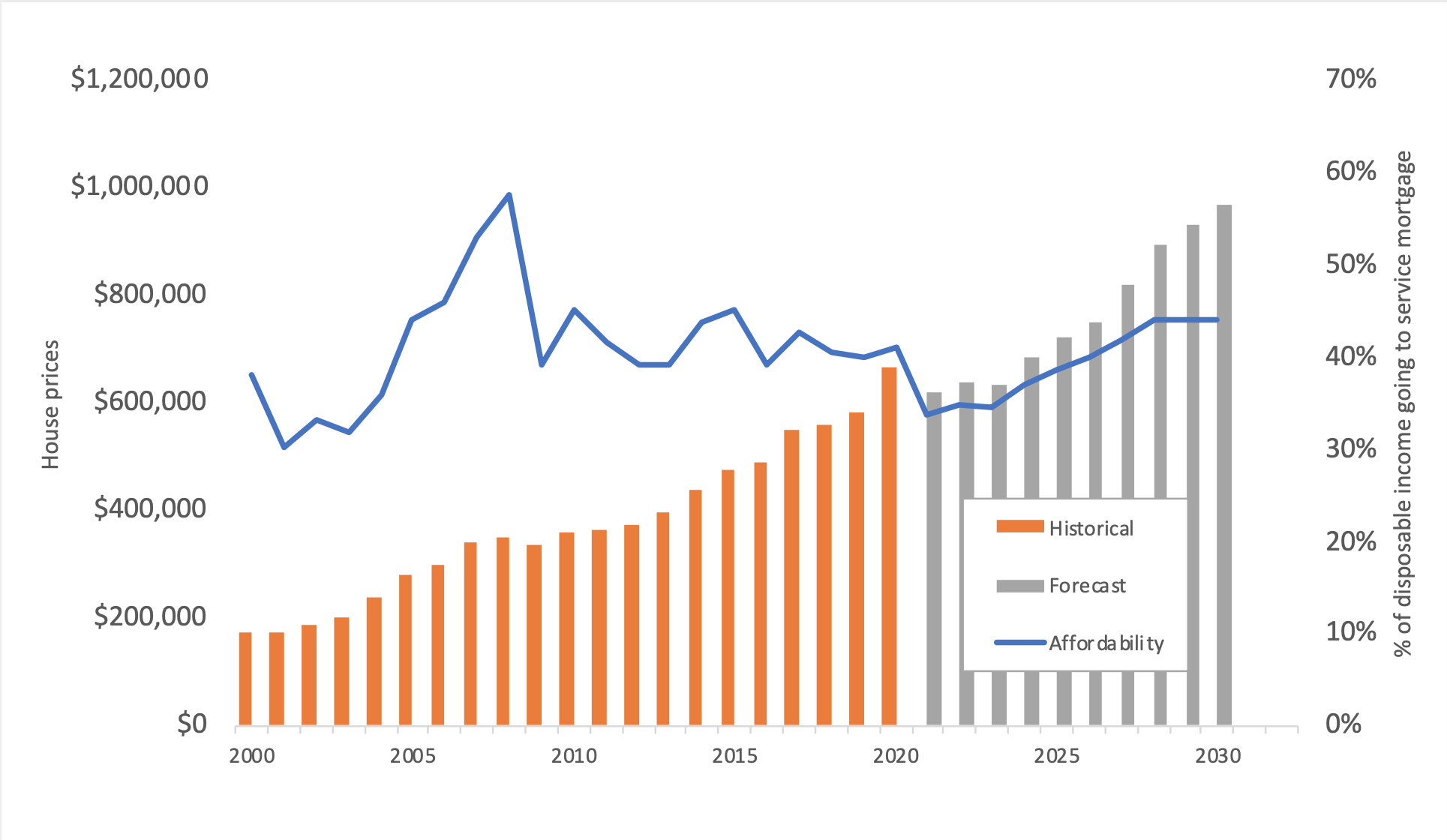
So the percentage of their weekly pay packets that would have to go towards their mortgage payments would have gone from 28.5% in November 2019 to 43.7% in November 2021.
That’s a worry because mortgage payments are considered unaffordable if they take up more than 40% of take home pay.
The problem is particularly acute in Auckland, where the amount required to service a 90% mortgage has increased from 43.2% of take home pay in November 2019 (already unaffordable) to an excruciating 62.1% in November this year.
That effectively rules out home ownership in Auckland for all but the highly paid.
Using the same measures, home ownership would also now be considered unaffordable for typical first home buyers on average rates of pay in Northland, Waikato, Bay of Plenty, Hawke’s Bay, the Wellington Region and Nelson/Marlborough.
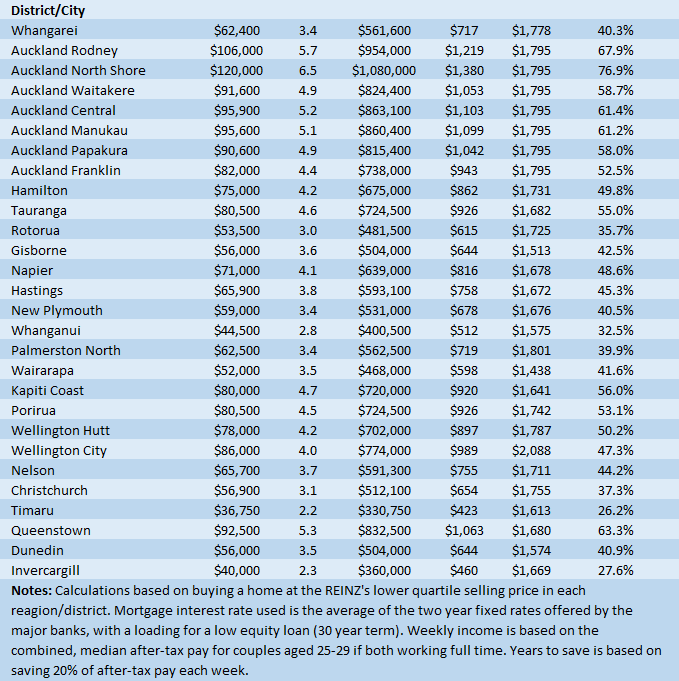
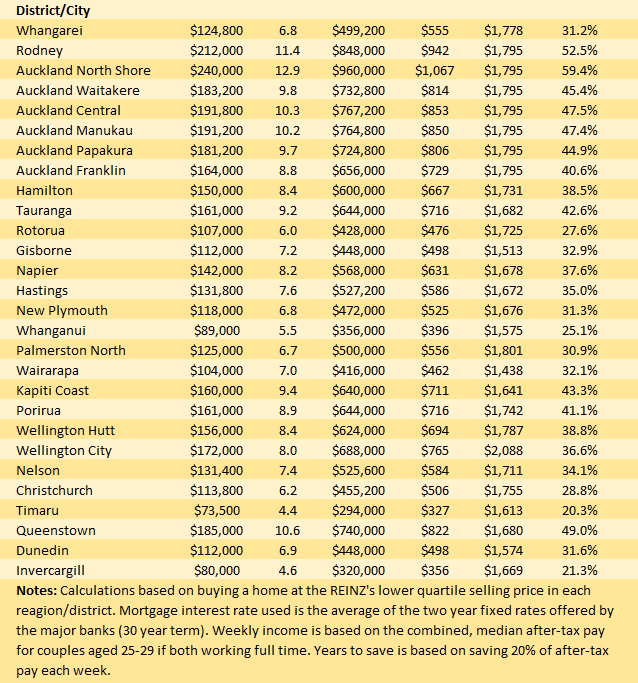
The tables below give the main affordability measures for all major urban districts, with either a 10% or 20% deposit.
The comment stream on this story is now closed.
- You can have articles like this delivered directly to your inbox via our free Property Newsletter. We send it out 3-5 times a week with all of our property-related news, including auction results, interest rate movements and market commentary and analysis. To start receiving them, register here (it's free) and when approved you can select any of our free email newsletters.
We welcome your comments below. If you are not already registered, please register to comment
Remember we welcome robust, respectful and insightful debate. We don't welcome abusive or defamatory comments and will de-register those repeatedly making such comments. Our current comment policy is here.