By Katharine Moody*
It has been two years since I introduced a formula approach for a weekly rent maximum to Parliament’s Petitions Committee. In this time, rental market conditions have improved marginally for both landlords and tenants.
Despite the cooling of rental price increases, many other statistics are going in the wrong direction. Nationally, rent costs are now the highest ever as a proportion of median incomes. Last year nearly 20% of households spent 40% or more of their income on housing costs, up from 18% in 2023. And for the year ended June 2024, 9.4% of households were in material hardship, up from 8.6% in the previous year.
New Zealand also faces additional headwinds in the housing space associated with uncertainty in the global trade environment. We can expect more internal shocks, similar to the wholescale layoffs in timber and paper production markets. Even though many of the individuals laid off in Ruapehu and Tokoroa might be homeowners in these communities, some will now need the Accommodation Supplement from central government, where they might not have qualified previously. And the ‘caps’ on that subsidy, combined with unemployment benefits might not cover existing mortgages.
Even the National government when introducing their Going for Housing Growth plan, admit that all- things-accommodation are dire;
Our housing shortage manifests in different ways; from very high prices for first home and other buyers, poor quality, increasing rents, and growing demand for social housing which has resulted in over 3,500 families living in motels and more than 400 living in their cars.
That is the situation, despite them noting that;
The government spends nearly $4 billion1 each year on housing subsidies. Our housing shortage particularly affects low-income households.
The NZ Property Investors Federation (NZPIF) said to me two years ago when I was formulating my proposal that to fix the housing crisis you have to fix the rental crisis first. And the good news is, a number of the NZPIF requests were implemented with the change of government; (See more here).
The NZPIF also recognises that shortfalls in the current Accommodation Supplement settings are causing tenant hardship, as they also suggest above, that;
Private rental providers should receive all the Government support that social housing providers receive (bullet 8. under Lower Costs, Lower Rents).
What could we have instead of these subsidies?
An optimally functioning housing market requires the full spectrum of offerings from social housing, market rental, rent-to-buy, shared-equity purchase and market purchase at an affordable rent-to-income level.
Given the regulatory changes to improve rental property bottom lines, combined with slow (but seemingly steady) house price declines, I believe now is a good time to claw back some of the $4 billion dollars per annum in government expenditure on housing subsidies.
Bearing in mind, $4 billion in annual savings would buy in any one year:
the full monty Dunedin Hospital upgrade;
more than the entire annual Pharmac budget;
a reinstatement of the Jobs for Nature programme;
more than the entire Early Childhood Education budget before the recent cuts; or
the entirety of the scrapped $3 billion Interisland ferry project.
These are but a few examples of the social cost of allowing our housing market to get so out-of-kilter with median household incomes. Governments the world over are to blame as reluctant regulators of this market, and New Zealand in 2024 was one of the worst.
Further studies on the weekly rent formula model
So, what progress has been made on my formula approach to rental market regulation;
(RV/1000) - x% = weekly rent maximum
The Petitions Committee reported back on the proposal in September 2024. There was no appetite from the Ministry of Housing and Urban Development (MHUD) or Ministry of Business, Innovation & Employment (MBIE) to regulate private sector rent, although that was not unexpected given the election was only two months away.
However, the Social Policy & Parliamentary Unit (SPPU) of the Salvation Army conducted further research on a version of the formula approach as a means to identify;
… a fair rent based on actual median household incomes and house prices… to provide an alternative source of information in the rental sector.
The fair rent information produced based on the formula approach is intended to supplement the market rent information provided by Tenancy Services.
The SSPU report, titled Tackling Rental Affordability in Communities applies the findings of their research. The data is impressively granular, using Community Compass databases. And a fair rent calculator look-up tool (look up by residential address) is currently under development.
The SPPU results are visualised in the following Rental Affordability by Territorial Local Authority diagram below (see page 5. of the report);
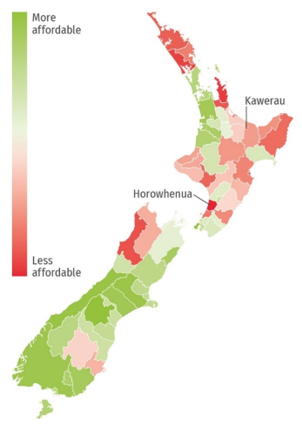
You may want to do a double take on that diagram. I expected our major cities, particularly Auckland, to be the least affordable housing markets. But not so, when you look at median household incomes for each district against the median house price. Where median household incomes are highest – rent as a proportion of income, is lowest. And where median household incomes are the lowest, rent as a proportion of income, is highest.
In other words, despite being geographically located in a lower housing cost district, those renting in those locations suffer more as a percentage of income in making their weekly rent payments.
From a planning perspective, these findings are a concern. Logic would suggest that over time families in the ‘pink’ geographic districts will migrate toward the main centres (i.e., the ‘green’ districts) with higher wages and better rent-to-income ratios.
New Zealand last experienced a domestic urban migration wave and a ‘hollowing out’ of our small urban areas in the decades post-1984. Due to the influx of ‘economic refugees’ from small town New Zealand, infrastructure deficits in our main urban centres started mounting rapidly during these decades.
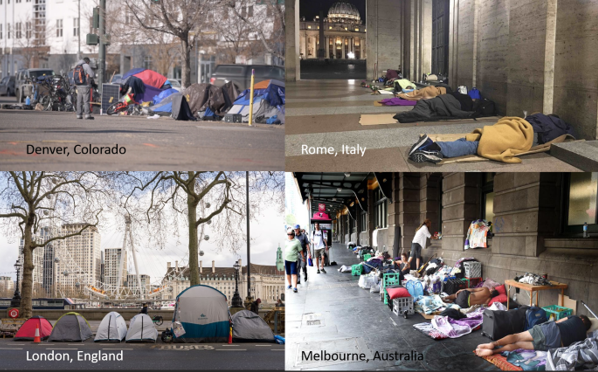
And if future economic conditions mirror that era, the larger urban centres (already struggling under the pressure of increasing international migration) will experience greater and greater housing stress and homelessness. This is what we see overseas.
Conclusions
Which leads me to conclude that the Going for Housing Growth policy of the National-led government, won’t be enough – not nearly enough.
The government, through their Kainga Ora reset, has made it clear, they aren’t going to be the ones to build our way out of this. Neither does the government make decisions for the residential development sector. A sector already under strain.
So, how might the government begin to claw back on their $4 billion annual rental assistance costs, while also making housing more affordable at the same time for all New Zealanders?
I would suggest, that regulation of the private rental market is a necessary step, and perhaps the only way to avoid the plague of homelessness seen in so many of our OECD counterpart cities.
The sooner they pick up the policy work on an affordable rental market, the better.
1) The National government’s plan does not break this number down into individual line items in the budget, but from HYFU 2024, it is likely made up of $2,495 million in Accommodation Assistance plus $1,619 million in Income-Related Rents.
*Katharine Moody is a senior tutor at Massey University's College of Humanities and Social Sciences in Palmerston North, who comments on interest.co.nz as "Kate". The views expressed in this article are her own and don't necessarily reflect those of Massey University.
We welcome your comments below. If you are not already registered, please register to comment
Remember we welcome robust, respectful and insightful debate. We don't welcome abusive or defamatory comments and will de-register those repeatedly making such comments. Our current comment policy is here.