
The number of new homes completed in Auckland sank to a three year low in 2025, and appears unlikely to pick up much until 2027, based on Auckland Council data and building consent figures.
Auckland Council issued 14,441 Code Compliance Certificates (CCCs) for new dwellings last year. That's the lowest number since 2022, and down 20% from its annual peak of 18,103 in 2023.
CCCs are issued when a building is completed, so are the best measure of actual new supply, while building consents are issued before construction starts, so are an indicator of likely future supply.
On average, it takes around two years from the time a residential building consent is issued until building work is completed and a CCC is issued.
So the number of new homes being completed, approximately reflects the number of building consents issued around two years previously.
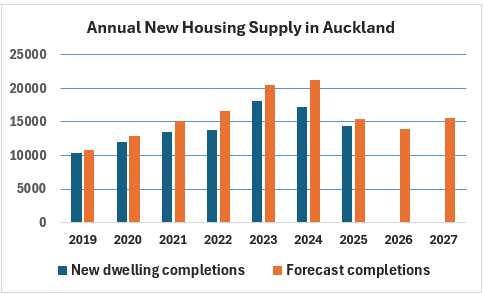
In the graph below, the blue bars show the number of new dwellings (CCCs issued) in Auckland each year from 2019 to 2025.
This shows they increased steadily from 2019 to 2023, then dropped away in 2024 and 2025.
Those figures of actual completions are compared to the number of residential building consents issued in Auckland two years previously (the orange bars).
So the figures for 2025 for example, show the number of completions (CCCs) in Auckland that year, compared to the number of residential building consents issued for Auckland in 2023.
This shows us several things.
Firstly, there is a reasonable correlation between the number of homes being completed and the number of building consents issued two years previously, so it's a useful comparison.
Secondly, it shows that a gap between the two sets of figures developed as construction activity picked up strongly between 2021 and 2024.
In 2019, the number of new home completions in Auckland was equivalent to 96% of the residential building consents issued for the region two years previously. But by 2024 that figure had dropped back to 81%.
That was likely due to capacity restraints in areas such as labour and materials supplies because of pandemic restrictions initially, followed by general difficulties in the construction industry gearing up during a period of significant growth.
Those capacity restraints have now eased, and the completion rate was up to 93% last year and could well go higher this year.
Finally, looking at building consent trends over the last two years gives a reasonable indication of potential levels of building activity over the next two years, as shown in the last two orange bars (for 2026 and 2027) in the graph below.
This suggests the current downturn in the number of new homes being completed in Auckland will probably bottom out at somewhere around 14,000 this year before picking back up to around 15,500 next year.
The building industry is probably already feeling the effects of a pick up in activity in Auckland, with new dwelling consents in 2025 up 12% compared to 2024.
With the ratio between consents and completions now back up above 90%, that should mean more new housing starts and more residential work underway, although things show no sign of getting back to anywhere near the highs of 2023/24.
A quarterly analysis of residential building consent trends is available here, while the same analysis for the major types of commercial building consents is available here.
The comment stream on this article is now closed.

We welcome your comments below. If you are not already registered, please register to comment
Remember we welcome robust, respectful and insightful debate. We don't welcome abusive or defamatory comments and will de-register those repeatedly making such comments. Our current comment policy is here.