

The latest residential property auctions featured a chilly start to winter with a big drop in the number of properties on offer and fewer selling under the hammer.
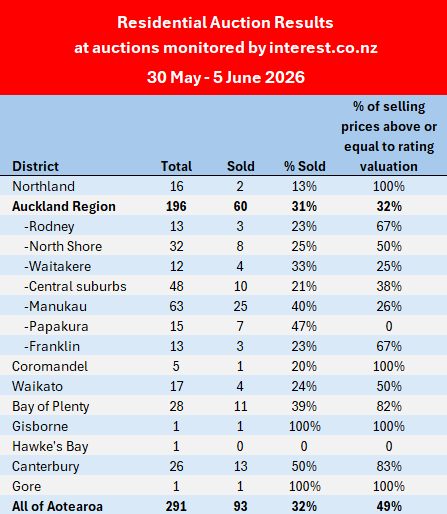
Interest.co.nz monitored the auctions of 291 residential properties around the country over the week of 30 May to 5 June, down from 340 the previous week and 345 the week before that.
That was the lowest number of properties on offer in a single week so far this year, apart from the short week after the Easter break.
Sales results were also slightly softer, with 93 properties selling under the hammer at the latest auctions, giving an overall sales rate of 32%, down from 33% the previous week and 37% the week before that.
Selling prices also appeared softer, with less than half (49%) of the properties that sold achieving prices equal to or above their rating valuations.
Prices were particularly soft in Auckland where under a third (32%) of the properties that sold achieved prices equal to or greater than their rating valuations.
So not a great result for the first week of winter in the auction rooms.
Details of the individual properties offered at all of the auctions monitored by interest.co.nz, including the selling prices of those that, are available on our Residential Auction Results page.
The comment stream on this article is now closed.

13 Comments
HOLDING COSTS of property all exploding much higher, is the future for NZ. In 5 years, its switched from a "cannot lose value" asset, to a dead weight liability.
Insurance costs in some USA jurisdictions, now exceed 10k yearly, for average homes.
NZ insurance costs will contine to swallow larger premiums, leading to higher uninsurance.
Decades of lack of infra renewels, will cause all rating costs to continue rising at breakneck speeds. Or expect more regular and adept moonfish dodging, on your morning walks. PDK preaches expertly on this topic.
Then cost of debt funds about to move muuuuch higher, in a higher inflation world.
This will see the historic 2023 to 2025 RVs, being lower, upon lower stepping stones, to much lower RVs, as they reset over future years.
To all the tens of thousands of vendors - trying to sell over the last to 2 to 3 years ...... praying for lunacy 2021 tulip mania prices again........on market, off market, on market, off market, frustrating the hell out of the poor, integrity bereft, falling income RE Agent.
The "best time to sell a real estate liability, was yesterday" New Oneroof troupe??
Now, the best-selling price, is what you get today.
Waiting for poooperty price recovery, could have you waiting motionless in the rest home bed, in the 2040s - 2050s or if ever??
All for falling house prices in NZ, long may it continue.
The real issue is however that after decades and decades of cramming ever increasing levels debt into every corner of our economy and personal lives, an increase in the cost of debt will bring with it significant pain, even for those of us who didn't jump on the debt gravy train.
The wax in the wings of speculation has melted. Specarus is falling earthward back towards the long term mean. The overcomitted specarati will become increasingly horrified as they wake up to the fact leverage works in reverse. In a very ugly way.
Burn.
House prices falling in Aussie and UK now, BTC falling, even gold and share markets falling.
Going to be a long weekend for those leveraged long AI investors
Yip and I believe we still have years of similar conditions ahead of us before the ‘recovery’ (aka mystical’green shoots’) appear.
We had house prices rising 2x the general rate of inflation for a few decades. Something which is mathematically impossible to sustain. Why?
1. Inflation is highly positively correlated to wages/rents
2. Present Value (PV) of house prices are are the sum of those discounted (r) cash flows (cf). Ie for those who don’t understand asset pricing the key equation to value an asset is Present Value = Cash flow / discount rate.
If the PV of an asset (eg housing) has been rising at 7% pa (or doubling every 10 years) while the underlying cash flows (wages/rents) have only been increasing at half of that (ie at the general rate of inflation targeted by the RBNZ CPI) then this is only possible if the denominator of the PV = CF/r equation keeps getting smaller. Ie that is that mortgage rates keep dropping.
As soon as the denominator of the equation goes flat, it is mathematically impossible for the PV to rise unless the cash flows are growing significantly.
But here is the next problem - if the cash flow (wages/rent) is growing significantly (say >5%) then it means the economy and RBNZ have an inflation/CPI problem, which means interest rates will be going up (a lot!) which increases the r value of the PV = CF/r equation…which completely nullifies any present value growth of the asset as the cash flows get discounted at a much higher rate. Ie you end up with flat or falling house prices even though wage/rent growth might be high.
When I look at multiple outcomes about 5-6 years (or even from about 2013 when I first realised there was something really wrong with the relationship between house price growth and wage growth) ago using a bunch of different future possibilities for cash flows and discount rates and inflation probabilities for NZ housing, they all showed that a floor or equilibrium for the market would only be achieved if prices fell about 30-40% in nominal terms or around 50% in real/inflation adjusted terms. Ie prices could remain flat in nominal terms while inflation and rates were persistently high (eg stagflation - which appears to be unfolding).
I think we are only a little over halfway to achieving any equilibrium that so we may still have another 5 years of so to go before this is all resolved and the PV = CF/r might mathematically actually allow for any real (inflation adjusted) house price growth.
People laughed at me for trying to explain this about 7-8 years ago - they just couldn’t see (or didn’t want to see) that the numbers meant it was impossible for 7% growth in the housing market to last forever (ie attacking the fallacy of the prices double every 10 years narrative been used as a defining ‘truth’ of the property industry).
Houses are cheap right now. Whether you are in the "flat for another decade" or "onwards and upwards from here" camp, now is a great time to get on the property ladder - especially in Auckland. However, I personally would stay well away from the Wellington market. Too risky at any price.
Cheap now H??? You really are that PonziBeliefTied?
- I see it as not by any measure cheap or reasonable, not even close.
The were reasonably priced (not cheap) leading upto the year 2001.
https://fred.stlouisfed.org/series/QNZR628BIS
Since then mass lunacy took over and the REAs and FIRE industry had a field day in the mass delusion of many Kiwi's, into the fervent belief, that hoarding houses, levering Debt, was the only road to riches.
Truth is, it was, until 2021.
- Since then, it has been the opposite.
All that that stacked and loaded, Debt upon Debt, since around 2015, will have to meet a reckoning with their follies.
This Debt stacked unwind will be epic and the legend that will be written of by the poets and economic scholars alike.
Fastest to liquidate from now, will be the least eviscerated.
Funny guy.
https://youtu.be/BktT8wXe-2w?si=Zmbe7CcuqKe16tHP
Bernard Hickey link above. He goes into great depth why the ponzi is over. How we bet the lot on a housing market and we are now up Schitt creek without a paddle. I’ve showed this to my boomer parents in almost desperation to get them to pivot away from residential property as an investment as they think another boom is just around the corner. It’s all they’ve ever known..
Hi R, Yes mass delusion of the boomers and some of their kids, is a very strong property cult, to break from.
- I'm sure some have idolised images of Ashley Churchless and Tony Comb, within their property boom homage grottos.
He does concede however that if interest rates are dropped and/or migration ramps up then there is room for another spike.... id suggest that should either/both occur the it would be the last hurrah. The neverending asset price growth is ultimately supported by the consumption of the debtors.
https://www.statista.com/chart/16902/least-affordable-cities-for-housin…
sure Auckland and London almost equal
Jobs and economic mass are so similar. Tui....

We welcome your comments below. If you are not already registered, please register to comment
Remember we welcome robust, respectful and insightful debate. We don't welcome abusive or defamatory comments and will de-register those repeatedly making such comments. Our current comment policy is here.