
‘Consumer sentiment slips as deep pessimism continues’.
That was the headline in this week’s Westpac-MI Consumer Sentiment Bulletin.
According to Matthew Hassan, Westpac’s Head of Australian Macro-Forecasting, the latest reading of consumer sentiment is ‘amongst the weakest seen in the fifty-year history of the survey’.
The survey’s sub-indexes for ‘family finances vs a year ago’ and ‘family finances, next 12 months’ both dropped sharply, down 7.5% and 8.5% respectively.
Hassan writes that ‘cost-of-living issues remain front and centre’ for Australians.
Well, perhaps not for all Australians. The cost of living won’t be troubling the 200 people identified in last month’s Rich List 2026 prepared by The Australian Financial Review. Their total wealth is estimated at A$707 billion, up from $668 billion in 2025.
According to the AFR, Australia now has 178 billionaires compared to 150 last year. A fortune of $1.87 billion is required to make the top 100.
While it’s difficult to calculate the value of assets held by individuals, these figures are similar to those from the latest Australia’s Richest 250 prepared by The Australian newspaper. That list identifies188 billionaires, with an entry point of $1.72 billion for the top 100.
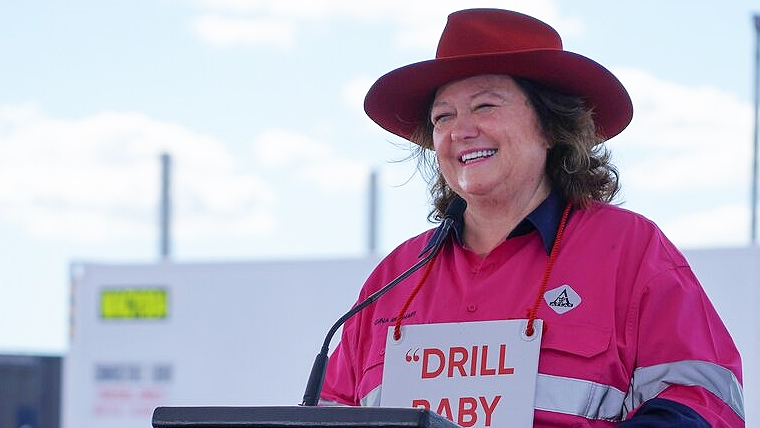
There’s no dispute as to Australia’s richest person. Topping the AFR list for the seventh year in a row is mining magnate Gina Rinehart with a fortune estimated at $39 billion. Her four children, all billionaires in their own right, also make the list with a combined wealth of more than $10 billion.
Despite their great wealth, or perhaps because of it, the Rinehart clan are not without their troubles. Gina Rinehart’s eldest son, John Hancock has been in a bitter legal dispute with his mother for the last 20 years over a family trust and the ownership of iron ore assets worth billions.
Rinehart has been in the spotlight recently as a major donor to the populist One Nation political party. In the space of the last 12 months support for One Nation in the polls has surged from 5% to around 30%, with the party now ahead of both the Labor government and the opposition Coalition.
Rinehart’s generosity to One Nation includes the gift of a $2 million Cirrus G7 aircraft in which the controversial One Nation leader Pauline Hanson flies around Australia.
Coming in at number two on the AFR rich list is Sydney property developer Harry Triguboff with $29.7 billion. He’s followed by packaging king Anthony Pratt with $25.2 billion.
Notable risers in the wealth stakes in 2026 are the key families behind pharmacy giant the Chemist Warehouse. After the successful backdoor listing of the group last year via Sigma Healthcare, the Verrocchi brothers and the Gance family each have fortunes in excess of $12 billion.
Sigma Healthcare is currently considering a possible A$14 billion takeover of UK chemist giant Boots. What happens next could have a major impact on where the Verroocchi and Gance families sit on next year’s rich lists.
The biggest losers this year were software company Atlassian’s co-founder Scott Farquhar and his wife Kim Jackson. While they still sit at number 13 on the list with $11.7 billion, that’s a dramatic drop from last year’s position at number 4 with $21.4 billion.
Farquhar’s co-founder Mike Cannnon-Brookes and his ex-wife Annie Cannon-Brookes suffered a similar fall.
Richard White, founder of cloud-based software company WiseTech, dropped two places and $1.7 billion.
It’s been a bad year for software.
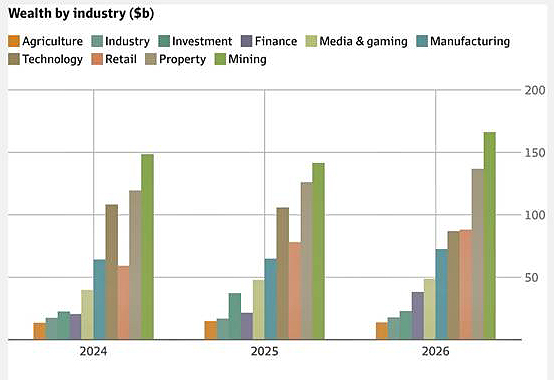
But not mining. That sector is responsible for five of the top ten fortunes on the AFR list. It’s followed by property, retail, and technology as a source of wealth for Australia’s superrich.
Source: Australian Financial Review
How do Australia’s billionaires stack up against their international counterparts?
One comparison speaks volumes. The combined wealth of Australia’s 200 richest people is estimated at A$707 billion. While that’s a staggering sum, it’s substantially less than the personal fortune of Elon Musk.
As at the time of writing, the Bloomberg Billionaires Index assesses Musk’s net worth at US$696 billion (just shy of A$1 trillion). The Forbes Real-Time Billionaires list gives a figure of US$795 billion (A$1.13 trillion). Those numbers could rise dramatically in the coming days with the listing of Musk’s SpaceX.
The other key difference is the source of wealth. According to both Bloomberg and Forbes, the top eight fortunes in the world are technology based. All are American.
Of the 500 billionaires on the Blomberg list, just nine are Australian, with Gina Rinehart coming in at number 61. (There’s one kiwi, Graeme Hart at number 285 with US$12 billion.)
The prospects for the Australian economy over the next twelve months are uncertain. The rate of unemployment is rising, productivity growth is weak, and inflation remains a threat. The government is struggling to pass its budget reforms, and the ongoing Iran crisis is undermining confidence.
But no one will be surprised if next year’s rich lists reveal more billionaires with even greater fortunes.
*Ross Stitt is a freelance writer with a PhD in political science. He is a New Zealander based in Sydney. His articles are part of our 'Understanding Australia' series.
We welcome your comments below. If you are not already registered, please register to comment
Remember we welcome robust, respectful and insightful debate. We don't welcome abusive or defamatory comments and will de-register those repeatedly making such comments. Our current comment policy is here.