
Residential property auction activity continues to decline as the market moves further into winter.
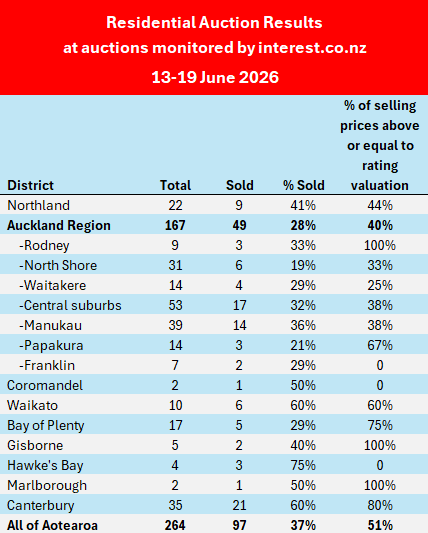
Just 264 residential properties were offered at the auctions monitored by interest.co.nz over the week of 13-19 June. That's down from 296 the previous week and 345 a month ago. So the auction room temperatures are definitely dropping.
Of the 264 properties offered at the latest auctions, 97 sold under the hammer, giving an overall sales rate of 37%.
The sales rate has been bouncing around in the mid-to-high 30% range over the last several weeks so there's no real change there. But it's down from the 40%-plus sales rates at the start of the year.
Of the 97 properties that sold under the hammer at the latest auctions, just over half (51%) achieved prices equal to above their respective rating valuations, down from 57% the previous week.
Selling prices appeared to be particularly soft in Auckland, where just 40% of the properties that sold fetched prices equal to or above their respective rating valuations.
The table below gives a regional break down of the results.
Details of the individual properties offered at all of the auctions monitored by interest.co.nz, including the selling prices of those that sold, are available on our Residential Auction Results page.
The comment stream on this article is now closed.

13 Comments
Property is an interesting market for 4 months of the year there is no liquidity and you are effectively locked in.
Enjoy the ride.
The selling below CV is telling. Even allowing for that, the auction success is only just breaking 50%.
Chilling results for speculords and ticket clippers indeed.
🍿
Werent we all complaining that the economy was driven by rising house prices?
Now that its stopped its apparently terrible!!
Transforming to other drivers for the economy requires housing to stop rising non stop and fall from the covid induced torrent of cash at ridiculous interest rates I would have thought - or am I missing something??
Well said. The damage to kiwis that cheap printed cash and stupid govt/rbnz policy will be felt for generations. The only winners in the last 20 yrs were foreign bank owners and risk taking tax avoider.. also called investors.
Transforming to other drivers for the economy requires housing to stop rising non stop and fall from the Covid induced torrent of cash at ridiculous interest rates
Both criteria have been well met, now the NZ Economy is looking at new places to speculate, perhaps invest.
When you consider investment , the prudent mix is probably mainly offshore and a little bit onshore
IE NZ Super Fund has 11% of its total portfolio invested in New Zealand
- so if you take the huge amount that was borrow in NZD on margin 5:1 and gambled in NZ Property (most still in the market and hoping for a new bag holder to appear
- and assume that now only the deposit is available, and 90% of that goes offshore into nvideo,rocket lab spacex etc (perhaps margin opportunities here for some)
- We are down to a fraction of $$$ left to invest in NZ, most of that will goto managed funds
- Ma And Pa are not about to start a new rocket lab.
The economy is starting to really crater, all those "hanging on" are failing, there is a hospo business failing every day in The Hearld, smaller businesses are being pushed over by IRD.
I suggest our small business "investors" are desperate for survival right now not investing in new things.
Just as the Ponzi falling over is a once in 30 year event, this down cycle is also a ONCE IN 30 YEAR EVENT
this is not an economic correction, its an economic CRASH. IMHO we are probably only 30-40% through this and the energy war in the middle east is going to make it even worse.
And lets be honest, a huge number of small businesses lived off the back of the Ponzi itself, roofers, landscape, kitchens, even hospo lived off the feel rich factor of capital gains. Our entire society is connected to the PONZI
Can you remember the back to back 20 years when "My house made more then me....."
Its a massive mess and it is not over
I see the NZ Super fund is the largest individual tax payer in NZ now.
That in itself tells you where there is money to be made and revenue for the Government.
As of 31 March 2025 NZ had $422 billion invested offshore and we had $633 billion invested from offshore here. As Kiwisaver and people invest overseas this will probably close up. (Stats Dept)
It would be interesting to know how much tax the IRD collects from the $422 billion we have offshore (I assume NZ Super fund is part of this) but as Kiwisaver grows and people invest overseas this could become a major source of Government income.
Yes I agree a lot of small business lived of the housing bull market and if this dosnt return it will have to adapt and change. From what I can see this is why Auckland is struggling as it relied heavily on housing compared to other regions.
Yes I agree a lot of small business lived of the housing bull market and if this dosnt return it will have to adapt and change.
The people who set these businesses up saw the opportunity, they could sell services to the people who "BORROWED BILLIONS", so said people could make capital gain. The Ponzi was so huge, but now sitting here in my office looking out at a dull gray Auckland day, I cannot see what is going to replace it. In AKL we will need to start a second harbour crossing to keep the big heavy construction industry going, or it will leave NZ.
IMHO we need a big home solar subsidy project just to keep people busy.
Maybe its survival based but I see more and more black market deals ie its $60 a ton plus gst , or $55 a ton cash.
The black market must be huge now.
It’s going to be painfull. It reminds me post 1987, up until 1993 94 it was very grim.
We do have many good businesses doing well but these are increasingly tech driven, even if within traditional industries. This requires higher education levels and it’s very competitive competing offshore - it’s bloody hard work.
Solar would provide jobs setting up but having residential and commercial solar myself the great thing, as an owner, is they require no input!! Just sunshine, so once the install is done it just works. On my commercial stuff it’s the easiest business I have ever had as there are no people involved and I get money sent each month, not much in the middle of winter but overall a real return of over 10% per annum and a 7 year payback.
(The Chinese government has stopped subsidising panels now and my installer tells me they are now 30% more from the start of the year. I’m grateful to the CCP for the subsidy!!)
There are no easy answers but I believe you can’t wait for the Government to provide them.
https://www.stuff.co.nz/home-property/360995101/ten-years-ago-we-bought…
This is a very honest read.
The numbers
We paid $650,000 for the house, which was market value at the time, and scraped together a 10% deposit of $65,000.
Today, homes.co.nz estimates the house is worth around $780,000, which sounds perfectly reasonable, an increase of about $130,000 over more than ten years.
‘We purchased based upon fear’
They fell for the ‘be quick’ scam artists who sold them financial lies. Ie ‘buy now or you will be priced out of the market (forever..)’
And these people purchased in 2015…it’s the people who purchased closer to the 2021 peak who will be suffering financially much more than this example.
But you don't lose money until you sell.....
Residential property is now worth roughly $1.65 trillion, more than twice the combined value of commercial property, the domestic equity market, and all managed superannuation funds. Nearly two-thirds of the $550 billion in bank lending in 2024 went into housing, Davis says.
“This concentration gives housing an outsized role not only in household balance sheets but also in macroeconomic stability and political decision-making. It has produced a sharp divide between those who own housing and those who do not – one that increasingly shapes life trajectories.
“Housing wealth is disproportionately concentrated among older and higher-income households, reinforcing intergenerational inequality and magnifying resistance to reform.”
This has made housing “a defining axis of social division, between owners and non-owners and across generations”.
“In 2024, the wealthiest 10% of households owned nearly half of all wealth, while the poorest half owned less than 7%.”
Meanwhile homelessness remains “stubbornly high”, renting has become a “long-term condition” for those who cannot afford a house, and the Government forks out more than $4 billion in housing-related subsidies.
Treating housing as a means for private wealth accumulation rather than essential infrastructure “is neither economically rational nor socially sustainable, but rather a recipe for continued drift, rising inequality and mounting fiscal pressure”.
https://www.afr.com/property/residential/auction-clearance-rates-plunge…
Labor’s decision to introduce a minimum 30 per cent tax on capital gains from July 2027 and abolish negative gearing, the most significant changes in a generation, are designed help first home buyers get into the market. Australian property prices have risen 400 per cent since 2000 and capital city markets are among the least affordable in the world.
SQM Research managing director Louis Christopher forecasts Sydney housing prices will fall by up to 9 per cent this year and Melbourne up to 7 per cent.
“Other cities will record a slowdown, and indeed there’s strong evidence now that we’ve seen the peak in the market for pretty much all capital cities, except for Hobart and Darwin.”

We welcome your comments below. If you are not already registered, please register to comment
Remember we welcome robust, respectful and insightful debate. We don't welcome abusive or defamatory comments and will de-register those repeatedly making such comments. Our current comment policy is here.