
The number of new homes being consented has risen steadily for the last two years with almost 40,000 consented in the 12 months to May this year, according to Statistics NZ.
That's good news for future housing supply and for the construction industry, but how many of the homes being consented are actually getting built?
At the national level, we simply don't know.
That's because while we have very good information at both the national and regional level on consent numbers, the same can't be said for data on dwelling completions, because most local councils simply don't release reliable completion data on a timely basis.
Fortunately there is one notable exception, which is also the country's most populous region and the one with the highest level of building activity - Auckland.
Auckland Council releases figures showing how many Code Compliance Certificates (CCCs) it has issued for new dwellings each month.
CCCs are issued when a building is completed and provide a reliable indicator of new housing supply, while building consents are an indicator of potential future supply.
There's a rough rule of thumb that on average it takes around two years from the time a dwelling is consented until it is finished and a CCC is issued.
So to get an idea of how many consented homes are actually being built, we need to compare completions with building consents issued two years previously.
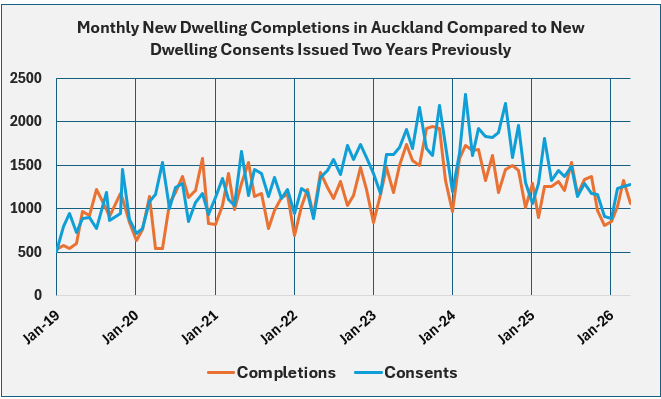
Interest.co.nz has put those two sets of figures into the graph below, which shows the monthly trends from January 2019 to May 2026.
The orange line in the number of CCCs issued (completions) for new dwellings in Auckland each month, and the blue line is the number of new dwelling consents issued in Auckland for the same month two years previously. The May 2026 completions figure is compared to the May 2024 building consent figure.
This shows some interesting trends.
Up until about the middle of 2022, the two sets of figures followed each other quite closely, suggesting most of the homes that were consented were getting built.
But from mid-2022 onwards, the blue line (consents) surged ahead, while the orange line (completions) failed to keep up.
This was caused by strong growth in Auckland consent numbers from mid-2020, which was greater than the construction industry could keep up with, with capacity constraints following pandemic restrictions likely playing a major role.
That surge in consents peaked in March 2022 and then began a steady decline.
The number of homes being completed over the same period also increased as the building industry lifted its capacity, but it wasn't enough to close the gap between the number of homes being consented and the number being built.
That gap persisted from around March 2022 until July 2025, creating an overhang of consented properties that were not completed.
We don't know whether those projects were cancelled, put on hold, or reconfigured in some way. Probably it was a bit of all three.
However, as the graph shows, consents and completions in Auckland have been back in equilibrium since the middle of 2025, meaning for the last year or so, the building industry has by and large kept up with the number of homes being consented, seeing them through to completion.
However, consents in Auckland are once again on the rise.
In the 12 months to May this year, 16,862 new dwellings were consented in the Auckland region, according to Statistics NZ.
Over the 12 months from May 2025 to April 2026, Auckland Council issued 14,010 CCCs for new dwellings.
That suggests Auckland's residential construction industry is going to have to increase its capacity by around 20% over the next two years if it is to complete all of the homes that are currently in the planning pipeline.
If it doesn't manage that, we are likely to see the re-emergence of the gap between the number of homes that are consented in the region and the number that actually get built.
The comment stream on this article is now closed.

We welcome your comments below. If you are not already registered, please register to comment
Remember we welcome robust, respectful and insightful debate. We don't welcome abusive or defamatory comments and will de-register those repeatedly making such comments. Our current comment policy is here.