
The Earthquake Recovery Minister says the private market has the capacity to deal with the tight housing situation in Canterbury, as new figures show asking prices for homes in the region hit a new high in March and inventory levels fell.
The average asking price for houses listed for sale in quake-hit Canterbury rose to a new high in March of NZ$383,395, up 2% from houses listed in February and up 7% from March 2011, figures released by realestate.co.nz show.
And while the 1,532 new listings of houses for sale during the month was similar to that listed in February, the level of unsold inventory in the region fell during March to 20.9 weeks of equivalent sales, down 17% from February and down 60% from March 2011, according to realestate.co.nz's March Property Report. However, Brownlee questioned why the government would step in to a market that hasn’t yet hit the national average asking price.
National average asking prices hit a new high of NZ$429,865 during the month, up 1% from February and 3% from a year ago. Read Realestate.co.nz's views on the national situation in Gareth Vaughan's article here.
Tight
Many Christchurch home-owners whose properties were ruined in the earthquakes that have hit the city since September 2010 are reporting rising prices of the stock of houses available for them to buy, and that prices are rising beyond what they can afford from the assistance they have received from the government.
In June last year, the government offered to buy-out red-zone homeowners at 2007 values, while giving them another option that a homeowner could choose to receive a government payout for the value of their land, while they continued to deal with their own insurance company for a payout on their home. There are currently about 7,000 red-zoned properties in Christchurch.
The head of the Canterbury Earthquake Recovery Authority (CERA) told Parliament's Finance and Expenditure Committee in March that CERA envisaged 26,000 new sections would be coming onto the Christchurch market by next year.
'The market will take care of it'
The government has come under fire from Opposition Parties who say it has not done enough to support the housing market in Canterbury as prices rise due to a shortage of available housing, and as rents rise in tandem.
Speaking to media in Parliament Buildings on Tuesday morning, Minister Gerry Brownlee, who was tasked by Prime Minister John Key with overseeing the government's operations in quake-hit Canterbury, said the government believed the private sector had the capacity to deal with the market pressures.
There were houses available for sale in Canterbury, Brownlee said, while land and building packages were being offered by a number of companies in the city.
“We think at this stage, it’s best that the private market takes care of it,” he said.
When asked about rising asking prices for houses listed for sale in Canterbury, Brownlee noted this was still below the national average asking price.
“You’re asking the taxpayer to step in to a market that hasn’t yet hit the national average?” he said.
“It’s not Canterbury’s where the government assistance will be coming from. I think it’s a difficult situation for people there – no question. But I think the capacity does exist for the market to sort it out,” Brownlee said.
Govt comfortable with situation
The figures from realestate.co.nz follow comments from Housing Minister Phil Heatley in Parliament last week indicating the government was content with the current actions it had taken regarding the housing situation in Christchurch.
The government was "not considering...at this time" regulating the Christchurch rental market, and it was boosting the supply of temporary homes available in Christchurch.
“The Minister responsible for earthquake recovery [Gerry Brownlee] announced last week that we’re providing more temporary accommodation in Christchurch to provide for supply," Heatley said in response to questions from New Zealand First MP Denis O'Rourke in Question Time last week.
“Clearly we’ve got new developments coming on stream, and we believe that supply will help meet demand and therefore drive down rental and house prices. That’s what our primary objective is,” Heatley said.
"We’re buying people out of properties in the red-zone where they can take that check and buy elsewhere. I’m assured by the Minister of Earthquake Recovery (Gerry Brownlee) that when he reads the newspaper, there are sections and house packages available," he said.
“We also have the temporary housing villages, Mr Speaker. We have the accommodation supplement, those seeking rental in Housing New Zealand properties have the Income-related rents supplement.
“Yes, we’re open minded to any other interventions, but at this stage Mr Speaker, we believe that our progress so far is sufficient. If we need to ramp up, we will,” Heatley said.
Tight in Canty, sellers have the power
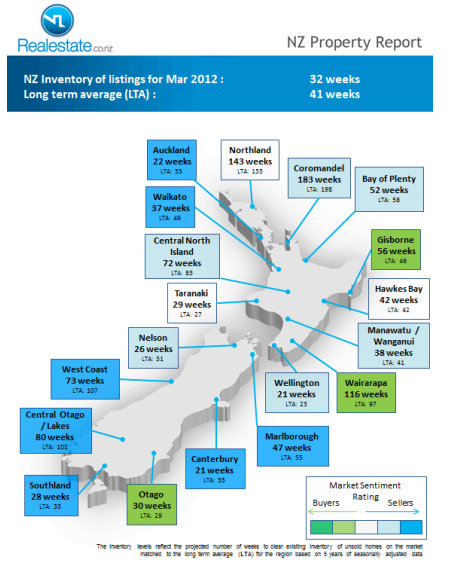
Realestate.co.nz CEO Alistair Helm said that while the trend over the first 2 months of the new year had been to see some balance of inventory-to-demand, "the current picture as represented in the chart below shows a [national] market facing tightness in availability of listings with 7 of the 19 regions (dark blue) so low in inventory that they are very clearly providing sellers with the ultimate power."
"Coupled with these 7 regions, are a further 6 (light blue) where inventories are below long term average and show strong signs of a sellers’ market," Helm said.
See inventory levels around the country in the table below:
We welcome your comments below. If you are not already registered, please register to comment
Remember we welcome robust, respectful and insightful debate. We don't welcome abusive or defamatory comments and will de-register those repeatedly making such comments. Our current comment policy is here.