

Finance Minister Bill English says the Government stepping in to take the supply of land away from local government in order to tackle a shortage of new houses being built would be a "dramatic" solution but "possible" if housing affordability continues to worsen.
English told Radio NZ (listen to the interview with English here) that Auckland Council was due to produce a housing strategy and a draft new plan by March.
"That's an excellent opportunity to look at whether they have shifted their strategy to enable more housing and we've got the same kind of opportunity in Christchurch with the Canterbury rebuild," English said.
He also said the Government was planning a study into the cost of building materials, which last year's Productivity Commission report on housing affordability said comprised about half the price of all residential construction costs and rose about 19% in real terms on standard homes between 2002 and 2011.
English's comments come after an annual international study comparing 337 urban markets, released yesterday by Demographia, showed in parts of central Auckland the median multiple, or the house-price-to-income multiple, is well over seven times. Auckland's North Shore has almost reached seven times. In Manukau it has reached six times, and in Waitakere it's 5.5 times.
Housing is considered "affordable" when it can be purchased for less than three times annual household incomes. It is "moderately unaffordable" at between three and four times household incomes, is "seriously unaffordable" between four and five times household incomes, and "severely unaffordable" above five times annual household incomes. See the full story on this here.
English said forecasts from Treasury and others suggested house prices will continue rising. According to the Real Estate Institute of New Zealand, the national median house price reached a record high of NZ$389,000 in December, with the Auckland median price NZ$535,000.
English told Radio NZ that there would also be some growth in supply of housing and therefore prices would ultimately level off.
"And I think that points to the core issue here that we need to get more flexible supply of housing and that's why we're focusing on working with councils to ensure that we can get enough houses coming on to the market to meet the kind of demand that's pretty evident now in Auckland and Christchurch."
Auckland Council getting 'clear message'
Auckland Council was getting a "pretty clear message" from the Government and opposition parties.
"Opposition political parties who've got plans which simply can't be executed unless they dramatically change the planning system," said English. "And I think the councils would probably prefer to adapt what they have than have their planning system just ripped up so the opposition can build more houses."
"So we are working with them (councils), communicating with them," he added.
The Labour Party wants to build 100,000 houses at an average cost of about NZ$300,000 each over 10 years with leader David Shearer saying this price is plausible because building new homes on the scale of 10,000 a year would bring costs down by about 30% to 40%.
'Dramatic solution'
Meanwhile, asked about the Government potentially taking control of land supply away from local authorities English said: "That's a dramatic solution and possible if the situation continues to get significantly worse."
"But of course government doesn't have the knowledge of the local circumstances that council has and actually it doesn't have a mandate from local voters to make those decisions in entirety. So we would be better to do what we're doing now which is working with councils, putting across a very clear set of objectives, those are backed up by the Productivity Commission, by I think a broad political consensus," said English.
"What we're saying to the councils is 'the Government really wants to see results here. If the councils don't take action then the Government will'."
'Anecdotal evidence of large building materials players exerting excessive market power'
Asked whether there was anything the government could do to make the cost of building materials come down English said: "That's another part of the solution. There has been quite a lot of focus on the building materials industry (with) plenty of anecdotal evidence that large players (are) exerting market power, excessive market power, and they're jacking up prices one way or another."
"It's not obvious that there's anything there that breaks the law but we would be keen to have a look at it a bit more closely. The Productivity Commission recommended what they called a market level study and we're just working out exactly what that would be," said English.
The Productivity Commission's report last year noted that trade prices for a series of building materials in New Zealand were significantly more expensive than in Australia, with the Australian price as a percentage of the New Zealand price put at 76% (see table 10.2 below). The Productivity Commission said New Zealand had a number of different characteristics to Australia that impact on the price of materials. These include a small and dispersed population with relatively low demand for construction services and building materials making it harder to generate economies of scale.
Overall he said the housing affordability issue problem stemmed from "a chain of activity" starting from when a council starts zoning land right through to getting the final building consent.
"And that chain of activity just takes too long and has too much cost built into it."
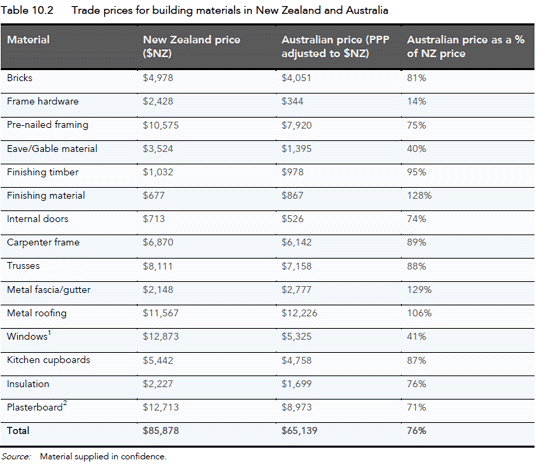
(Update adds table 10.2).
We welcome your comments below. If you are not already registered, please register to comment
Remember we welcome robust, respectful and insightful debate. We don't welcome abusive or defamatory comments and will de-register those repeatedly making such comments. Our current comment policy is here.