
By Bernard Hickey
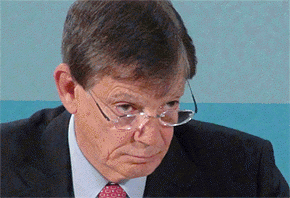
Reserve Bank Governor Graeme Wheeler has laid out an ultra-orthodox prescription for New Zealand to improve its prosperity, including improving productivity, opening up to more foreign investment and returning the government's books to surplus.
Wheeler detailed his views in a luncheon speech to the Canterbury Employers' Chamber of Commerce in Christchurch.
He said New Zealand's economic destiny was largely in its own hands.
Improving New Zealand’s productivity and competitiveness was critical to improving prosperity, Wheeler said in his second speech of his Governorship. He said there was no easy formula for boosting economic growth rates as New Zealand was a commodity-producing economy dependent on growth in world output and trade.
He said there were ways to build prosperity in the longer term and the Reserve Bank was committed to helping "cement the foundations for this growth."
"As well as ensuring price stability and reducing the risk of inflation surprises, the Bank is strengthening financial sector regulation and supervision to promote a stable and efficient financial system," Wheeler said, adding that strong international demand for New Zealand’s commodity exports would also help build prosperity.
"However, we need more investment to help with job creation and market development Instead of welcoming foreign investment, we have one of the more restrictive frameworks among OECD countries," he said.
"We should re-examine the factors, including tax and regulation, that diminish and distort the incentives to both save and invest.”
Wheeler said returning to fiscal surplus and lowering public sector indebtedness would also strengthen the economy’s resilience and create more room for responding to future economic shocks.
"Improving education and employment outcomes, especially for Maori and Pacific Islanders, will also help to strengthen New Zealand’s skill base, improve productivity, and reduce inequality," he said.
“We’ve much to do in continuing to build our global linkages and addressing government spending and regulatory issues that diminish productivity and competitiveness. But addressing these will create valuable payoffs for our future given our major resource endowments, our impressive agricultural and primary production engine, and the potential in our education, tourism and other sectors.”
Will talk about exchange rate later in Feb
Wheeler opened the speech with a brief discussion of the global drivers and touched briefly on exchange rates.
"With official interest rates close to zero in the major advanced economies, investors continue to search for higher yields in countries with stronger growth rates, favourable commodity price outlooks, sound macroeconomic policies, and higher interest rates," he said.
"As with Australia, Canada, Sweden, Norway and some Asian and Latin American countries, the ensuing exchange rate appreciation affects the growth of our import substitution and export sectors," he said, adding he would return to talk about this issue in greater depth when addressing the New Zealand Manufacturers and Exporters Association (NZMEA) later this month.
Wheeler then went on to talk about New Zealand's poor productivity record.
"Since 1990, our labour productivity has grown at an annual rate of one percent, about one and three quarters percent below the seven largest OECD economies. This is the main reason why our real per capita GDP is now 25 percent below the OECD median. This is striking given the high international rankings for the quality of our institutions, control of corruption, ease of doing business, and according to the World Bank, the highest per capita endowment of renewable resources in the world," Wheeler said.
He said this was partly due to New Zealand's small size and distance from markets, but this wasn't the whole story.
"Besides market size, we perform poorly on our macroeconomic environment, and especially on our budget deficit and low national savings. But regulatory and performance-related factors also diminish our growth potential. Many of the remedies to substantially improve our ranking lie in our own hands, and groups such as the 2025 task force, the Savings Working Group, and the Productivity Commission, emphasised reforms that can raise our living standards," he said.
'Save more and invest better'
The first issue was to raise New Zealand's level of saving and investment, and then to improve the quality and productivity of that investment.
He pointed out that the best performers had been Asian countries which had savings and investment rates of as much as 30% of GDP, while New Zealand households had run net savings deficits of minus 2.25% in the last 25 years, the lowest in the OECD.
"Our desire for such high levels of consumption was met by borrowing the savings of foreigners. As a consequence, our net foreign liability position is 73 percent of GDP, one of the highest ratios in the OECD, and not much different from some countries that have been at the centre of the financial crisis in the euro area. The build-up in external debt increases our vulnerability to economic shocks and the high propensity of New Zealanders to borrow means that higher interest rates than elsewhere are required to achieve similar inflation outcomes," he said.
"Much of our investment goes into housing rather than more productivity- promoting investment, and in 2011, 70 percent of households’ net wealth was in the form of net equity in housing," he said. "We need more investment, including foreign investment, that can bring benefits of job creation, technology transfer and market opening."
'Cut government deficits and reduce debt'
He said the government needed to focus on returning to surplus and lowering public debt.
"Increasing fiscal deficits mean that monetary policy has to be tighter and interest rates higher than otherwise, and this adds to the exchange rate pressures on the export and import substitution industries," Wheeler said.
"This constrains output and employment in sectors facing international competition - sectors where productivity growth potential is usually higher. Instead, resources often find more attractive returns in the non-traded or sheltered sectors where, although measured productivity is lower, producers face less international competition and can raise prices more readily. This is one reason why it’s critical to cut back ineffective government spending, and ensure that our welfare spending is targeted better at those in need."
'Improve equality and education of the poor'
Wheeler said modern growth theory stressed the importance of human capital, knowledge and skills, which meant the quality of education was critical in creating opportunities for growth in real incomes.
"Globalisation and technology have widened the distribution of income within most advanced economies, including New Zealand, over the past three decades. In the mid 2000s we had greater income inequality than most OECD economies, and this is unlikely to have changed," he said.
"The bottom income deciles are populated by those with lesser skills, and those who experience prolonged and recurrent spells of unemployment. Addressing these groups would both promote productivity and reduce inequality."
Wheeler pointed to New Zealand's relatively high ranking of 7th out of 65 OECD countries for high school students maths, reading and science.
"But, we have the greatest difference in reading performance between students from different socio-economic backgrounds out of all OECD countries, and the PISA scores for Maori and Pacific Island students are much lower than the average for students of European descent," he said.
'Price stability crucial'
Wheeler said the best way for the Reserve Bank to help was to preserve price stability because that helped long term planning and reduced incentives for buying speculative properties such as investment properties.
Elsewhere, he said the bank was working on macro-prudential tools, confirming comments from his Deputy Grant Spencer last week that consultation would begin in late March.
"Later next month, we will consult with financial institutions on a framework for the potential use of macro-prudential instruments. These instruments, which include the counter cyclical capital buffer, sectoral capital requirements, the core funding ratio, and quantitative restrictions on high loan-to-value ratio lending, are designed to increase the resilience of the financial system to shocks, and dampen the financial cycle when concerns increase about systemic risk."
We welcome your comments below. If you are not already registered, please register to comment
Remember we welcome robust, respectful and insightful debate. We don't welcome abusive or defamatory comments and will de-register those repeatedly making such comments. Our current comment policy is here.