

By Gareth Vaughan
National residential property values rose 10% in 2013 with Auckland area values up 15.4%, government valuer Quotable Value says.
QV also says there's no apparent impact on values yet from the Reserve Bank's restrictions on banks' low equity home loans and there won't be in Auckland, although there will be in the rest of the country. The other major influence on the property market this year is likely to be rising mortgage interest rates, QV says, increasing the cost of servicing mortgages meaning people borrow less and offer less for properties.
The national average residential property value rose 10%, or $42,314 in 2013 to $466,022, QV says, with Auckland area values up 15.4%, or $92,681, to $693,549 at December 2013 from $600,868 at December 2012. Nationally values are now 12.5% above the previous market peak reached in late 2007. For the last three months of 2013 national values rose 3%.
"As was the case in 2012, most of the nationwide increase in values was driven by strong increases in Auckland, and to a lesser extent Christchurch," said Jonno Ingerson, QV.co.nz's research director.
“Sales volumes each month up until October were also higher than the same month in 2012 by between 5% and 18%. This represented an increase in activity but this was still well below the level of sales seen in 2003 to 2007, and is only just getting back to a long term average level."
The Reserve Bank introduced restrictions on banks' high loan to value ratio (LVR) residential mortgages from October 1. This mean banks must restrict lending at LVRs above 80% (where borrowers don't have a deposit of at least 20%) to no more than 10% of total new mortgage lending. This 10% limit excludes high LVR loans made under Housing New Zealand’s Welcome Home Loans scheme, the refinancing of existing high-LVR loans, bridging finance or the transfer of existing high-LVR loans between properties, and new residential construction loans.
"The Reserve Bank signalled well before October that they were likely to put in place measures to cool the market, and these began to have an immediate impact, at least on activity," said Ingerson.
"The number of sales slowed down and the number of new listings followed suit. As yet there appears to have been no impact on values, although it is really too early to expect dramatic change."
Ingerson said the LVR restrictions should have an impact on the market for at least the first half of 2014.
"The first sign so far of their impact is a decline in the number of new listings,” said Ingerson.
“The impact of the speed limits is likely to differ across the country. Auckland values are expected to keep increasing throughout the year as both internal and external migration boosts the population while the supply of housing remains tight. This strong demand and low supply is likely to keep pushing values up, although the rate of increase will probably be less than the previous year.”
However, Ingerson said that around the rest of New Zealand the LVR restrictions will reduce property turnover and values.
"Outside of Auckland and Canterbury there isn't the same imbalance between supply and demand. There generally aren't multiple purchasers vying for the same property, so the LVR speed limits are likely to significantly decrease demand and therefore prices.”
| Average current value |
12 month change % |
3 month change % |
Since 2007 market peak change % |
|
| Auckland - North Shore | $820,459 | 16.6% | 4.9% | 27.1% |
| Auckland - Waitakere | $538,095 | 18.6% | 4.7% | 26.9% |
| Auckland - City | $822,536 | 15.0% | 3.6% | 32.1% |
| Auckland - Manukau | $575,638 | 16.4% | 5.9% | 25.8% |
| Auckland Area | $693,549 | 15.4% | 4.6% | 26.9% |
Here's more detail from QV's release
Main centre comparison
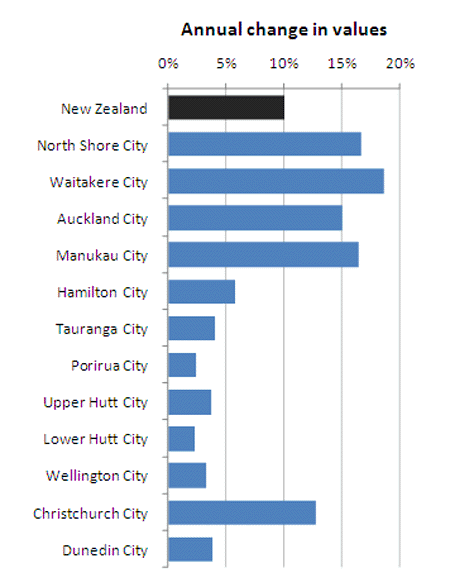
“A comparison of the main centres shows how much the nationwide annual increase of 10% was pushed up by Auckland and Christchurch. From the North Shore to Manukau values increased between 15% and 18% annually, and values in Christchurch went up 12.7%. In contrast, the rest of the main centres increased between 2.5% and 4.0% apart from Hamilton which was slightly higher at 5.8%,” said Jonno Ingerson.
“Considering that values in Auckland have now been increasing since early 2011 it is not surprising that they are now 27% above the previous 2007 market peak. Likewise values in Christchurch are 20% above the previous peak. Tauranga remains 8.2% below peak, while the Wellington area, Hamilton and Dunedin are just above or below previous peak levels.”
Provincial centres
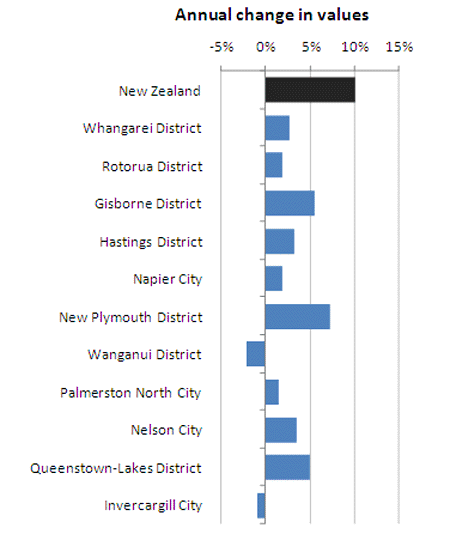
Jonno Ingerson said, “The provincial centres showed less of a clear trend over 2013 than the main centres. Apart from Wanganui and Queenstown all the provincial centres increased during 2013, but the increases were less than 5%. The exceptions were Gisborne which increased by 5.5%, and New Plymouth 7.3%.”
“Relative to the previous market peak, only New Plymouth and Nelson are beyond that level by 4.5% and 5.1% respectively. Most of the other centres remain a few percent below peak, while Whangarei, Gisborne and Wanganui are over 15% below as all three of those areas did not show the same recovery in the market in 2009 and 2010 that most of the rest of the main centres did.”
“Compared to 2012, sales volumes dropped in many of the provincial centres by a few percent. The notable exceptions were Whangarei, New Plymouth and Nelson where sales were well above the year before.”
The outlook for 2014
“The LVR speed limits are likely to have an impact on the market for at least the first half of 2014. The first sign so far of their impact is a decline in the number of new listings,” said Jonno Ingerson.
“The impact of the speed limits is likely to differ across the country. Auckland values are expected to keep increasing throughout the year as both internal and external migration boosts the population while the supply of housing remains tight. This strong demand and low supply is likely to keep pushing values up, although the rate of increase will probably be less than the previous year.”
“In the last month or two of 2013 there were early signs that values in Christchurch and the surrounding areas may be faltering. In a few months from now we should be able to tell whether this was due to the LVR speed limits having a temporary influence, or whether values in Canterbury have reached their ceiling.”
“Across the rest of the country it is likely that the LVR caps will have a downward impact on property turnover and values. Outside of Auckland and Canterbury there isn't the same imbalance between supply and demand. There generally aren't multiple purchasers vying for the same property, so the LVR speed limits are likely to significantly decrease demand and therefore prices.”
“The other big influence on the property market this year is going to be the upcoming increase in mortgage interest rates. The last two or three years have been characterised by historically low interest rates which have encouraged people into the market. As rates rise later this year as they are expected to, this will increase the cost of servicing mortgages which in turn will lead to people borrowing less and therefore offering less for properties.”
“Counter to these potential downward forces are increasing levels of business and consumer confidence, particularly in the big cities. Consumer confidence in particular is a strong driver of the property market.”
“As is usually the case over the Christmas break, people tend to rethink their options. This may be particularly the case this year with the introduction of the LVR speed limits.
Buyers will be considering whether to stay out of the market and save more of a deposit, to find alternative sources of funds to boost their existing deposit (for example borrowing from family), or whether to downgrade their expectations to a lower value property.”
“Nationwide values are likely to increase only modestly this year, but that will probably be as a result of everywhere outside of Auckland slowing while the Auckland market itself will continue to increase.”
We welcome your comments below. If you are not already registered, please register to comment
Remember we welcome robust, respectful and insightful debate. We don't welcome abusive or defamatory comments and will de-register those repeatedly making such comments. Our current comment policy is here.