
Content supplied by realestate.co.nz
Auckland continued to provide potential buyers with plenty of new listings in December while other regions went into a typical Christmas listings slowdown.
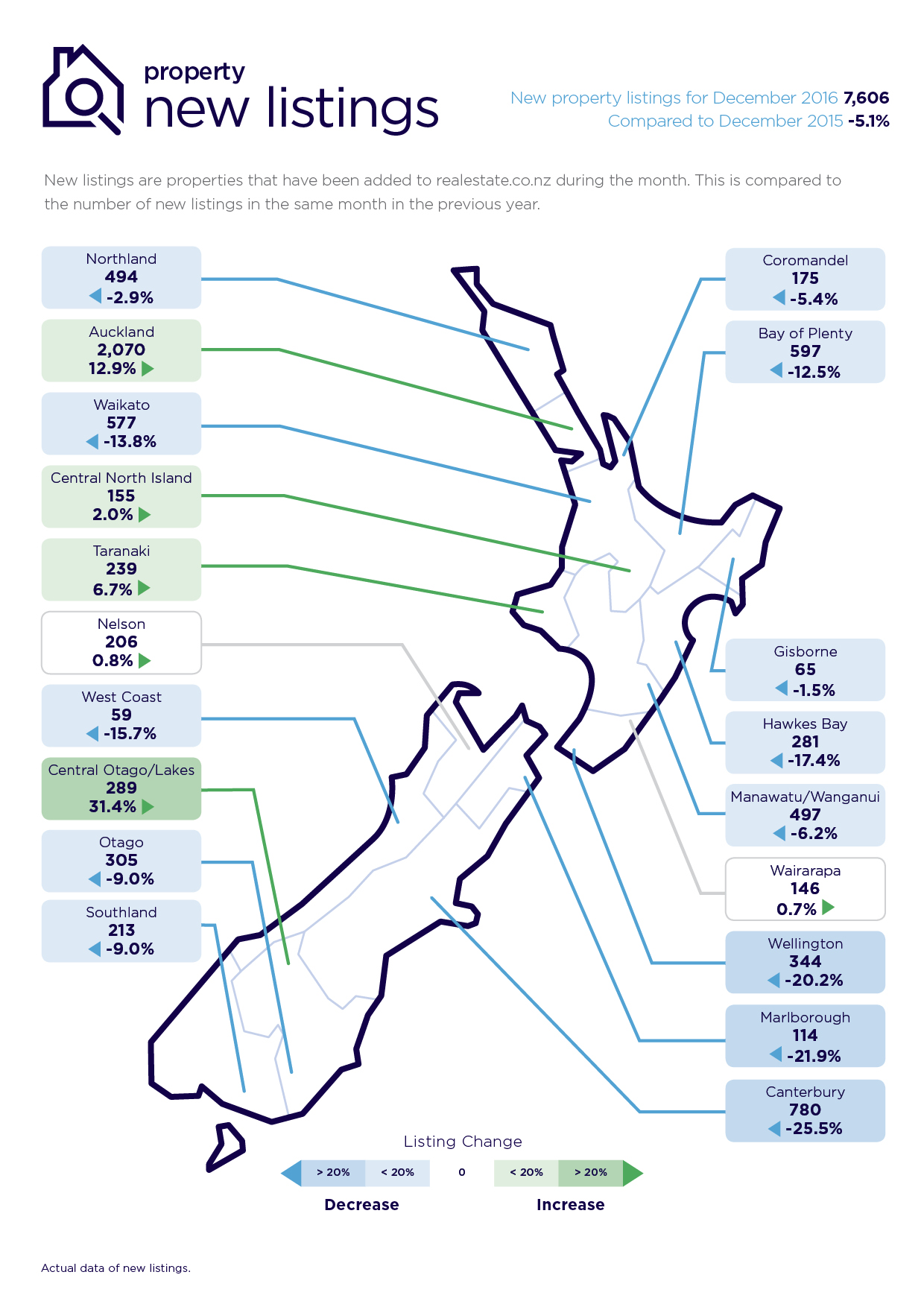
Real-time market statistics from realestate.co.nz show that although nationally the new listings figure was down -5.1% when compared with December 2015, Auckland saw a healthy increase in new stock of +12.9%. All other major population centres followed the national trend with decreases; Waikato down -13.8%, Bay of Plenty down -12.5%, Wellington down -20.2%, Canterbury down -25.5% and Otago down -9%.
“Clearly there is still strong interest in the Auckland property market with many people still thinking it is a good time to sell and not being influenced by the festive season,” said realestate.co.nz CEO Brendon Skipper.
The total number of properties for sale in Auckland was up +18.4% compared with December 2015. But in all other regions of the country, total stock was down.
Asking prices still on the move
While the national average asking price inched up further to a new all-time high of $617,847, there were several variations in the asking price around New Zealand.
The average asking price in Auckland went up marginally in December compared with the previous month – just under $950,000, at $949,898.
Gisborne went up +12% to $328,107 while neighbouring Hawke’s Bay went off the boil, down nearly -8% to $373,169. Other upward movers were Southland which gained +8.2% to $277,476, and Coromandel, up nearly +7% at $684,927.
The biggest drop came in the Marlborough region, down nearly -9% to $435,297.
“Overall, there are more regions going up in asking price than down, and the trend appears to be towards higher prices, albeit at a slowing rate,” Skipper said.
Tightening of stock in most of the major centres
In terms of inventory, Auckland is again against the trend in December. Auckland has gone up from 14 weeks to 15 weeks – the only one of the main centres to show an increase in this measure.
The customary tight market supply in Wellington was exemplified with inventory of listings dropping from eight weeks to six weeks. In Waikato the measure went down from 13 weeks to 12 weeks, and in Canterbury the figure dropped from 18 weeks to 16 weeks. Inventory of listings tells us if there were no new properties to come onto the market as of today, theoretically there would be no properties left for sale in these regions within 6, 12 and 16 weeks respectively.
We welcome your comments below. If you are not already registered, please register to comment
Remember we welcome robust, respectful and insightful debate. We don't welcome abusive or defamatory comments and will de-register those repeatedly making such comments. Our current comment policy is here.