
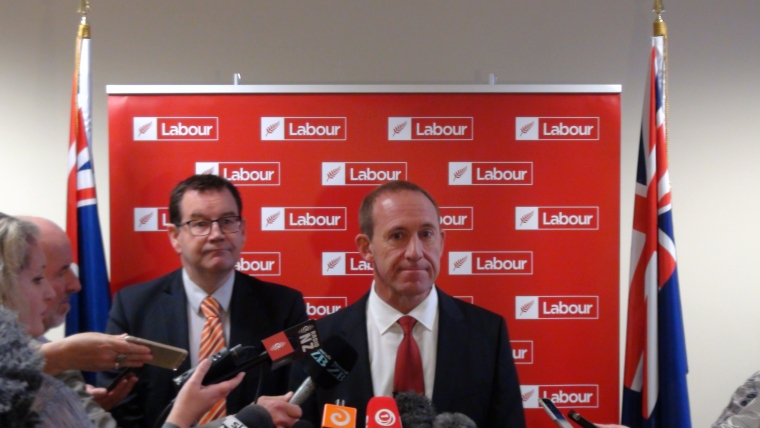
A Labour-led government would phase out negative gearing for property investment over five years, leader Andrew Little announced Sunday.
Speaking to party delegates at the Labour Party’s election year congress, Little said the corresponding income would be earmarked for a government-subsidised insulation plan for private property owners.
Rental property losses would be ring-fenced under the proposals, meaning investors would no longer be able to use tax losses on properties to offset tax on other income, Little said.
The practice would be phased out over five years, with loss deductibility reducing 20% per year over that timeframe.
Labour had already announced it was to tackle negative gearing, but to date had not provided details on how it would do this, and over what time period.
Little claimed the move would net the government an extra $150m a year once fully implemented, raising $1.2bn over ten years.
That money will pay for a Labour plan to grant a maximum of $2,000 to private homeowners – owner occupiers and investors – to fund up to half the cost of insulation upgrades or double glazing at the current building code, or for them to install a “clean, fixed form of heating.”
Housing getting further out of reach
Much of Little’s congress speech was dedicated to housing issues. He told delegates that the $315,000 first home he and his wife bought in 2000 would be worth $830,000 today.
“Its value has nearly tripled. But here’s the thing: Families’ incomes haven’t tripled since 2000. Nowhere near. That’s why housing is getting further and further out of reach,” Little said.
“New Zealand’s housing crisis - yes, crisis - is not just about out of control prices. It’s about the insurmountable barrier that many first home buyers now face. It’s about the rapid increase in rent that tenants are seeing now,” he said.
“It’s about the fact that what is happening with housing is now the main cause of growing inequality and growing poverty in New Zealand today.”
Little said that while door knocking for the Mt Roskill by-election, he had come across one street where multiple houses were each filled with more than one family.
“That’s not the New Zealand we want. We can do better. As Jacinda and I travel the country doing public meetings, housing is the number one issue people raise with us, every single place we go,” he said.
Little said a resident in Hamilton’s Jebson Place had told him a “once a thriving state house community” had been gutted as houses were emptied yet not filled with new families.
“So, I told her why I was there that day. I was announcing that Labour will tear down all those abandoned old buildings. And in their place we are going to build a community of 100 affordable KiwiBuild and state houses – a place for families, once again,” he said.
Labour will lead the largest house building programme “since Michael Joseph Savage carried that dining table into 12 Fife Lane,” Little said.
“We’ll use the money we get from selling the first bunch of houses at cost to build more homes and sell them. And we will keep on doing that - build, sell, build, sell - helping more and more and more families buy a place of their own.”
Building houses was only part of the answer, Little said. The other was “dealing with those things that jack up prices and put homes out of reach for so many.”
“If we want to make sure all Kiwi families get a fair shot – that when it comes to buying a home they have a level playing field – we’ve got to get the speculators out of the way. We can’t let our homes be gambling chips anymore,” he said.
Demand-side policy
He outlined three steps on the demand-side of Labour’s housing policy:
“First, we’ll ban overseas speculators from buying existing houses. Simple as that. We’ll do that in our first hundred days.
“Second, we’ll make speculators who flip houses within five years pay tax on their profits.
“Third, today I’m announcing Labour will close the tax loophole that allows speculators to claim taxpayer subsidies for their property portfolio.”
“Right now, speculators can take losses from their rentals and offset that against their personal income. It allows them to avoid paying tax. This loophole is effectively a hand-out from taxpayers to speculators. It gives them an unfair advantage over Kiwi families,” Little said.
On the side of first home buyers
Families did not deserve to have the odds stacked against them by their own government, Little said. “They deserve a fair shot. With Labour that’s what they’ll have.”
“Now, let me be clear. This isn’t about the mum and dad investor who has bought a rental as a long-term investment. The vast majority of them don’t use this loophole. Those that do will have time to adjust,” he said.
“This policy is about the big speculators who purchase property after property. It’s about those big time speculators who are taking tens of thousands of dollars a year in taxpayer subsidies as they hoover up house after house.
“I say to people who would defend these loopholes - how can we as a society possibly defend handing out subsidies to property speculators when most young couples can’t afford to buy their first home,” Little said.
“You ask me whose side I’m on? It’s families. It’s first home buyers.”
Below is the Labour Party factsheet on its negative gearing proposal:
Losses from rental property investments will be ring-fenced. Speculators will no longer be able to use tax losses on their rental properties to offset their tax on other income, a practice called negative gearing. This move has been recommended by the IMF and the Reserve Bank.
The biggest users of this loophole are large-scale speculators who own multiple rentals and use losses on new acquisitions to continually reduce their tax. The speculators’ tax loophole helps them outbid home buyers for properties because the taxpayer effectively subsidises part of their cost of servicing mortgages.
Ending this loophole will not affect most people who have bought a single rental as a long-term investment because most of them are not using it. Those that do use this loophole generally only do so for a few years after purchase.
It is time to end the subsidisation of speculators by taxpayers. Removing the speculators’ tax loophole will put home buyers on a level playing field and give them a fair shot at buying a home. For a smooth transition, this change will be phased in over five years, with loss deductibility reducing by 20 per cent a year.
Removing the speculators’ tax loophole will save taxpayers around $150 million a year once fully implemented. Total savings in the first ten years will be $1.2 billion. Labour will use this money to help 600,000 families heat and insulate their homes to modern standards.
Below is its factsheet on the insulation proposal:
Removing the speculators’ tax loophole will save taxpayers around $150 million a year once fully implemented. Total savings in the first ten years will be $1.2 billion. Labour will use this money to help families insulate and heat their homes to modern standards.
All property owners will be able to access a grant of a maximum of $2,000 per dwelling to pay for up to 50 per cent of the cost of insulation upgrades and double glazing that meet or exceed the current building code, or of the cost to install a clean, fixed form of heating.
Eliminating the speculators’ tax loophole and redirecting the savings into home insulation will assist with making 600,000 homes warmer and healthy to live in.
This investment will complement Labour’s Healthy Homes Bill, which will require all rentals to be fit for families to live in and support the delivery of our climate change goals.
We welcome your comments below. If you are not already registered, please register to comment
Remember we welcome robust, respectful and insightful debate. We don't welcome abusive or defamatory comments and will de-register those repeatedly making such comments. Our current comment policy is here.