
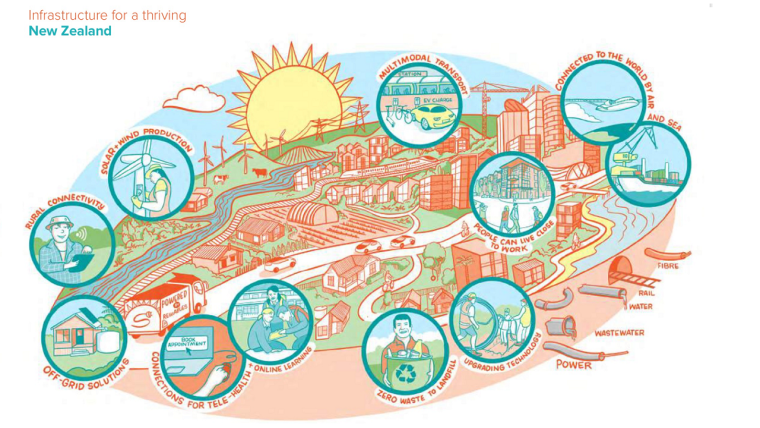
Big decisions and trade-offs will need to be made in order to assure New Zealand of the future infrastructure it needs, the first strategy document released on Monday by the New Zealand Infrastructure Commission indicates.
The document is billed as "New Zealand’s first-ever long-term infrastructure strategy".
The Government has welcomed it, and will be giving its official response to the strategy - which contains 68 specific recommendations - in September.
Rautaki Hanganga o Aotearoa – New Zealand Infrastructure Strategy 2022–2052 sets out the infrastructure challenges and opportunities facing New Zealand over the next 30 years. It draws on research, consultation and the views of more than 20,000 New Zealanders. (The 68 recommendations are on pages 88-97 of the attached PDF.)
The New Zealand Infrastructure Commission, Te Waihanga Chief Executive Ross Copland says to meet the country's ambitions, "there are some big decisions and trade-offs that need to be made".
"Electricity generation capacity needs to increase by some 170% to meet our net zero carbon goals; while it will cost about $90 billion to fix New Zealand’s water networks. Some $5 billion of local government infrastructure is vulnerable to sea level rise. These challenges come at a time when construction costs are rising 60% faster than prices elsewhere in the economy and we expect a shortfall of 118,500 construction workers in 2024,” he says.
“More of the same simply won’t cut it. The strategy shows we will have to be smarter about how we plan, deliver and pay for our infrastructure. This includes changing the way we pay so we can better manage demand and use of networks. We also need a consenting system that actively prioritises meeting our net-zero carbon goals and housing New Zealanders. Much of our existing resource management system is not enabling of our national objectives.”
Recommendations in the strategy include:
- Achieving net-zero carbon emissions at minimum cost, and making it easier to leverage our abundant renewable energy resources.
- Making use of tools like congestion charging on busy roads to make better use of our transport connections.
- Increasing housing opportunities in areas with good access to infrastructure access and enable greater and easier urban development through minimum levels of upzoning and mixed-use zoning.
- Allowing for water meters to manage demand and encourage water conservation.
- Preparing infrastructure for the impacts of climate change.
- Reducing the amount of waste we create, particularly for products that can’t be recycled.
- Increasing technology use, including greater uptake of real-time data about infrastructure that can help with planning and maintenance, for instance, through digital twins.
- Standardising planning policy across New Zealand and ensuring New Zealand cities plan for significantly more growth.
- Streamline consenting processes, particularly for infrastructure that helps meet national objectives like a zero-carbon economy, and reduce the regulatory burden on construction materials.
- Providing greater certainty for businesses in infrastructure industries to invest in skills and training development, and developing the talent required to deliver New Zealand’s future infrastructure.
It is planned to revise the strategy at least every five years.
"This is the beginning of a much longer-term ongoing conversation with all New Zealanders,” Copland says.
Infrastructure Minister Grant Robertson said the strategy was "an invaluable piece of work".
"We have never had a single document setting out New Zealand’s long-term infrastructure strategy and a vision for how infrastructure can lay the foundation for the people, places and businesses of Aotearoa New Zealand to thrive for generations to come."
Robertson says over decades the country has "simply not invested enough, not planned far enough ahead or with sufficient coordination or efficiency to meet our infrastructure needs".
"This has helped fuel the housing crisis, made it difficult to reduce emissions and significantly impacted our productivity and overall wellbeing."
There is an "urgency" to addressing our current infrastructure deficits while also meeting future needs caused by population growth and climate change, he says
“The strategy also shows that while further investment is critical, we must be smarter about the way we plan for, deliver and use all of our infrastructure. Trying to just build our way out of these challenges would mean nearly doubling what we currently spend to around 9.6% of GDP over a 30-year period. That’s over $31 billion per year – a sum that we would struggle to afford or have the capacity to deliver.
“This means we need to get more from the infrastructure we do build, reducing costs and prioritising for the greatest impact."
Robertson says the Government is now preparing a response to the strategy, which will set out the steps to turn strategy into action.
"As required by legislation, we will share this response in September, determine which recommendations to prioritise, and assign lead agencies to implement them. In many cases responding to the recommendations builds on current work underway - such as resource management reform, the health and disability sector reform, and the Three Waters Reform Programme.
“However, the recommendations in the Strategy cannot be met by the Government alone. New Zealand needs the whole system, including central and local government, iwi/Māori and the private sector to work together to address the significant challenges we face. We all have a part to play."
We welcome your comments below. If you are not already registered, please register to comment
Remember we welcome robust, respectful and insightful debate. We don't welcome abusive or defamatory comments and will de-register those repeatedly making such comments. Our current comment policy is here.