
Central government has little faith in local government, according to a new report.
It adds central government sometimes dumps costs onto local government without thinking through the impact.
These are among several sharp comments made in a new report on local government, which calls for changes such as four-year terms of office and a far more robust funding system.
“The current legislative framework for local government is highly prescriptive, reflecting low central government trust in the sector,” the report says.
The report is called He piki tūranga, he piki kōtuku, or The future for local Government, and it pulls no punches.
“Significant funding challenges constrain local government’s ability to deliver services....and there is limited capacity or resource to work with communities on complex challenges.
“These pressures are exacerbated by the unfunded mandate from central government to perform more roles without additional funding.”
The report is the final stage of a review done by a panel chaired by a retired local council chief executive Jim Palmer, which included the former deputy mayor of Auckland, Penny Hulse. The review was established by the Minister of Local Government, Nanaia Mahuta, in 2021 at the request of the local government sector.
The panel says the need for dramatic change in the way local government is run is driven by challenges that are unlikely to abate.
“Extreme weather events, persistent inequity, and low social cohesion are already affecting communities here,” the panel says in its report.
“ All of these challenges will only intensify over the next 30 years.....the current local government system is not set up for future success.
“Decisions by successive governments have marginalised local government and left it in a precarious position in terms of focus, resourcing, and viability.”
In their report, the panel makes several recommendations for improvements, including four-year terms of office and 16 and 17-year-olds being allowed to vote.
It also speaks forcefully about funding problems for the sector.
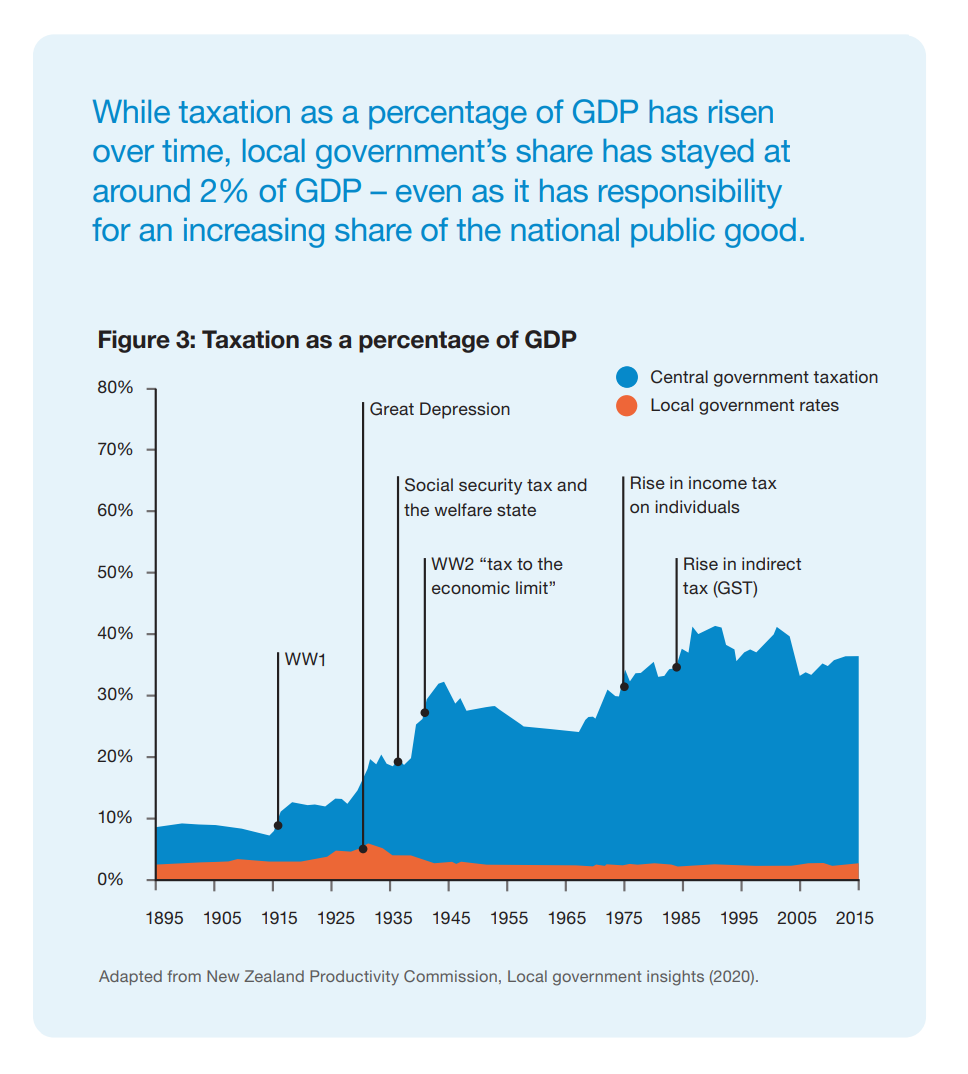
“While taxation as a percentage of GDP has risen over time, local government’s share has stayed at around 2% of GDP, even as it has increasing responsibility for delivering the public good.”
The panel wants rates to remain the main funding mechanism for councils, but it has other recommendations to boost its income.
It wants central government to pay rates on properties it owns in local Government areas. In addition, there should be an annual transfer of revenue equivalent to GST charged on rates, which is currently around $1 billion. It also wants central Government to develop an intergenerational fund to help pay for climate change. Cabinet should also have to consider the funding impact on local government of the decisions it makes.
It also wants state assistance to achieve a proper partnership with iwi, which it says it lacks at present.
To achieve this, it wants this explicitly recognised in legislation, as well as a statutory requirement for councils to strengthen authentic relationships in the local exercise of kāwanatanga and rangatiratanga.
“(The Government should require councils to …..develop and strengthen their capability and capacity in the areas of Te Tiriti o Waitangi, te ao Māori values, mātauranga Māori, tikanga, and the whakapapa of local government.”
Meanwhile, the body of the report goes on to give more some trenchant criticism of the current system.
“The local–central government relationship is strained and competitive, in part due to misalignment of operating environments and decision making processes,” it says.
“Collaboration between central and local government is inconsistent and fails to harness the strengths of both. Citizen participation in local democracy is declining, and people have lost confidence and trust in the current democratic process and institutions.
“Engagement between councils and communities is often transactional rather than relational.”
To improve this governance, the panel has several recommendations. There should be more democratic innovations, such as participatory and deliberative institutions. There should also be a single transferrable vote or STV system, lower thresholds for the establishment of Māori wards and Te Tiriti-based appointments to councils.
There should also be a new Crown department dedicated to the central–local government relationship.
We welcome your comments below. If you are not already registered, please register to comment
Remember we welcome robust, respectful and insightful debate. We don't welcome abusive or defamatory comments and will de-register those repeatedly making such comments. Our current comment policy is here.