
By Chris Trotter*
"What about inequality?" It was Newshub Nation’s Rebecca Wright who lobbed the question at National’s campaign boss, Chris Bishop. He watched it bounce towards him stony-faced. There was a long pause, until, finally, in one of those responses meme-makers dream about, Bishop replied: “What about it?”
It is difficult to think of a better illustration of how important the concept of equality is to New Zealand politicians, and how imperfectly it is understood. Wright is from a generation for whom the idea of inequality – the negation of equality – is a moral catastrophe. They have been taught to prize equality as an unequivocal “good” – hence her non-sequitur of a question.
No wonder Bishop was flummoxed. Wright did not appear to understand that the policies he had just been outlining in education, health and housing were critical to facilitating social equality; or that the goal itself can only ever be achieved by multiple processes operating simultaneously. One cannot simply command inequality to disappear and – Hey Presto! – it is gone. Politics is not a magician’s trick.
But, if equality is imperfectly understood, then the notion of “equity” poses an even bigger challenge to the nation’s political comprehension. Which is unfortunate, because the word is appearing more and more frequently in New Zealand’s political conversations.
It has been the “go to” word for activists, journalists and left-leaning politicians for some time now – but not for the rest of the population. In the week just passed, however, Equity crashed into popular consciousness when New Zealanders were informed that to ensure equity in health outcomes, Te Whatu Ora (Health New Zealand) will, in part, be determining the order of access to non-urgent surgery by factoring-in the patient’s ethnicity.
The entirely predictable popular reaction has been one of outrage at the notion that one’s ethnicity may soon be a deciding factor in where one stands in the surgical queue. If this is what Equity looks like, then a great many New Zealanders don’t want a bar of it.
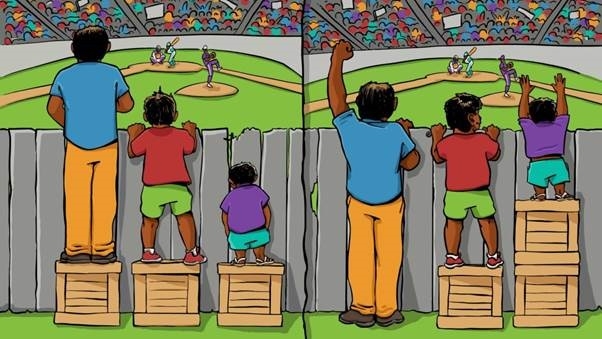
For many – perhaps most – people, the word ‘equity” is a synonym for the word “equality”. And, to be fair, this is very often the way politicians expect the word to be understood. But the assumption that “equity” and “equality” mean roughly the same thing could not be more wrong. The difference between these two words is as important as the difference between “reform” and “revolution”.
Most New Zealanders believe in and expect to enjoy “equality of opportunity”. They recoil from the idea of people receiving preferential treatment. Everybody is expected to line-up behind the start-line before the starter’s pistol sets them off and running in the great race of life. Very few people, however, expect the runners to cross the finish line at the same time. Most accept that in a contest someone comes first and someone last. A race in which everyone crosses the finish-line at exactly the same moment is not a race – it’s a jack-up.
But “jacking-up” the race is precisely what the proponents of “equity” believe in. What they are seeking is not “equality of opportunity”, but “equality of outcome”.
If there are people in the race who have had the advantage of professional coaching, then those denied that advantage need to be advanced several metres ahead of the start-line. If there are runners who have enjoyed excellent nutrition all their lives, then those who have been poorly nourished since childhood must be similarly advanced along the track. If there are competitors who, on account of their ethnicity, enjoy a greater measure of confidence in their ability to win the race than those whose ethnicity has accustomed them to coming last, then those so afflicted also deserve advancement. Calculate these handicaps correctly and every runner should cross the finish-line simultaneously. And there you have it – Equality of Outcome!
Except, of course, that’s not the way it would go – not unless the people calculating the handicaps have guns. What sort of seasoned runners are going to consent to seeing others positioned so far ahead of themselves? Rather than compete on such terms, many athletes would simply walk away from the contest altogether. Those awarded handicaps in the name of equity would then have to be reassessed and assigned a new handicap. How else could everybody be guaranteed to cross the line together? Not that anyone would be there to applaud them when they did. If the outcome of a contest has already been thoroughly engineered, why would anyone turn up to see it? Life is uncertain. So is sport. That’s why people watch.
The partisans of equity insist that their only goal is “fairness”: all they are seeking is a society in which everyone gets to enjoy life’s bounties; a society without “winners” and “losers”; a society in which the very idea of some people being allowed to “succeed” while others “fail” is regarded as obscene.
“Team Equity” will always get a hearing in New Zealand, where “fairness” is celebrated as the Prince of Virtues. What they will not find so easy to sell, however, is the idea that fairness requires people to be treated differently. That’s because Kiwis understand “fairness” to mean everybody being treated the same.
When someone attempts to jump a queue in New Zealand, or is given more than others are getting, the backlash is extreme. Those responsible are told in no uncertain terms that while everyone is entitled to a “fair go”, that does not mean they’re entitled to receive special favours. It is astonishing that Te Whatu Ora decided that provoking such a backlash – especially one brimming with racial animosities – was an acceptable risk.
This is where the propensity of New Zealanders to treat equity and equality as synonyms leaves Team Equity facing an enormous problem. In regard to Māori-Pakeha relations particularly, the argument has shifted well beyond the generally accepted notion that the indigenous people, the colonisers, and their descendants, were guaranteed, and receive, equal treatment.
According to Māori nationalists, “equal treatment” can only mean that all the advantages accruing to the destroyers of Māori sovereignty must be left untouched, while the tangata whenua, stripped of their autonomy by colonisation, are condemned to play a never-ending game of catch-up. Unsurprisingly, they’re demanding a solution considerably “fairer” than that.
What that fairer solution might look like is set out in the He Puapua Report. It presents a twenty-year plan to give effect to the promises of equity (not equality) embodied in Te Tiriti o Waitangi. Essentially, it sees Māori and Non-Māori running in the same race, but on separate tracks, until such time as both sets of runners become genuinely competitive. And the handicap? Well, that will come in the form of a more “equitable” distribution of the New Zealand state’s fiscal resources, achieved by the construction of a more equitable, te Tiriti-based constitution.
This is what makes He Puapua less a blueprint for reform, and more a road-map to revolution.
The chances of selling that sort of revolution to Pakeha New Zealand, however, are as slim as the chances of selling the idea of moving Māori and Pasifika patients ahead of Pakeha New Zealand’s nearest and dearest on the waiting-lists for non-urgent surgery.
Is this racism? Of course it is! Will Te Whatu Ora’s Equity Calculator defeat it? Not a chance! The only way to come anywhere near a true equality of outcomes, is to build a system – in this case a health system – sufficiently well-resourced to accommodate the needs of all New Zealand’s citizens – when they need them.
After all, no one really minds where they’re placed in the queue – providing it’s a short one.
*Chris Trotter has been writing and commenting professionally about New Zealand politics for more than 30 years. He writes a weekly column for interest.co.nz. His work may also be found at http://bowalleyroad.blogspot.com.
We welcome your comments below. If you are not already registered, please register to comment
Remember we welcome robust, respectful and insightful debate. We don't welcome abusive or defamatory comments and will de-register those repeatedly making such comments. Our current comment policy is here.