
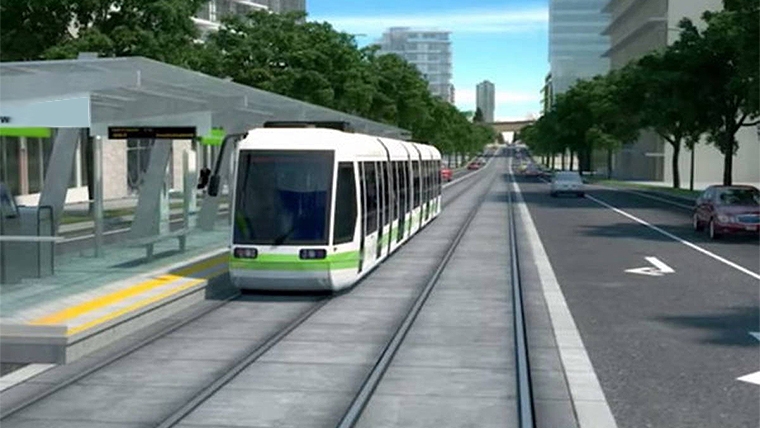
The Green Party says it could cut more than $5.6 billion off the cost of building light rail to Auckland Airport by putting it on the existing road lanes, instead of in a tunnel.
Tunneled light rail from Britomart to the airport has been estimated by the Government to cost $14.6 billion, while a surface alternative was priced at $9 billion.
The Greens’ surface plan would save even more money by not widening the road and therefore not needing to purchase any roadside property.
Building the rail line on the existing transport corridor in this way, would presumably mean replacing a bus or car lane along the route.
It could be completed by 2032 and cost $4.8 billion. The first stage would be from Britomart to Mount Roskill and would cost $1.9 billion to build by 2029.
“We don’t need the most expensive light rail project in the world. We need light rail that can be delivered without delay and within budget, with sensible sequencing, so the network can grow over time,” the party said in a policy document.
Money saved on the Auckland Light Rail project could then be directed towards similar projects in New Zealand’s other major cities.
Wellington could build a light rail line from Island Bay to the train station for $1.8 billion by 2029, instead of a second car tunnel.
Christchurch could build a light rail line starting with Church Corner to Papanui via the city centre, and then working outwards towards Hornby and Belfast in phase two.
The Greens estimate the first line could be operating by 2029 and the whole network operation by 2032 with a total price tag of $4.8 billion.
Greener cities
These light rail costs were revealed as part of the Green Party’s sweeping Climate-safe Communities policy, which aims to make cities more climate resilient.
A policy document outlining the suite of policies said previous governments had designed cities around cars, which had left them less livable and more vulnerable to climate change.
After the election, Cabinet will have to establish a National Planning Framework under the new Natural and Built Environments Act.
The Green Party wants to use this opportunity to steer council towards urban planning rules that would make communities more resilient to extreme weather and emit less carbon.
For example, it would require councils to assess tree cover in various suburbs and create a plan to improve the amount of urban trees. This would be incentivised through rebates or discounted “tree bonds”.
The policy would include a range of initiatives to make cities better at absorbing and filtering heavy rainfall, to avoid regular repeats of the flooding seen this year.
These include financial incentives for green roofs and onsite rainwater storage, promoting storm drains in planning rules, and requiring water entities to help councils manage risk.
The Green Party would reprioritise transport funding from building new urban highways towards walking and cycling infrastructure, doubling the minimum investment level from $500 million to $1 billion.
This would aim to encourage kids to cycle to school, like in 1990 when 12% of children cycled to school. That number had dropped to just 2% by 2014.
“Parents are hesitant to let kids make their own way to school because it isn’t safe, and therefore have to ferry them around in vehicles,” the policy document said.
A $750 million fund would be made available to councils over three years to fund community projects that are restoring and protecting nature in their local areas.
One example given, was community projects which were working to restore streams to their natural state, bringing them out of pipes and creating room for them on the surface.
“Giving urban streams more room to move can play a significant part in making our cities more resilient to flood risks”.
We welcome your comments below. If you are not already registered, please register to comment
Remember we welcome robust, respectful and insightful debate. We don't welcome abusive or defamatory comments and will de-register those repeatedly making such comments. Our current comment policy is here.