
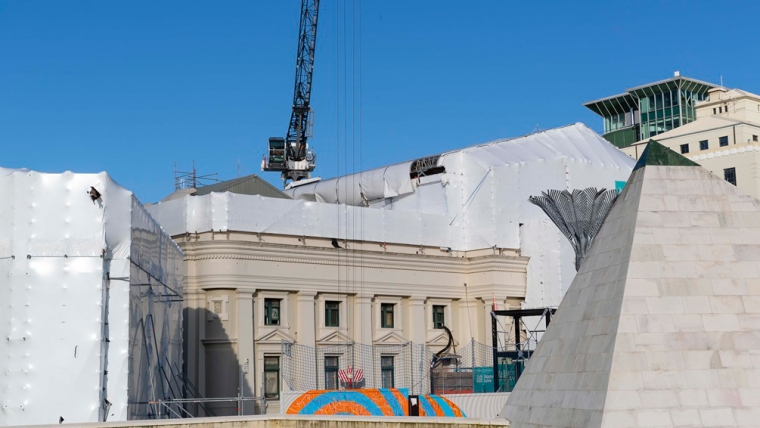
The Wellington City Council voted on Wednesday to spend $147 million restoring the Town Hall, despite economic consultants warning the city is on track to breach its debt covenants.
Wellington’s Town Hall has been closed since 2013 for earthquake strengthening which was originally supposed to cost $43 million. Since then it has blown out to be up to $329 million.
Decision makers were faced with $204 million of sunk costs or another up to $147 million to get the job finished.
Council has said that demolition was not an option for the heritage-listed building which will be rehearsal, recording, and performance space for classical music once restored.
The New Zealand Symphony Orchestra is currently based at the Michael Fowler Centre, the city also has the Opera House and the St James Theatre which may also need strengthening.
It also just built a brand new convention centre, called Tākina, for over $180 million.
The morning of the vote, a trio of concerned Wellingtonians released an assessment of the city’s finances they had commissioned from consultants Castalia. It called for a delay in the process to decide how rates are divided between different types of land, known as the Rating Policy Review.
Robert Fisher, John Swan and Luke Pierson, who commissioned the Castalia report, said the city council should not make decisions about rating policies before full finances are public.
Castalia's assessment of the city’s finances found the council was facing significant costs that had not been factored into the 2021 Long-Term Plan.
One example was the extra money approved on Tuesday to finish the restoration of the Town Hall, and another $46 million would go towards the Thorndon Quay and Hutt Road project
More than $250 million would also need to be spent on a zero waste rubbish bin system and processing plant over the next 10 years.
Over the next seven years, more money will be spent to strengthen the Opera House and the Michael Fowler Centre, plus $272 million of water infrastructure, $331 million on transport, and $61 million of community housing cost increases.
Castalia said if all this spending did go ahead, the city would breach its covenants with the Local Government Funding Authority (LGFA).
With just the confirmed projects, it would still exceed its own debt limit — although it would stay below the LGFA limit.
John Swan, a spokesperson for the trio, said ratepayers were facing a billion dollar financial hole that couldn’t be covered with debt. It would likely require significantly higher rates.
“We must as a city now push pause and potentially take some very challenging decisions around how we navigate our current financial situation. Continuing on as we have is simply not an option,” he said.
In a submission to the council, the three Wellingtonians said the city would have to raise significant new debt, increase rates, sell assets, or cancel commitments.
The report and submission were not specifically about the Town Hall budget blow-out, but it has become symbolic of the challenges Wellington City Council faces.
A narrow majority of councillors voted in favour of progressing with the Town Hall restoration.
Rebecca Matthews, a progressive council member, said she felt like she was “stuck between a rock and an old place”. She proposed prioritising cost management over heritage protection.
“Where there is tension between heritage and the future, I consider myself on the side of the future,” she said.
Iona Pannett took the opposite view, saying the Town Hall was the city’s “number one heritage building” and needed to be protected.
Tamatha Paul, the newly-elected Green MP for Wellington Central, reluctantly supported funding the remainder of the repairs.
She said council’s are always bound by decisions made by previous councils and stumping up the money was the best option despite being “uncomfortable”.
In November, S&P Global Ratings gave Wellington a “one-in-three” chance of a credit rating downgrade within the next two years.
“Wellington is in the midst of a large capital program that is driving deficits and debt levels higher than our previous expectations and those of many ‘AA+’ peers,” it said.
We welcome your comments below. If you are not already registered, please register to comment
Remember we welcome robust, respectful and insightful debate. We don't welcome abusive or defamatory comments and will de-register those repeatedly making such comments. Our current comment policy is here.