
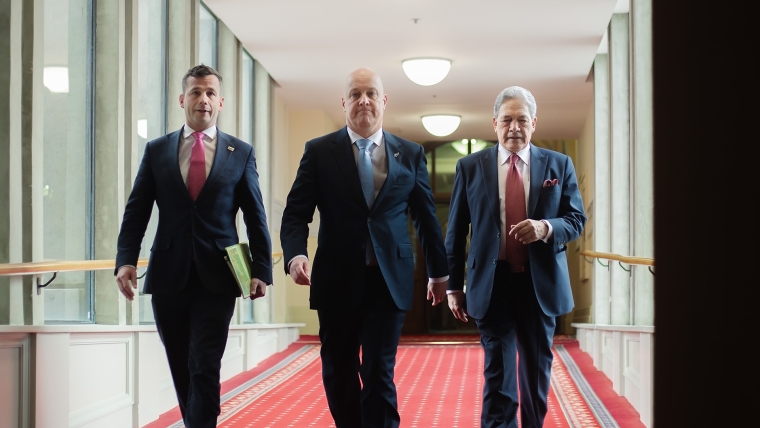
The leaders of the National, Act, and NZ First parties have signed on the dotted line, agreeing to form the first three-party coalition in New Zealand’s MMP era.
Detailed coalition agreements struck between National and each of the other parties outline policy commitments and compromises that will be supported by all three partners.
Prime Minister-designate Christopher Luxon made it clear during the election campaign that his preference was for a two-party coalition with the Act Party.
Differences between the twin coalition agreements shows why. The three parties share many policy goals but have different worldviews underlying them.
It looks somewhat like The Triple Entente military alliance formed between France, Russia, and the United Kingdom in the build up to the First World War.
These three nations did not have a long history of cooperation or shared ideologies but were drawn together to counterbalance the growing power of Germany, Austria-Hungary, and Italy.
Similarly, National, Act, and NZ First have formed an alliance to push back on, what they see as, high levels of government spending, heavy-handed regulation, and eroding social values.
Agree to disagree
But the agreement leaves room for these parties to push forward these shared priorities, while still showcasing some differences.
“The Parties will do this whilst recognising the importance in a democracy of maintaining independent political identities arising from the voting public’s choice,” the agreements said.
It includes a process for dealing with disputes, names particular policies as belonging to particular parties, and even leaves room for Cabinet members to “agree to disagree”.
The tension and compromises inherent in the agreement are personified by splitting the role of deputy-Prime Minister between Winston Peters and David Seymour.
Be careful not to call them “co-deputy Prime Ministers” as it appears to be a touchy subject, as one Newshub reporter sensed and used to elicit a reaction from Peters.
The political veteran may prove to be a challenge. Luxon had to once intervene in the press conference when he started an argument with a journalist.
Peters also refused to say whether he trusted the other two leaders, instead labelling it a “stupid question” and leaving the answer up to the public’s imagination.
Compromise first
National and Act promised to be a pro-business government that would rebuild the economy, which it considered to have been held back by the Labour government.
On Thursday, one business figure told Interest.co.nz the initial excitement about the change in government had disappeared during the drawn out coalition negotiations.
Some key policies have also disappeared. Foreign buyers will not be allowed back into the housing market and therefore the tax cut plan will need to find a new source of revenue.
Plus the retirement age will stay at 65, instead of being gradually lifted to 70, in another win for NZ First.
The party also negotiated some extra scrutiny on businesses that provide utilities and essential services.
There will be a select committee inquiry into banking competition, more power for the Grocery Commissioner, and review of some energy sector settings.
Plus, more funding will be provided to Inland Revenue to chase tax avoidance.
NZ First also negotiated wins for its key constituents in Northland and on the fringe of society.
It wants to investigate the reopening of Marsden Point Refinery and the possibility of building a drydock and a rail line to service it.
A $1.2 billion Regional Infrastructure Fund will be established and overseen by Shane Jones.
Act like it
While obvious concessions were made to NZ First during the negotiations, the Act Party also secured a number of its key priorities.
Top of the list was a new Minister for Regulations that will have sweeping power to review settings across all of government and crack down on unwanted rules.
The Reserve Bank’s monetary policy remit will be refocused on price stability and the second mandate, supporting maximum sustainable employment, will be removed. Further advice will be sought on whether to get rid of the monetary policy committee, making the Governor the sole decision maker, and setting a specific time limit for achieving the inflation target.
There will be deeper cuts to the public service, with a goal to get the number of staff in government agencies back towards 2017 levels.
Act’s flat tax principles will be considered as one way to achieve National’s proposed tax cuts, and 90-day work trials will be available to all businesses regardless of their size.
The coalition government will also support the Treaty Principles Bill through a first reading, and into a Select Committee review, but no further.
Whether it goes to a referendum or passes further readings will be decided at a later date and is not agreed in the coalition deal.
Contradictions
There are policy areas in the two agreements that seemingly pull in different directions and could cause tension in the future.
For example, Act’s agreement promises to liberalise immigration settings and allow more into the country.
It would increase the cap on the Recognised Seasonal Employer scheme, remove median wage requirements from Skilled Migrant Category visas, and make it easier for family members of visa holders to work.
Meanwhile, NZ First has historically been uncomfortable with high levels of inward migration and its coalition agreement strikes a much more cautious tone.
It calls for the Accredited Employer Work Visa to be “improved” and for Immigration New Zealand to work harder to “ensure migrants are filling genuine workforce needs”.
Also, it requires the incoming-government to “address and provide solutions for the long-expressed concern of the OECD into the lack of focus in NZ Immigration Policy”.
Another difference is that Act explicitly withholds support for future tax changes (such as further indexation in 2026) while NZ First specifically requires an assessment of how inflation has impacted the brackets that year.
National-led coalition, for now
These are some of the key compromises that National has had to swallow in order to get into government and occupying 70% of the seats in Cabinet.
It gets support for the rest of its policy suite in return and achieves its goal of booting Labour out of the Beehive.
Christopher Luxon will have his hands on most levers of power and will be thinking not just about the next three years but the possibility of further terms that could follow.
Those future terms may not be so reliant on both support partners.

We welcome your comments below. If you are not already registered, please register to comment
Remember we welcome robust, respectful and insightful debate. We don't welcome abusive or defamatory comments and will de-register those repeatedly making such comments. Our current comment policy is here.